SUMMARY
Childhood seizures span a wide spectrum, from benign, self-limited febrile seizures to defined, age-dependent epileptic syndromes and acute provoked seizures from infection, metabolic derangement, or structural injury. A seizure is a transient episode of abnormally synchronous neuronal firing; epilepsy is the tendency toward recurrent unprovoked seizures.
This lesson works through: the definitions and classification of seizures (generalized vs. focal), the top causes of acute childhood seizures, the three classic epileptic syndromes (infantile spasms, childhood absence epilepsy, benign rolandic epilepsy), the key mimics (febrile seizures and syncope), and management — including status epilepticus and the signature side-effect profiles of antiseizure drugs.
Overview
Definitions
- Seizure: transient, high-frequency synchronous neuronal activity producing abnormal behavior or experience.
- Epilepsy is diagnosed by any one of: (1) ≥2 unprovoked seizures >24 hours apart; (2) one unprovoked seizure with a high probability of further seizures over the next 10 years; or (3) a defined epilepsy syndrome (e.g., childhood absence epilepsy).
- Status epilepticus: a seizure lasting ≥5 minutes, or repeated seizures without regaining awareness between them.
Epidemiology
About 1% of children have an afebrile seizure by 14 years, and 0.4–0.8% have epilepsy by 11 years. Generalized epilepsy is the most common type in childhood (~50% of all childhood epilepsies).
Pathophysiology
Seizure discharge reflects an imbalance between excitatory and inhibitory input or abnormal neuronal membrane properties.
Causes of acute (provoked) seizures
- CNS infection: bacterial meningitis, viral encephalitis.
- Metabolic: hypoglycemia and hyponatremia (also hypocalcemia, hypomagnesemia).
- Structural / traumatic: head trauma (contusion, subdural hematoma), intracranial hemorrhage or infarction, brain tumor.
- Neurocutaneous disorders: tuberous sclerosis, neurofibromatosis.
Classification
Seizures are classified by presence/absence of fever (febrile vs. afebrile), extent of brain involvement, impairment of consciousness, and movement pattern. The two anatomical groups are:
- Generalized onset (both hemispheres): tonic–clonic, absence, myoclonic, tonic, atonic.
- Focal onset (one hemisphere): with retained awareness or with impaired awareness.
Core seizure phenotypes:
- Absence (petit mal): commonest in children; very brief (~10 s); may occur many times a day.
- Myoclonic: quick, repetitive jerks.
- Tonic–clonic: a tonic phase followed by a clonic phase.
- Tonic: sustained stiffening.
- Atonic: sudden loss of tone ("drop" attacks), often mistaken for fainting.
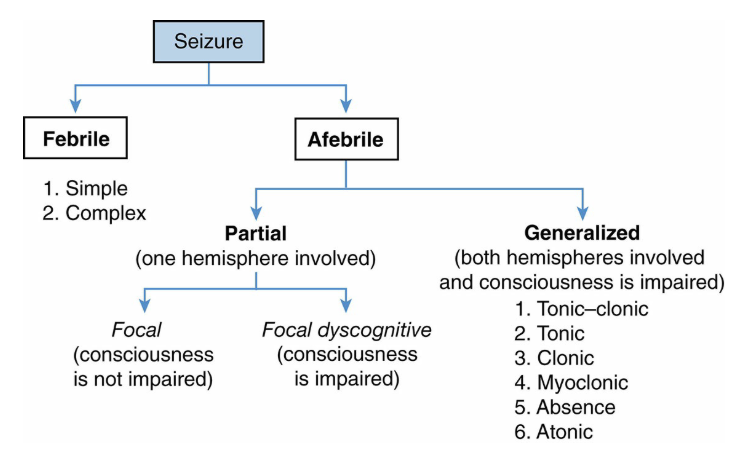
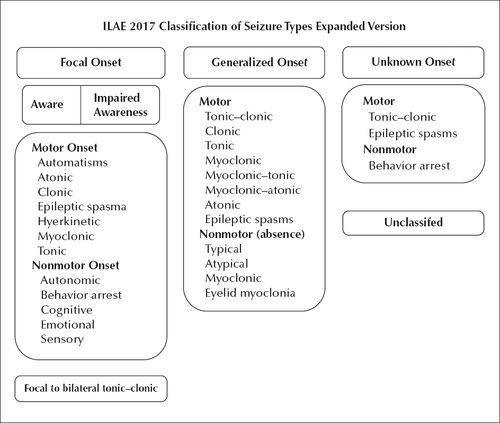
Refer to the seizure-type and antiepileptic-drug reference for the preferred agent matched to each seizure type.
Febrile Seizures
A febrile seizure occurs in a child 6 months–6 years old with fever (temperature >38 °C) in whom CNS infection, metabolic imbalance, and a history of afebrile seizure have been excluded. They are the most common childhood seizure type (2–4% of all children). The cause is unknown, though several gene associations exist.
Risk factors
- Fever from a mild viral (influenza, adenovirus, HHV-6 / roseola) or bacterial (e.g., Shigella) infection.
- Recent immunization (DTaP, MMR).
- Family history of febrile seizures (first- or second-degree relative).
- Day-care attendance; winter season; prolonged neonatal hospital stay.
- Recurrence is more likely with first seizure before 12 months, fever <24 h or only mild temperature elevation before the seizure, family history of febrile seizures/epilepsy, and complex features.
Subtypes
- Simple: generalized (tonic–clonic or atonic), nonfocal; a single episode <15 minutes (or multiple episodes totaling <30 min).
- Complex: focal; >15 minutes (or multiple episodes >30 min) and/or recurs within 24 hours.
Diagnosis
Clinical — based on history, a normal neurological exam, and exclusion of CNS infection; a normal exam needs no neuroimaging or EEG. Perform a lumbar puncture whenever meningitis is suspected at any age, and strongly consider it in a child 6–12 months who is under-vaccinated for Haemophilus influenzae type b or Streptococcus pneumoniae, or whose immunization status is unknown.
Management & prognosis
- Antipyretics, reassurance, and parental education.
- Abortive medication only if the seizure lasts ≥5 minutes (treat as status epilepticus).
- Normal development/intelligence expected; slightly increased risk of later epilepsy — 1–2% after simple, 5–10% after complex febrile seizures.
See the febrile seizure overview for the full risk-factor list, abortive management, and benign prognosis.
| ملاحظة سريرية – Clinical Pearl | |
| Complex febrile seizure means focal, or longer than 15 minutes, or recurring within 24 hours — this type carries a higher risk for epilepsy (5–10%) compared with simple febrile seizures (only 1–2%). | ملاحظة |
Epileptic Syndromes
Epileptic syndromes are defined by a characteristic age of onset, seizure type, and EEG pattern. The three most common in childhood are infantile spasms, childhood absence epilepsy, and benign rolandic epilepsy.
Infantile spasms
- Age: 3–7 months (rare after age 2).
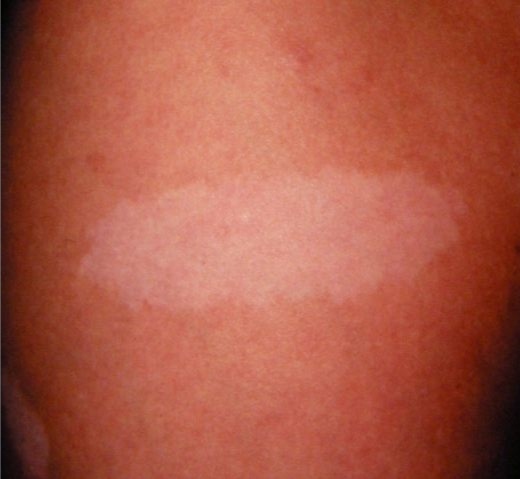
- Etiology: cerebral dysgenesis, metabolic/genetic disorders (PKU, trisomy 21), intrauterine infection, hypoxic–ischemic injury. Tuberous sclerosis is the single most commonly identified cause.
- Presentation: sudden, simultaneous flexion of the neck/trunk with flexion-adduction of the limbs ("jackknife" / "salaam" spasms) lasting 1–2 s each, in clusters of 5–10 over several minutes, often triggered by the sleep-to-wake transition.
- EEG: hypsarrhythmia — a high-amplitude, disorganized background with multifocal spike-wave discharges.
- Treatment: ACTH (IM; effective in 50–70%); oral vigabatrin is preferred for tuberous-sclerosis-associated spasms and is often combined with ACTH. Others: valproate, topiramate, ketogenic diet, pyridoxine, surgery.
- Prognosis: poor — frequent moderate-to-severe intellectual disability.
Tuberous sclerosis is readily flagged on skin exam by a hypopigmented ash-leaf macule.
| West syndrome triad — the SUN sets in the West | |
|
جملة تذكرية |
| ملاحظة سريرية – Clinical Pearl | |
| Any infant aged 3–7 months with clusters of flexion spasms (salaam), especially on the sleep-to-wake transition, should be evaluated for tuberous sclerosis (ash-leaf spots) — the most commonly identified cause — with EEG demonstrating hypsarrhythmia. | ملاحظة |
Childhood absence epilepsy
- Age: 4–12 years, more common in girls; genetic (autosomal dominant inheritance described).
- Clinical features: sudden impairment of consciousness (staring spells) with preserved muscle tone; brief (<20 s, typically 5–10 s) and frequent (tens–hundreds/day); unresponsive to tactile/verbal stimuli; simple automatisms (eye blinking, chewing) often present; no loss of posture, incontinence, or postictal state; readily provoked by hyperventilation for 2–3 minutes.
- EEG: generalized 3-Hz spike-and-wave discharges.
- Treatment: ethosuximide (first-line), valproate, or lamotrigine. Carbamazepine can worsen absence seizures.
- Prognosis: good — most resolve by adolescence without cognitive impairment.
The 3-Hz generalized spike-and-wave pattern is the diagnostic hallmark:

Absence seizures vs. inattentive (daydreaming) staring:
- Absence: occur during all activities, last <20 s, do not respond to voice/touch, and show automatisms.
- Inattentive staring: occurs mainly during "boring" activities, variable length (often >1 min), stops with voice/touch, and lacks automatisms.
| فخ امتحاني – Exam Trap | |
| Exam Trap: Absence seizures do not present with a postictal state or loss of posture, and are readily provoked by hyperventilation over 2–3 minutes. If you observe staring with impaired awareness and postictal confusion, consider focal seizure rather than absence. Note: carbamazepine worsens absence seizures. | تذكر |
See the childhood absence epilepsy summary for its clinical features, 3-Hz EEG hallmark, and first-line ethosuximide. The related juvenile myoclonic epilepsy summary covers the adolescent syndrome with morning myoclonus.
Benign rolandic epilepsy (BECTS)
- Benign childhood epilepsy with centrotemporal spikes — the most common focal (partial) childhood epilepsy (~15%).
- Age: 3–13 years (peak 6–7); boys more affected; autosomal dominant with age-dependent penetrance.
- Presentation: nocturnal focal seizures in the early morning with oral–buccal features (moaning, grunting, drooling); may spread to face/arm and secondarily generalize to tonic–clonic.
- EEG: biphasic spike-and-sharp-wave discharges in the midtemporal and central regions.
- Treatment: valproate or carbamazepine. Prognosis excellent — remits spontaneously in adolescence.
Focal Seizures & Distinguishing Mimics
Focal seizures
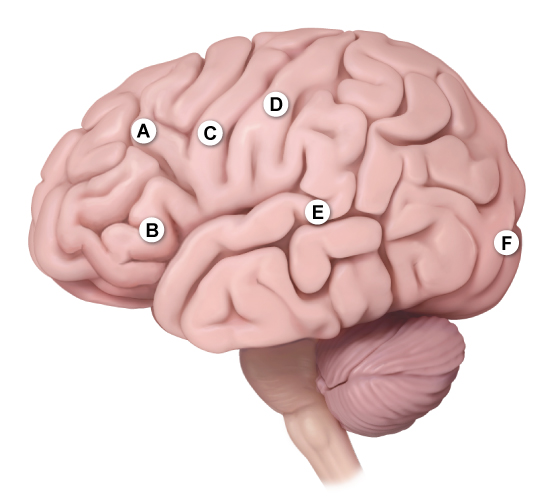
- Onset: abnormal activity begins in one cerebral hemisphere; symptoms may be motor, sensory, or autonomic. A focal onset makes an underlying structural lesion (e.g., tumor) more likely than a generalized onset.
- Focal aware: no loss of consciousness or postictal state; the seizure stays localized.
- Focal with impaired awareness: occurs when the discharge spreads; consciousness is impaired and automatisms (e.g., chewing, lip-smacking) are common.
- Postictal (Todd) paralysis: transient focal weakness after a focal motor seizure — a diagnosis of exclusion once stroke is ruled out.
- Workup: EEG plus brain MRI (to identify a triggering structural lesion).
Syncope vs. seizure
The most common non-epileptic mimic is vasovagal syncope. The key discriminators are the trigger, the presence of an aura/tongue-biting, and — most usefully — the postictal state. The table below uses the Medical Comparison template.
| Syncope vs. Seizure | ||
|---|---|---|
| Feature | Seizure | Vasovagal syncope |
| Typical triggers | Sleep loss, strong emotion, alcohol withdrawal, flashing lights | Upright posture, emotion, heat, crowded places |
| Onset clues | Aura (e.g., olfactory hallucination); can occur during sleep/sitting; head movements; tongue biting; rapid, strong pulse | Presyncope (lightheadedness); unlikely during sleep/sitting (except arrhythmia); pallor + diaphoresis; weak, slow pulse |
| Convulsive activity | Sustained tonic–clonic movements | Rarely a few clonic jerks with prolonged cerebral hypoperfusion |
| Recovery | Delayed — postictal drowsiness and confusion | Immediate, spontaneous return to baseline |
| فخ امتحاني – Exam Trap | |
| Exam Trap: Tongue biting, postictal confusion, and delayed return of consciousness all point to seizure. Conversely, pallor, diaphoresis, and immediate return of consciousness point to vasovagal syncope—even if a few simple clonic jerks occur due to cerebral hypoperfusion. | تذكر |
Management
Pharmacotherapy
Once the seizure type is defined, start single-drug therapy with the agent offering the best balance of high efficacy and low toxicity. Broad first-line choices by type:
- Focal: carbamazepine, lamotrigine, levetiracetam, or phenytoin.
- Generalized tonic–clonic: levetiracetam or valproate.
- Absence: ethosuximide or valproate.
- Myoclonic: valproate.
Refer to the seizure-type and antiepileptic-drug reference for the preferred agent by seizure type.
Status epilepticus
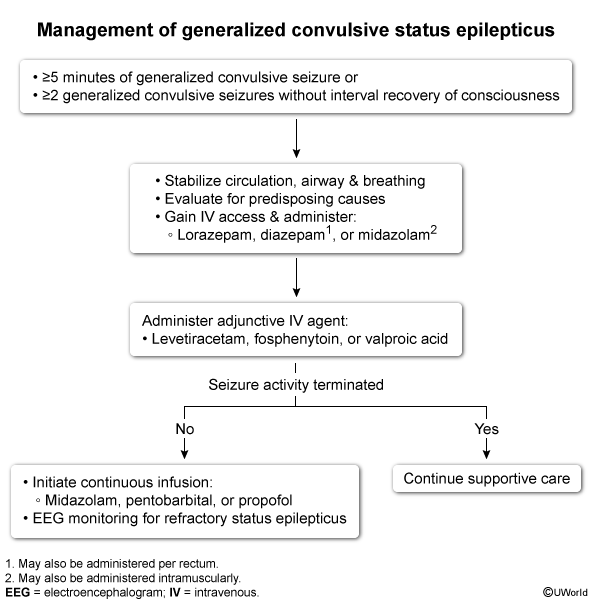
- Step 1: Stabilize airway–breathing–circulation and give an IV short-acting benzodiazepine (lorazepam or diazepam) as first-line abortive therapy; repeat if the seizure continues.
- Step 2: If seizures persist, give a loading dose of a second-line IV agent — fosphenytoin/phenytoin, valproate, or levetiracetam (phenobarbital is used in infants).
- Step 3: If still refractory, start a continuous IV infusion (midazolam, propofol, or pentobarbital) with EEG monitoring.
The full stepwise protocol is shown here:
Non-pharmacologic options (drug-resistant epilepsy)
- Surgery: resection of epileptogenic tissue; best outcomes with temporal lobe lesions (>75% achieve seizure control/remission).
- Vagal nerve stimulator: pacemaker-sized device delivering impulses to the vagus nerve; common side effect is hoarseness.
- Ketogenic diet: high-fat, low-carbohydrate diet that suppresses seizures by inducing ketosis.
Side effects of antiseizure medications
The table below uses the Disease Characteristics template and summarizes the signature, high-yield toxicity of each agent.
| Side effects of antiseizure medications | |
|---|---|
| Drug | High-yield side effects |
| Valproate | Teratogen (neural-tube defects), hyperammonemia, dose-related thrombocytopenia, weight gain, tremor, hepatotoxicity |
| Carbamazepine | Leukopenia, hepatotoxicity, SIADH (hyponatremia) |
| Phenytoin | Hirsutism, gingival hypertrophy, ataxia, Stevens–Johnson syndrome |
| Ethosuximide | Abdominal pain, skin rash, liver dysfunction, leukopenia |
| Phenobarbital | Severe behavioral changes, cognitive impairment (mainly used in infants) |
| Lamotrigine | Stevens–Johnson syndrome |
| Levetiracetam | Irritability, aggression |
| Topiramate | Cognitive slowing, metabolic acidosis, glaucoma |
| Vigabatrin | Permanent visual-field defects |
| Signature antiseizure-drug side effects | |
|
جملة تذكرية |
Key Points for Exams
- Epilepsy = ≥2 unprovoked seizures >24 h apart, OR one unprovoked seizure with high recurrence risk, OR a defined epilepsy syndrome.
- Status epilepticus = seizure ≥5 min or recurrent seizures without recovery → IV benzodiazepine first, then fosphenytoin/valproate/levetiracetam, then infusion.
- Febrile seizures (6 mo–6 y, benign): simple = generalized <15 min; complex = focal, >15 min, or recurs within 24 h. LP if meningitis is suspected or in an under-vaccinated infant 6–12 months.
- Infantile spasms → West syndrome triad (spasms + hypsarrhythmia + developmental regression); tuberous sclerosis is the commonest identified cause; treat with ACTH ± vigabatrin.
- Absence epilepsy: 3-Hz spike-and-wave, provoked by hyperventilation, no postictal state; ethosuximide first-line; carbamazepine worsens it.
- Benign rolandic epilepsy (BECTS): nocturnal oral–buccal focal seizures, centrotemporal spikes, excellent prognosis.
- Focal onset implies a structural cause → obtain MRI. Todd paralysis = transient postictal focal weakness (exclude stroke).
- Signature drug toxicities: phenytoin (gum hypertrophy/hirsutism), valproate (hepatotoxicity/teratogen), vigabatrin (visual-field loss), carbamazepine (SIADH), topiramate (stones/glaucoma/acidosis).
| Important – فكرة سؤال | |
Ethosuximide is first-line for pure childhood absence epilepsy and works by blocking T-type Ca²⁺ channels in thalamic neurons. Carbamazepine, phenytoin, and vigabatrin can WORSEN absence and myoclonic seizures — a classic board trap. When a child has both absence and generalized tonic–clonic seizures, choose a broad-spectrum agent (valproate). |
تذكر |
احصل على التجربة الكاملة
اشترك للوصول لفيديوهات الشرح التفصيلي والبطاقات التعليمية التفاعلية وأسئلة الممارسة مع تتبع التقدم.