شرح المدرسين

Summary
Placenta previa is implantation of the placenta in the lower uterine segment, partially or completely covering the cervical os, and a major cause of painless antepartum hemorrhage after 24 weeks. Risk is increased with previous caesarean section, multiparity, and advanced maternal age. Diagnosis is confirmed by transvaginal ultrasound, and management depends on stability and gestation, with caesarean section required in most cases. It carries risks of massive haemorrhage, hysterectomy, prematurity, and placenta accreta spectrum.
Definition & Pathophysiology
Definition
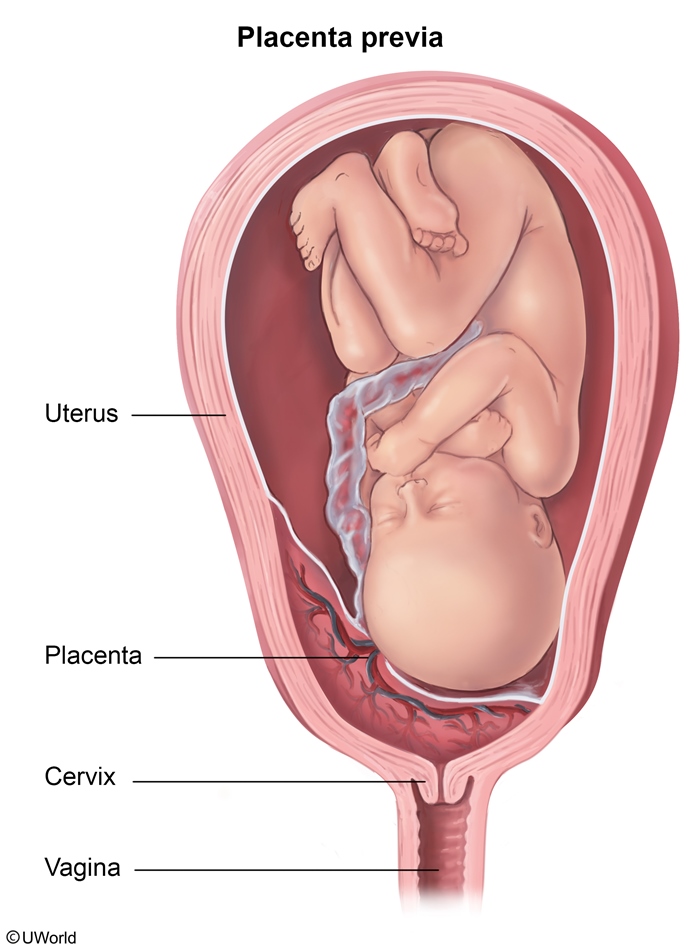
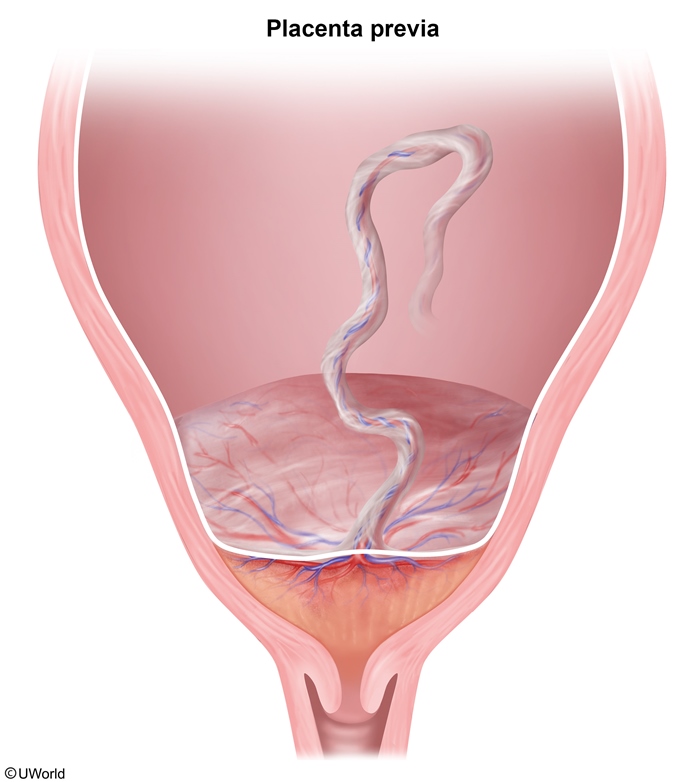
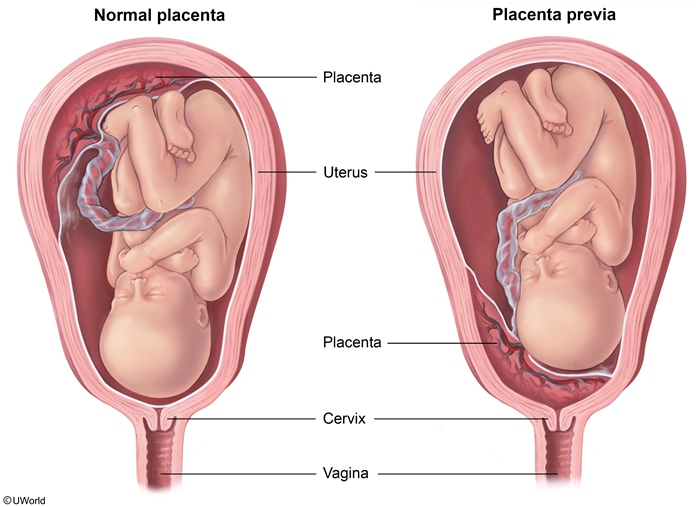
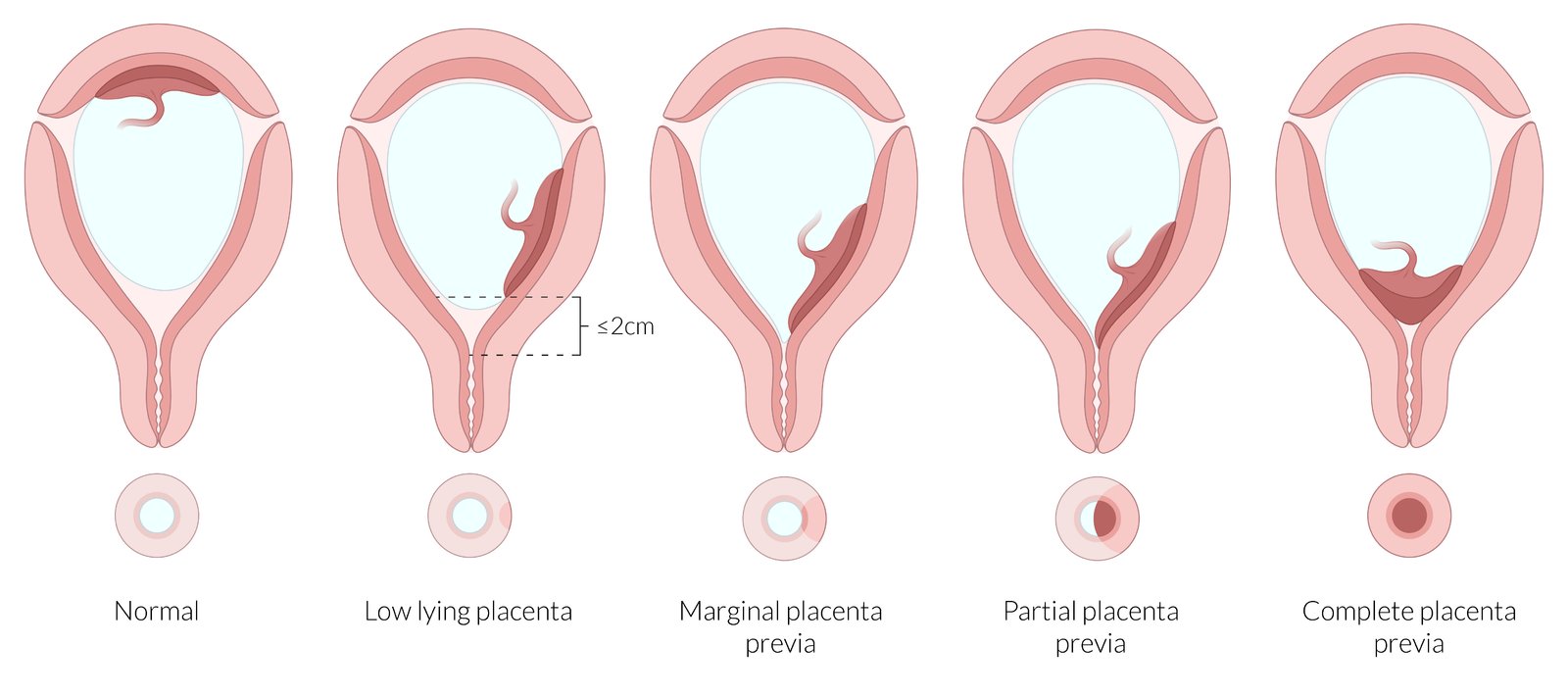
Placenta previa refers to implantation of the placenta in the lower uterine segment, where it partially or completely covers the internal cervical os. It is a major cause of antepartum hemorrhage (APH), defined as bleeding from the genital tract after 24 weeks of gestation and before delivery. A low-lying placenta (within 2 cm of the internal os between 24–28 weeks) may migrate upwards, whereas persistence beyond 28 weeks is termed placenta previa.
Epidemiology
Placenta previa occurs in approximately 0.5% of pregnancies. The incidence rises with increasing rates of caesarean section, maternal age, and multiparity.
Pathophysiology
The lower uterine segment stretches during late pregnancy and labor, but the placenta lacks elasticity. This stretching causes separation of placental tissue, leading to recurrent, painless vaginal bleeding. The bleeding is maternal in origin and can be spontaneous or provoked (e.g., intercourse, vaginal examination). Unlike abruption, there is no retroplacental clot formation, and the uterus remains soft and non-tender because no placental separation occurs at the primary implantation site.
Classification & Clinical Features
Classification
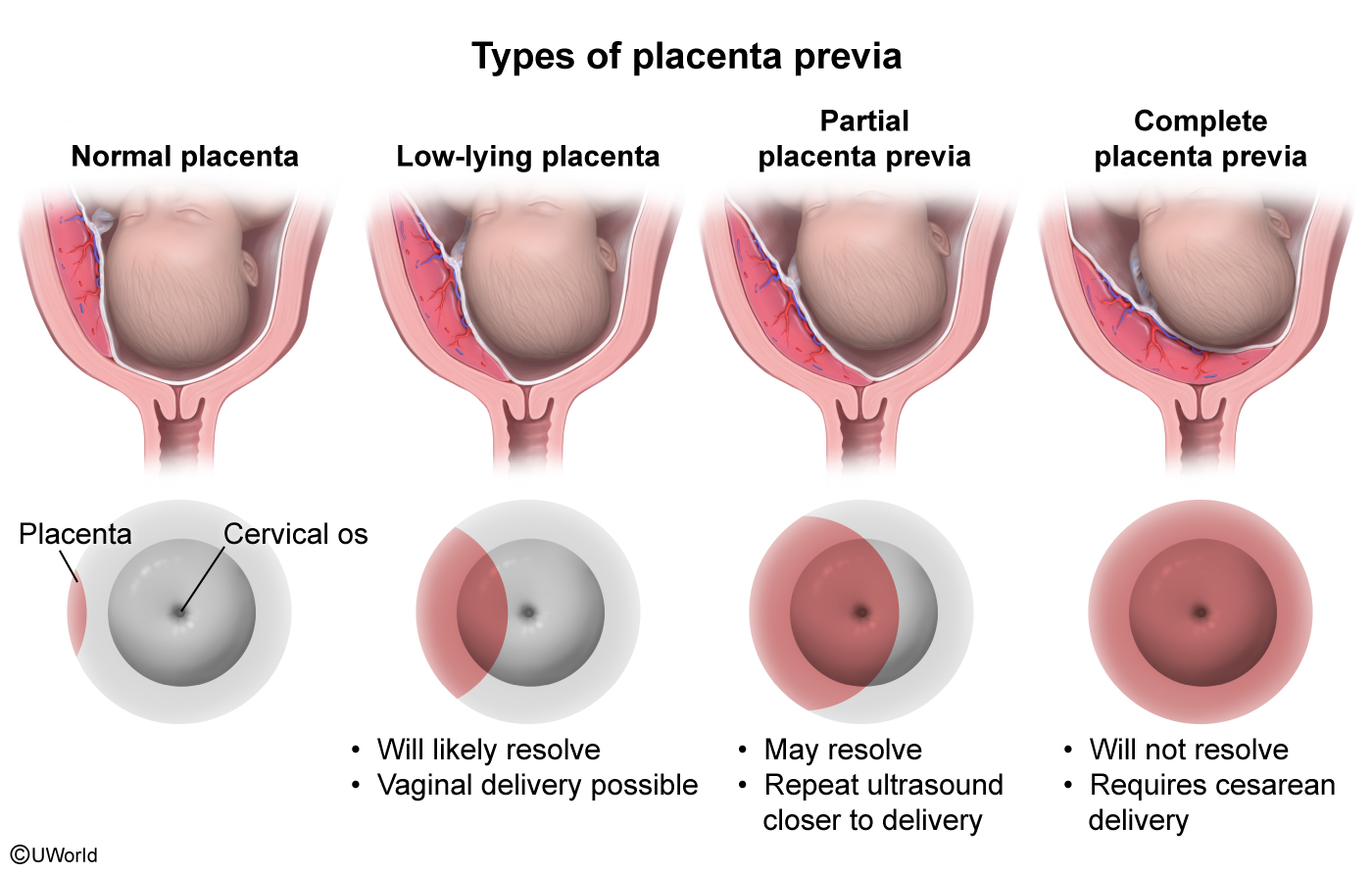
Placenta previa is classified by the degree of cervical os coverage:
| Classification of Placenta Previa by Cervical Os Coverage | |
| Grade I | Low-lying placenta |
| Position | Within 2 cm of the internal os but not reaching it |
| Delivery | Vaginal delivery may be possible if >2 cm from os at term; confirm with repeat scan at 32–36 weeks |
| Grade II | Marginal previa |
| Position | Reaches the margin of the internal os without covering it |
| Delivery | Traditional approach allowed vaginal delivery (anterior); current practice: elective caesarean preferred |
| Grade III | Partial (incomplete centralis) |
| Position | Partially covers the internal os |
| Delivery | Absolute contraindication to vaginal delivery; elective caesarean section at 36–38 weeks |
| Grade IV | Complete centralis |
| Position | Completely covers the internal cervical os |
| Delivery | Absolute contraindication to vaginal delivery; elective caesarean section at 36–38 weeks (earlier if bleeding) |
Clinical Features
Classical presentation: sudden, painless, bright-red vaginal bleeding in the second half of pregnancy (>20 weeks). The bleeding is often recurrent and unpredictable.
| Classic Presentation of Placenta Praevia | |
|
PBS:
|
جملة تذكرية |
Associated findings:
- Uterine examination: soft and non-tender; fetal parts are easily palpable (unlike abruption, where the uterus is woody/tender)
- Fetal lie: may be abnormal (breech, transverse) due to lower placental position
- Incidental finding: bleeding may be detected on routine ultrasound in an asymptomatic woman
Associated complications: preterm delivery, intrauterine growth restriction (IUGR), malpresentation, premature rupture of membranes (PROM), vasa previa, morbidly adherent placenta (accreta, increta, percreta).
Risk Factors
The highest-yield risk factors for placenta previa are:
- Previous caesarean section and uterine surgery: risk increases with number of scars (1/160 after 1 caesarean; 1/50 after 2 sections; 1/10 after 4 sections); curettage and myomectomy also increase risk
- Previous placenta previa: significantly elevated recurrence risk (recurrence rate 4–8%)
- Multiparity: each pregnancy increases risk; parity >3 is a recognized factor
- Advanced maternal age: >35–40 years; thought to reflect cumulative effect of previous pregnancies and uterine changes
Other risk factors (less exam-critical): multiple pregnancy, assisted conception (IVF/ICSI), smoking, history of uterine infection, and maternal hypertension.
| Top Risk Factors for Placenta Previa | |
|
CAMP:
|
جملة تذكرية |
Differential Diagnosis & Investigations
Differential Diagnosis of Antepartum Hemorrhage
When evaluating painless vaginal bleeding in the second half of pregnancy, the following conditions must be considered:
| Differential Diagnosis of Antepartum Hemorrhage (APH) | |||
|---|---|---|---|
| Feature | Placenta Previa | Placental Abruption | Vasa Previa |
| Bleeding character | Painless, bright red, recurrent | Painful, dark blood, concealed/revealed | Massive bleeding after membrane rupture |
| Uterine findings | Soft, non-tender | Tense, woody, tender, contractions | Normal tone; fetal distress |
| Fetal findings | May have abnormal lie (breech) | Possible fetal distress | Fetal distress/bradycardia |
| Placental location | Lower segment, covers os | Normal location; concealment | Velamentous cord insertion |
| Management | Planned CS if major; hospital admission | Obstetric emergency; immediate delivery | Fetal emergency; immediate delivery |
Other differential diagnoses to exclude: local genital causes (cervical ectropion, polyps, cervical carcinoma, cervicitis), show of labor (most common cause; small volume of blood-stained mucus), and uterine rupture (typically in labor with prior uterine surgery).
Diagnosis
Imaging — gold standard:
- Transvaginal ultrasound: **gold standard** for placental localization; most accurate in third trimester; safe even in the presence of bleeding (no risk of placental separation)
- Transabdominal ultrasound: initial screening modality; may be limited by obesity or maternal factors
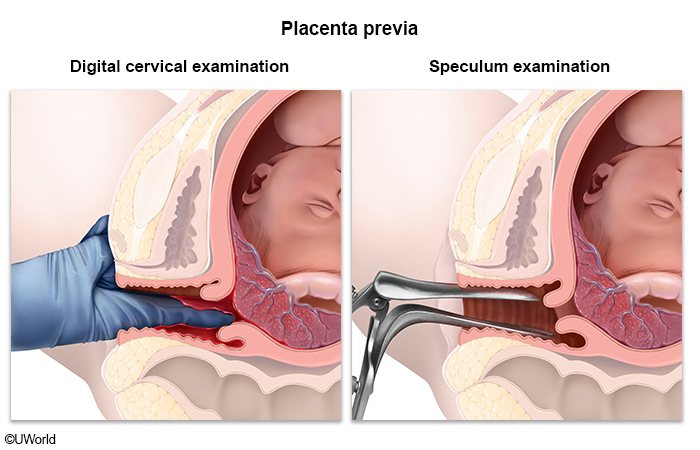
Critical safety principle — Avoid digital vaginal examination until placenta previa is excluded. Digital examination carries risk of catastrophic hemorrhage if placenta previa is present and undiagnosed.
| Critical Exam Trap – فخ امتحاني | |
|
Exam trap: Always on exams, if a patient presents with painless APH after 20 weeks with vaginal bleeding, the question may ask "patient is presenting to the ER, what is the FIRST step of examination?" — The answer is NOT digital vaginal examination! We must perform transvaginal ultrasound FIRST in order to exclude placenta previa before proceeding with digital examination, because digital examination is absolutely contraindicated until we confirm whether or not placenta previa is present — because it can cause catastrophic hemorrhage. |
تذكر |
Investigations
Hematological & transfusion: CBC (baseline hemoglobin to quantify anemia), coagulation profile (PT/INR, aPTT, fibrinogen), blood group and crossmatch (minimum **≥4 units** available for all cases)
Rh incompatibility: Kleihauer-Betke test (fetal-maternal hemorrhage) in Rh-negative women to quantify fetomaternal transfusion and guide anti-D immunoglobulin dose (standard: 500 IU per mL fetal red blood cells; 100 µg per 4 mL fetal whole blood)
Fetal wellbeing: Cardiotocography (CTG) ≥26 weeks to assess fetal heart rate, reactivity, and contractions; baseline for comparison if emergency delivery becomes necessary
Renal and liver function: baseline assessment in case severe bleeding requires massive transfusion or delivery under anesthesia
Management Protocols
Unified Management Strategy by Clinical Scenario
Management of placenta previa depends critically on maternal stability, gestational age, and severity of bleeding. All cases require hospital admission and preparation for possible emergency delivery.
| Clinical Scenario | Management Principles |
| Stable + Preterm (<37 weeks) |
|
| Stable + Term (≥37 weeks) |
|
| Unstable + Preterm (maternal or fetal distress) |
|
| Unstable + Term |
|
| Asymptomatic with low-lying placenta (Grade I, ≥2 cm from os) |
|
| All cases (universal principles) |
|
Special considerations:
- Rh-negative women: give anti-D within 72 hours of any bleeding episode; calculate additional dose if fetomaternal hemorrhage >4 mL of fetal RBCs (Kleihauer test)
- Massive transfusion: activate major haemorrhage protocol; maintain 1:1:1 ratio of packed RBC:FFP:platelets; check coagulation status and fibrinogen serially; ensure cell salvage theatre is on standby
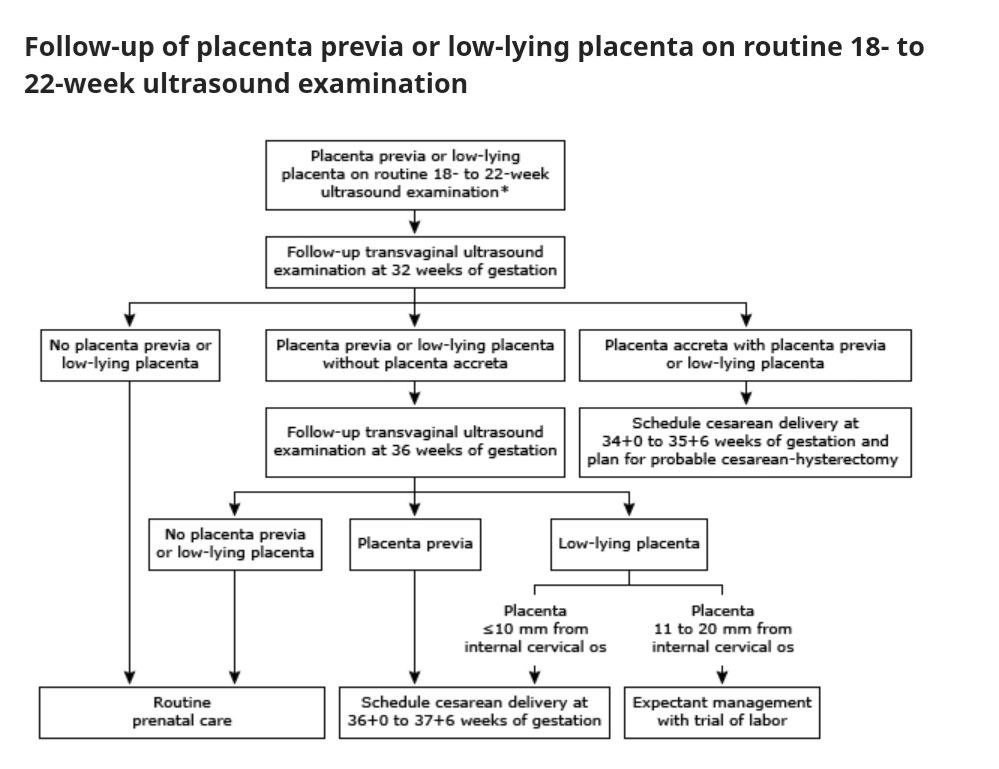
- Placental migration: approximately 50% of Grade I placentae migrate away from the os by term; 10% of Grade II may also migrate, justifying a repeat scan at 32–36 weeks
- Mode of delivery: vaginal delivery is considered only for Grade I and anterior Grade II if placenta remains >2 cm from os; Grade III and IV always require caesarean delivery
Prognosis & Outcomes
Prognosis & Outcomes
Maternal mortality is now rare (<1%) with modern obstetric care (blood transfusion, ICU support, emergency caesarean delivery). However, placenta previa carries significant morbidity:
- Massive antepartum and intrapartum hemorrhage (up to 10% require transfusion of ≥5 units)
- Peripartum hysterectomy: 0.1–1% of cases, indicated for uncontrolled hemorrhage, placenta accreta spectrum, or retained placenta
- Premature delivery: 5–10% of cases; prematurity-related complications (RDS, IVH, NEC) are the leading cause of neonatal morbidity in placenta previa pregnancies
- Placenta accreta spectrum: risk increases dramatically with number of prior caesarean sections and presence of previa (2–5% with 1 prior CS, 10–25% with ≥2 prior CS)
- Perinatal mortality: 2–4% (largely due to prematurity and placental insufficiency)
- Maternal intensive care admission: 5–15% if bleeding is severe
Key Points for Exams – نقاط مهمة للامتحانات
Exam-Critical Summary
Definition: Placenta covering or adjacent to cervical os, causing painless APH after 20 weeks.
Diagnosis: Transvaginal ultrasound (gold standard); digital vaginal exam contraindicated until previa excluded.
Classification: Grades I–IV based on os coverage; Grade III and IV are absolute contraindications to vaginal delivery.
Management: Hospital admission, bed rest, corticosteroids if preterm, planned caesarean delivery at 36–38 weeks for Grade III/IV. Stable preterm = expectant management with monitoring; unstable or term = urgent delivery.
Key risk factors: Previous caesarean (dose-dependent), multiparity, advanced maternal age, previous previa.
High-Yield Exam Pearls
- Painless vaginal bleeding in the second half of pregnancy until proven otherwise = think placenta previa. The tripod of diagnosis is: (1) painless bleeding, (2) soft uterus, (3) vaginal bleeding after 20 weeks. Do NOT perform digital vaginal examination without first excluding placenta previa by ultrasound — digital exam is absolutely contraindicated if previa is present.
- Transvaginal ultrasound is the gold standard and is SAFE in placenta previa. Many students incorrectly believe transvaginal ultrasound is contraindicated — it is not. Transvaginal ultrasound is the most accurate modality for placental localization even in the presence of bleeding because it does not involve mechanical disruption of the placenta.
- Placental migration is real and exam-relevant. Approximately 50% of Grade I (low-lying) and 10% of Grade II placentae migrate cephalad away from the cervical os by the end of pregnancy. This is why asymptomatic low-lying placentae are rescanned at 32–36 weeks — many will be eligible for vaginal delivery by term.
- Distinguish placenta previa from placental abruption clinically. Previa: painless, bright red, recurrent, soft uterus. Abruption: painful, dark blood, tense/woody uterus, fetal distress common. A single clinical pearl that separates them is uterine tenderness — abruption hurts, previa does not.
احصل على التجربة الكاملة
اشترك للوصول لفيديوهات الشرح التفصيلي والبطاقات التعليمية التفاعلية وأسئلة الممارسة مع تتبع التقدم.