شرح المدرسين

SUMMARY
Miscarriage (spontaneous abortion) is the most common complication of early pregnancy, with causes ranging from chromosomal abnormalities (50% of cases) to maternal, placental, and environmental factors. Diagnosis relies on clinical assessment combined with transvaginal ultrasound findings and serial β-hCG measurements where needed. Management is individualised and may be expectant, medical, or surgical — all with comparable safety profiles but differing risks, benefits, and psychological impact. Key to diagnosis and prognosis is the combination of ultrasound viability findings and cervical os status on physical examination. Appropriate follow-up care, emotional support, and anti-D prophylaxis in Rh-negative women are essential to prevent sensitisation and ensure optimal future pregnancy outcomes.
DEFINITION & EPIDEMIOLOGY
Definition
Miscarriage (spontaneous abortion) is defined as the spontaneous loss of a pregnancy before fetal viability. In the UK, viability is considered at <24 weeks' gestation; internationally, many definitions use <20 weeks or fetal weight <500 g.
Timing classifications:
- Early miscarriage: <12–13 weeks gestation (accounts for ~80% of all losses; most common)
- Late miscarriage: 13–24 weeks gestation (less common but carries higher morbidity)
Epidemiology
Miscarriage affects 10–25% of clinically recognized pregnancies, with the majority occurring before 12 weeks. Risk increases with maternal age (particularly >35 years) and decreases after fetal cardiac activity is confirmed. Approximately 50% of early pregnancy losses are due to chromosomal abnormalities — predominantly trisomies (trisomy 16, 21, 22) and monosomy X — making them the single most common preventable cause. The prognosis for threatened miscarriage is favorable: up to 50% progress to viable pregnancy once fetal cardiac activity is confirmed on ultrasound.
ETIOLOGY & RISK FACTORS
The majority of early miscarriages are due to fetal chromosomal abnormalities (≈50%), followed by maternal anatomical and endocrine factors. Most causes are non-preventable; only lifestyle factors and some maternal conditions are modifiable. Recurrent miscarriage (≥3 consecutive losses) warrants specialist investigation for maternal thrombophilia, uterine anatomy, hormonal dysfunction, or parental chromosomal rearrangements.
FETAL / PLACENTAL causes (most common):
- Chromosomal abnormalities (account for ~50% of early losses): trisomies 16, 21, 22; monosomy X (Turner); polyploidy (triploidy, tetraploidy). Most are incompatible with life beyond early pregnancy.
- Anembryonic pregnancy (blighted ovum): gestational sac develops without fetal pole; diagnosed when MSD ≥25 mm or gestational sac ≥10 mm without yolk sac on ultrasound.
- Congenital anomalies: complex fetal malformations incompatible with early survival.
MATERNAL causes:
- Advanced maternal age (>30–35 years): increases chromosomal abnormality risk exponentially (at age 45, risk of Down syndrome ≈1/30).
- Antiphospholipid syndrome (APS) and thrombophilia: causes placental insufficiency and thrombosis; associated with recurrent miscarriage.
- Uterine anomalies: septate uterus, fibroids, intrauterine adhesions (Asherman's syndrome) — mechanical factors reducing implantation success.
LIFESTYLE & ENVIRONMENTAL: Smoking, obesity (BMI >30), severe trauma, acute maternal infection (particularly first trimester), and iatrogenic causes (invasive chorionic villus sampling, amniocentesis).
PREVIOUS HISTORY: Prior miscarriage, previous uterine surgery (curettage, myomectomy), and parental balanced chromosomal rearrangements (e.g., carrier of translocation).
CLINICAL PRESENTATION & INVESTIGATIONS
CLINICAL PRESENTATION
Hallmark symptoms: Vaginal bleeding is the cardinal sign, often accompanied by the passage of clots or tissue fragments and suprapubic cramping pain similar to dysmenorrhoea. Some cases are asymptomatic and discovered incidentally during ultrasound screening. In severe miscarriage, especially with heavy bleeding, patients may develop haemodynamic instability: tachycardia, hypotension, pallor, dizziness, and shortness of breath.
Examination findings:
- Speculum: Visualise products of conception (POC) in the cervical canal or vagina; note cervical bleeding, cervicitis, or vaginal trauma.
- Bimanual: Assess uterine size (smaller than expected for dates in missed miscarriage), tenderness, and adnexal masses to exclude ectopic pregnancy.
- Abdominal: Generalised tenderness, distension, or rebound guarding (suggest sepsis or perforation).
DIFFERENTIAL DIAGNOSIS
The features of complete abortion—closed cervical os, expelled products of conception in vaginal canal, and empty uterine cavity—are detailed below for entities that must be excluded: below for entities that must be excluded:
| Differential Diagnosis – Important – فكرة سؤال | |
|
Key entities to exclude in first-trimester bleeding:
Rule: Always obtain β-hCG, perform TVUS, and exclude ectopic pregnancy before diagnosing miscarriage as the cause of first-trimester bleeding. |
تذكر |
INVESTIGATIONS
Transvaginal Ultrasound (TVUS — gold standard):
- Viability confirmed by fetal cardiac activity (detectable at 5½–6 weeks gestation; absence of heartbeat after this gestation indicates non-viable pregnancy).
- Crown-rump length (CRL) ≥7 mm without cardiac activity → non-viable pregnancy. Confirm with repeat scan in 7 days to avoid misdiagnosis.
- Mean sac diameter (MSD) ≥25 mm without embryonic pole → failed pregnancy (anembryonic gestation / blighted ovum).
- Gestational sac ≥10 mm without yolk sac is also diagnostic of failed pregnancy.
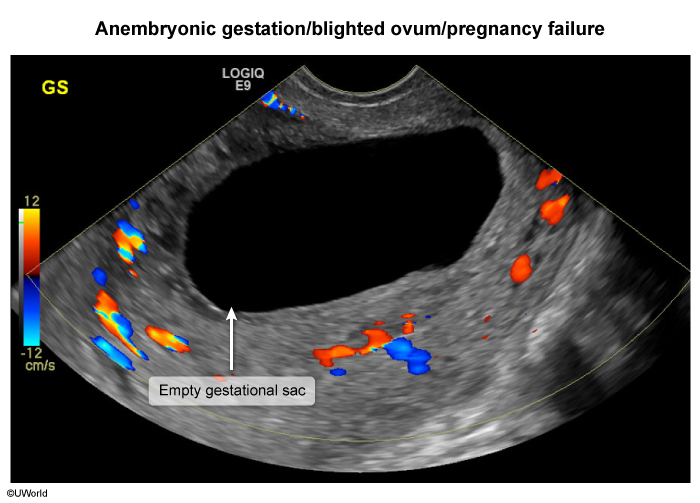
| Note: Confirming Missed Miscarriage Diagnosis | |
| Always confirm CRL and MSD measurements before diagnosing missed miscarriage to avoid hastily terminating a pregnancy without definitive confirmation. Always repeat the ultrasound after 7 days to confirm viability. | ملاحظة |
Laboratory tests:
- β-hCG: Serial values (>48-hour interval) may help in ectopic pregnancy suspicion (slow rise suggests ectopic or non-viable intrauterine pregnancy); NOT diagnostic for miscarriage alone.
- Full blood count: Assess for anaemia, thrombocytopenia, and baseline haemoglobin before any procedure.
- Blood group & Rh status: Essential for anti-D prophylaxis in Rh-negative women.
- CRP and high vaginal swabs: If infection or sepsis is clinically suspected (fever, foul discharge, systemic symptoms).
CLASSIFICATION OF MISCARRIAGE
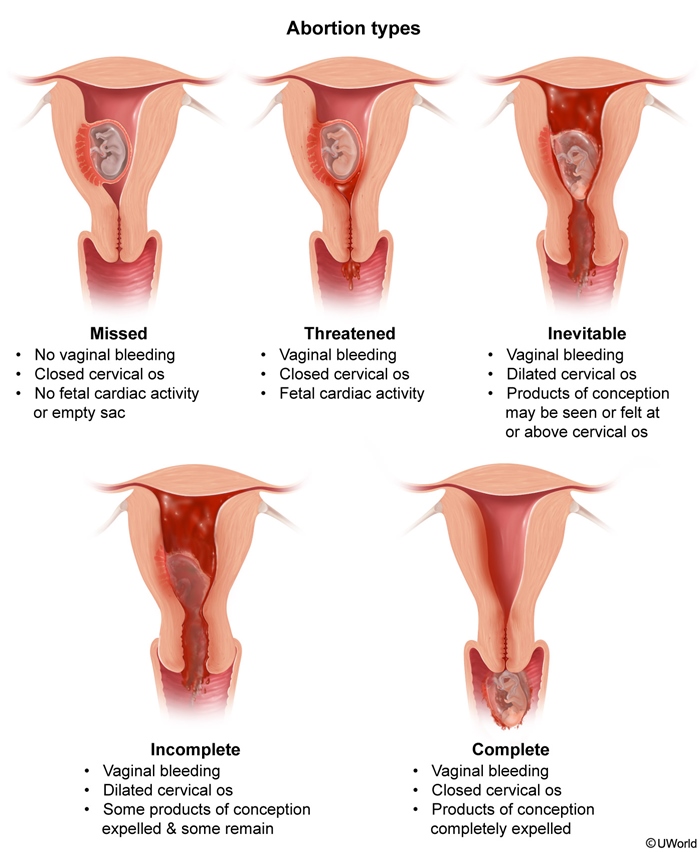
Miscarriage is classified into six types based on the combination of clinical presentation, ultrasound findings, and cervical os status. The cervical os status (open vs. closed) and ultrasound evidence of viability are the two most important discriminators.
| Classification of Miscarriage: Clinical, Ultrasound, and Management Features | ||||
|---|---|---|---|---|
| Type | Clinical Features | Ultrasound Findings | Cervical Os | Management |
| Threatened | Vaginal bleeding ± mild pain; pregnancy symptoms persist | Viable intrauterine pregnancy with fetal cardiac activity | Closed | Expectant management with reassurance; anti-D if >12 weeks & Rh-negative |
| Inevitable | Heavy bleeding, cramping pain, passage of clots; haemodynamic risk | Intrauterine pregnancy with or without fetal cardiac activity; may show sac separation | Open | Admit if bleeding heavy; expectant, medical, or surgical evacuation |
| Missed | Often asymptomatic or minimal bleeding; pregnancy symptoms regress | No fetal cardiac activity: CRL ≥7 mm or MSD ≥25 mm without embryo/yolk sac | Closed | Expectant, medical (misoprostol ± mifepristone), or surgical evacuation |
| Incomplete | Vaginal bleeding, abdominal pain; partial passage of tissue/POC | Retained products of conception; thickened endometrium (>15 mm); open cervix | Open | Expectant, medical, or surgical evacuation; anti-D if >12 weeks & Rh-negative |
| Complete | History of bleeding and tissue passage; pain and bleeding settle | Empty uterus; thin endometrium (<15 mm); no retained products | Closed/closing | No further treatment; discharge with GP follow-up; anti-D if >12 weeks & Rh-negative |
| Septic | Fever, rigors, severe pelvic pain, foul vaginal discharge; signs of systemic sepsis | Retained/infected products of conception; possible free fluid | Open or variable | Urgent: IV antibiotics, IV fluids, surgical evacuation; anti-D if >12 weeks & Rh-negative |
| Clinical Note | |
|
The most important finding on physical examination is the cervical os. If open with bleeding, the diagnosis will be inevitable or incomplete miscarriage; conversely, if closed with fetal cardiac activity, it will be threatened miscarriage. The cervical os status combined with viability on ultrasound determines the diagnosis and prognosis. |
ملاحظة |
Key clinical notes:
- Threatened miscarriage prognosis: Up to 50% will continue to viable term once fetal cardiac activity is demonstrated and os is closed.
- Septic miscarriage (miscarriage complicated by infection): This is a medical emergency requiring broad-spectrum IV antibiotics (e.g., ceftriaxone 2 g IV once daily + metronidazole 500 mg IV 8-hourly) and urgent surgical evacuation to prevent progression to septic shock and disseminated intravascular coagulation (DIC).
- Retained products of conception (RPOC): If >15 mm endometrial thickness and persistent bleeding after complete or incomplete miscarriage, evacuation may be required; always exclude neoplasia in older women before attributing RPOC to simple miscarriage.
MANAGEMENT
Choice of management depends on: clinical stability, gestational age, patient preference, severity of bleeding, risk of infection, and local protocols. All three approaches (expectant, medical, surgical) have comparable safety profiles when appropriate indications are applied; the choice is individualised.
ANTI-D PROPHYLAXIS (critical): All Rh(D)-negative, non-sensitised women require anti-D prophylaxis if miscarriage occurs after 12 weeks' gestation OR after surgical evacuation at any gestation. Standard dose is 500 IU/kg IM (typically 1500 IU for early loss, 500 IU per mL fetal red cells if larger transfusion risk). This prevents sensitisation and haemolytic disease of the fetus in future pregnancies.
| Note | |
| All Rh(D)-negative, non-sensitised women undergoing surgical evacuation at any gestation OR with miscarriage after 12 weeks require anti-D prophylaxis 500 IU/kg IM. Do not overlook this—it is a standard examination question. | ملاحظة |
| Management Options for Miscarriage: Expectant vs. Medical vs. Surgical | |||
|---|---|---|---|
| Feature | Expectant (Conservative) | Medical | Surgical |
| Mechanism | Natural passage of products of conception over days to weeks | Vaginal misoprostol (± mifepristone pretreatment) induces uterine contractions | Vacuum aspiration (<12 weeks) or evacuation of retained products (ERPC) |
| Advantages | Avoids intervention; managed at home; lower cost | Avoids surgery; can be outpatient; less invasive | Rapid and definitive; predictable outcome; suitable for haemodynamic instability |
| Disadvantages/Risks | Unpredictable timeline; risk of heavy bleeding or infection; may fail and require further treatment; prolonged emotional distress | Side effects (cramping pain, heavy bleeding, GI upset); possible need for surgical evacuation if fails (15–20%); incomplete response | Anaesthetic complications; uterine perforation; haemorrhage; intrauterine adhesions (Asherman's syndrome); rare but serious complications |
| Indications | Stable patient; <12 weeks preferred; patient preference; low risk of infection | Missed miscarriage; incomplete miscarriage; patient preference to avoid surgery | Haemodynamic instability; infected/septic tissue; trophoblastic disease; failed medical management; patient preference |
| Contraindications | Haemodynamic instability; coagulopathy; active infection; suspicion of ectopic pregnancy | Signs of sepsis; allergy to misoprostol; IUGR with live fetus | None absolute, but relative: severe thrombocytopenia; active bleeding diathesis |
DETAILED APPROACH BY TYPE:
Threatened miscarriage: Expectant management only; reassurance that up to 50% will progress to term. Serial ultrasound at 2 weeks to confirm ongoing viability or progression to complete/incomplete miscarriage. Anti-D if >12 weeks & Rh-negative.
Inevitable & incomplete miscarriage: All three modalities are appropriate. Surgical evacuation is preferred if heavy bleeding with haemodynamic compromise. Medical management (misoprostol 800 μg vaginal 6-hourly for up to 3 doses) is preferred for haemodynamically stable patients wanting to avoid surgery. Expectant is acceptable in early gestation if patient agrees.
Missed miscarriage: All three options carry equal efficacy. Medical management is often first-line in stable patients (mifepristone 600 mg oral single dose, followed 36–48 hours later by misoprostol 800 μg vaginal 6-hourly). Surgical evacuation is rapid and definitive if patient preference or failure of medical/expectant management occurs.
Septic miscarriage: EMERGENCY MANAGEMENT. Broad-spectrum antibiotics IV immediately (ceftriaxone 2 g IV daily + metronidazole 500 mg IV 8-hourly or cefoxitin 2 g IV 6-hourly), IV fluid resuscitation, and URGENT surgical evacuation under antibiotic cover to remove infected tissue and prevent septic shock. Monitor for DIC.
COMPLICATIONS
Complications of miscarriage and its management:
- Haemorrhage: The most common complication, ranging from spotting to life-threatening haemorrhage. Heavy bleeding with haemodynamic instability requires immediate IV access, fluid resuscitation, blood cross-matching, and often surgical evacuation. Transfusion threshold is Hb <7 g/dL in stable patients or symptomatic anaemia.
- Infection (septic miscarriage, endometritis): Occurs when miscarriage is complicated by bacterial colonisation of retained products or uterine cavity. Presents with fever (>38°C), rigors, pelvic pain, foul-smelling vaginal discharge, and systemic inflammatory markers elevated. Treat urgently with broad-spectrum antibiotics and surgical evacuation to prevent progression to septic shock, DIC, and multi-organ failure.
- Retained products of conception (RPOC): Partial expulsion of conceptus with residual tissue remaining in the uterus. Presents with persistent bleeding, pelvic pain, or subinvolution beyond 2–3 weeks. Diagnosed on ultrasound (>15 mm endometrial thickness, echogenic material in cavity). Managed by repeat ultrasound to confirm, then medical (misoprostol) or surgical evacuation if symptomatic or infection risk.
- Disseminated intravascular coagulation (DIC): Rare but life-threatening; associated with prolonged missed miscarriage (especially >4 weeks), septic miscarriage, or amniotic fluid embolism during surgical evacuation. Presents with bleeding from multiple sites, thrombosis, and laboratory derangement (low fibrinogen, prolonged PT/aPTT, low platelets). Manage with FFP, cryoprecipitate, platelet transfusion, and urgent evacuation.
- Intrauterine adhesions (Asherman's syndrome): Results from aggressive curettage or repeated evacuation, particularly in young women with early gestations. Presents as amenorrhoea or hypomenorrhoea after miscarriage. Diagnosed by hysteroscopy; managed with hysteroscopic adhesiolysis and oestrogen therapy to prevent recurrence. Risk reduced with gentle evacuation and ultrasound-guided technique.
- Psychological sequelae: Grief, anxiety, depression, and post-traumatic stress disorder are common after miscarriage, particularly if recurrent. Adequate counselling, support groups, and follow-up from primary care are essential.
KEY POINTS FOR EXAMS – نقاط مهمة للامتحانات
High-yield pearls for boards and clinical practice:
| Ultrasound Viability Criteria – جملة تذكرية | |
|
CRASH
Remember: Any gestational sac ≥25 mm without embryo or ≥10 mm without yolk sac = blighted ovum. |
جملة تذكرية |
| Exam Pearls – Cervical Os Status – Key Discriminator | |
|
ملاحظة سريرية: The cervical os status is the single most important physical sign in miscarriage classification:
Tip: Always perform a speculum exam FIRST to visualize the os; then bimanual exam to assess uterine size and tenderness. |
ملاحظة |
Critical exam facts:
- Prevalence: Miscarriage affects 10–25% of clinically recognized pregnancies; ~50% of these are due to chromosomal abnormalities.
- Threatened miscarriage prognosis: If fetal cardiac activity is present and os is closed, up to 50% will continue to viable term.
- Diagnosis of failed pregnancy: NEVER diagnose on single ultrasound — require either (a) CRL ≥7 mm without heartbeat on two scans 7 days apart, OR (b) MSD ≥25 mm without embryonic pole, OR (c) ≥10 mm GS without yolk sac. Avoid false diagnosis of demise in very early pregnancies.
- Anti-D prophylaxis: Mandatory for Rh-negative women if miscarriage occurs after 12 weeks OR after ANY surgical evacuation. Dose: 500 IU/kg IM (typically 1500 IU for early losses).
- Septic miscarriage: This is MEDICAL EMERGENCY. Broad-spectrum IV antibiotics + fluids + URGENT surgical evacuation. Do NOT delay for repeat imaging if clinical suspicion is high.
- Management choice: All three modalities (expectant, medical, surgical) have equal efficacy and safety when appropriate indications are applied; choice is individualised based on stability, patient preference, and clinical context.
- Asherman's syndrome risk: Excessive uterine curettage increases risk of intrauterine adhesions, particularly after repeated evacuation or aggressive instrumentation. Use ultrasound guidance and gentle technique.
- Ectopic pregnancy must be excluded: Any positive β-hCG with first-trimester bleeding requires TVUS to confirm intrauterine pregnancy before diagnosing miscarriage. Absence of IUP on TVUS despite positive hCG = ectopic until proven otherwise.
- Endometrial thickness thresholds on ultrasound: <15 mm = thin endometrium, consistent with complete miscarriage; >15 mm = thickened endometrium, may indicate RPOC or incomplete miscarriage.
- Common exam trap: A patient with a 5-week gestation and no visible yolk sac does NOT have a failed pregnancy — this is too early. Yolk sac is visible from 5½–6 weeks; fetal pole from 6½–7 weeks. Always correlate ultrasound with reliable dating history.
احصل على التجربة الكاملة
اشترك للوصول لفيديوهات الشرح التفصيلي والبطاقات التعليمية التفاعلية وأسئلة الممارسة مع تتبع التقدم.