شرح المدرسين

Summary
Gestational trophoblastic disease (GTD) is a rare pregnancy-related tumour spectrum, from benign moles to malignant neoplasia (invasive mole, choriocarcinoma, PSTT, ETT). It presents with vaginal bleeding or persistent symptoms post-pregnancy, diagnosed by β-hCG, ultrasound, and histology, and managed with evacuation, chemotherapy, or surgery, with high cure rates.
Definition & Pathophysiology
Gestational trophoblastic disease (GTD) refers to a heterogeneous group of rare pregnancy-related tumours arising from abnormal proliferation of trophoblastic tissue. GTD encompasses both benign (pre-malignant) and malignant conditions, with a spectrum ranging from molar pregnancies to highly aggressive neoplasms.
Pathophysiologic Basis
GTD arises from abnormal fertilisation events leading to atypical chromosomal complements and dysregulated trophoblastic growth:
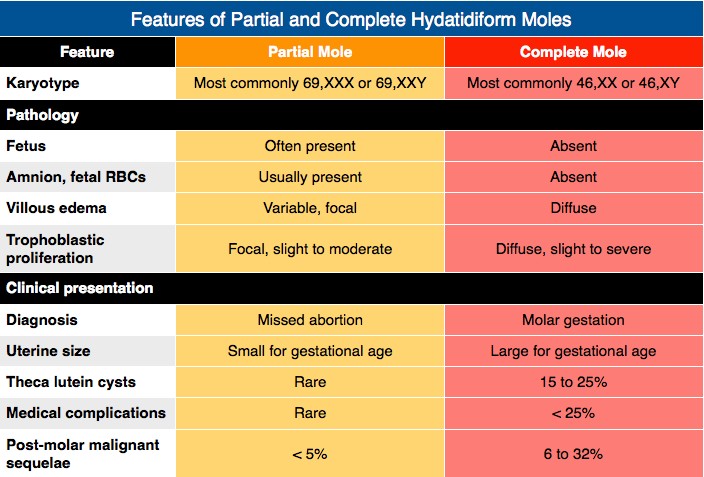
- Complete mole: Results from fertilisation of an "empty" (anucleate) ovum by a single sperm that duplicates or by two sperm. Paternal disomy yields a 46,XX (90%) or 46,XY (10%) karyotype with no embryonic tissue whatsoever. Microscopically, there is diffuse villous oedema (hydropic swelling) with circumferential trophoblastic proliferation, and risk of malignant transformation is 15–20%.
- Partial mole: Results from fertilisation of a normal ovum by two sperm, producing triploidy (69,XXY, 69,XXX, or 69,XYY). Characterized by focal villous oedema and variable embryonic development, with lower malignant risk (<5%).
- Neoplastic forms (invasive mole, choriocarcinoma, PSTT, ETT): Malignant transformation with myometrial invasion, vascular dissemination, and metastatic potential, driven by unrestricted trophoblastic proliferation and hCG production.
The excessive production of β-hCG in molar pregnancy is responsible for the most distinctive clinical features (hyperemesis, thyrotoxicosis, preeclampsia).
| Important - Question Idea | |
|
Always remember in the exam that Complete Mole has a completely paternal origin — there is no maternal DNA whatsoever. In contrast, Partial Mole is triploid and contains fetal parts. This difference in karyotype means each mole is different. |
تذكر |
Classification: Pre-malignant vs. Malignant GTD
Pre-malignant GTD (Hydatidiform Mole)
Complete Molar Pregnancy
- Results from fertilisation of an "empty" ovum by a single sperm that duplicates (most common) or two sperm.
- Karyotype: 46,XX (90%) or 46,XY (10%), entirely paternal in origin.
- No fetus, amniotic fluid, or placenta develops.
- Risk of malignant transformation: 15–20%
Partial Molar Pregnancy
- Results from fertilisation of a normal ovum by two sperm.
- Karyotype: 69,XXY (70%), 69,XXX (27%), or 69,XYY (3%).
- May present with abnormal fetus/placenta (triploid or mosaic).
- Risk of malignant transformation: <5%
Malignant GTD (Gestational Trophoblastic Neoplasia, GTN)
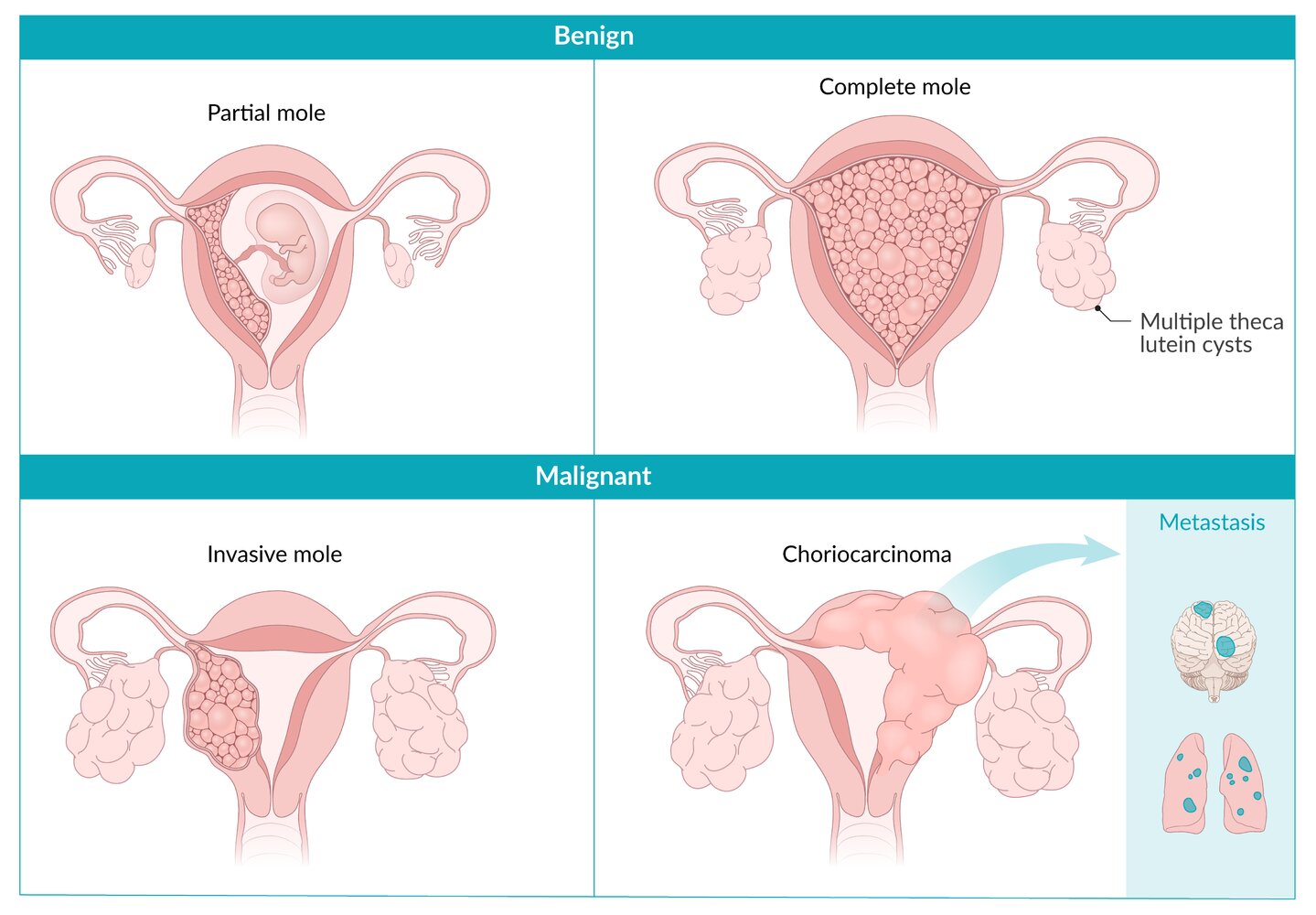
Invasive Mole – Locally invasive form of molar pregnancy with myometrial infiltration, occasionally metastasising. Arises in approximately 10–15% of complete molar pregnancies.
Choriocarcinoma– Highly malignant tumour composed of cytotrophoblasts and syncytiotrophoblasts without chorionic villi. Frequently metastasises to lungs (80%), brain, liver, and vagina. May follow molar pregnancy or normal/ectopic pregnancy; rapid progression if untreated.
Placental Site Trophoblastic Tumour (PSTT) – Rare malignancy of intermediate trophoblasts, often arising after normal pregnancy or miscarriage. May present with persistent bleeding and a uterine mass; lower hCG elevation than other GTN forms.
Epithelioid Trophoblastic Tumour (ETT) – Rare variant resembling squamous carcinoma, arising from chorionic-type intermediate trophoblasts. Slow-growing with moderate malignant potential.
Clinical Features & Risk Factors
Clinical Features of Molar Pregnancy
| Classic Presentation of Molar Pregnancy – VLHHP | |
|
V – Vaginal bleeding (first sign) Remember: All these are driven by excessively high β-hCG in molar pregnancy. |
جملة تذكرية |
Additional findings:
- Abdominal pain and uterine enlargement (soft, boggy consistency).
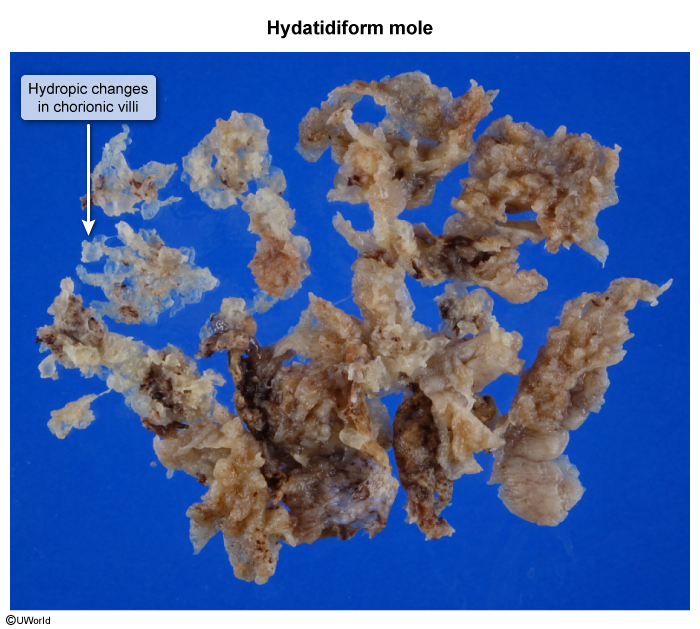
- Passage of vesicles ("grape-like" tissue).
- Theca lutein ovarian cysts (30–60% of cases), which regress post-evacuation.
Clinical Features of Gestational Trophoblastic Neoplasia (GTN)
Local disease:
- Persistent or heavy vaginal bleeding after pregnancy/miscarriage.
- Enlarged uterus or inadequate involution postpartum.
Metastatic features (site-specific):
- Lungs (most common): Cough, dyspnoea, haemoptysis; "cannonball metastases" on chest imaging.
- Brain: Seizures, headaches, focal neurologic deficits.
- Liver: Abdominal pain, hepatomegaly, jaundice.
- Vagina: Vaginal nodules (highly vascular, prone to bleeding).
Key Risk Factors for GTD
- Prior molar pregnancy (highest risk; ~1–2% chance of recurrence, not reduced by change of partner).
- Extremes of maternal age: <20 years or >35 years.
- History of miscarriage or infertility.
- Ethnic predisposition: Higher incidence in Asian and Indian populations.
Investigations & Diagnosis
Laboratory Investigations
Serum β-hCG (first-line): Markedly elevated; serial monitoring is the cornerstone of diagnosis and surveillance. In GTD, levels are typically much higher than expected for gestational age.
Urinary pregnancy tests: Persistently positive post-partum (abnormal) — a red flag for persistent GTD.
Pelvic Ultrasound
Complete mole: Echogenic "snowstorm" or "bunch of grapes" appearance with multiple cystic spaces, large placental mass, and no fetal parts.
Partial mole: Thickened, cystic placenta with possible fetal parts visible ("Swiss cheese" appearance); more irregular than complete mole.
Histopathology (Definitive Diagnosis)
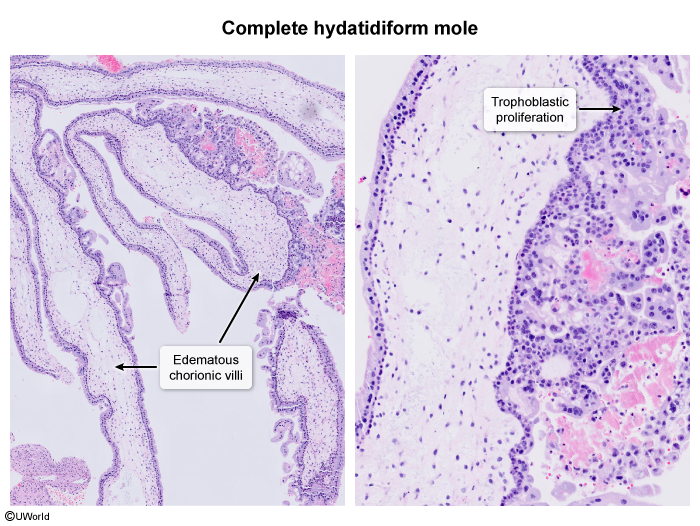
Complete mole histology: Diffuse villous oedema, circumferential trophoblastic proliferation, absent or scant fetal tissue, and absence of vascular invasion.
p57 immunostaining (KIP2 — maternal imprinted gene):
- Negative in complete mole (no maternal DNA).
- Positive in partial mole (maternal DNA present).
- This is a critical ancillary test in challenging cases.
| Note | |
|
The p57 immunostain depends on the maternal genome; therefore, it is negative in complete mole and positive in partial mole. This is a very important point in pathology questions and board exams. |
ملاحظة |
Imaging for Metastasis (if GTN Suspected)
Chest X-ray (first-line): Essential because lungs are the most common site of metastases. Look for "cannonball" nodules (large, round, well-demarcated opacities).
Choriocarcinoma histology and immunostaining:
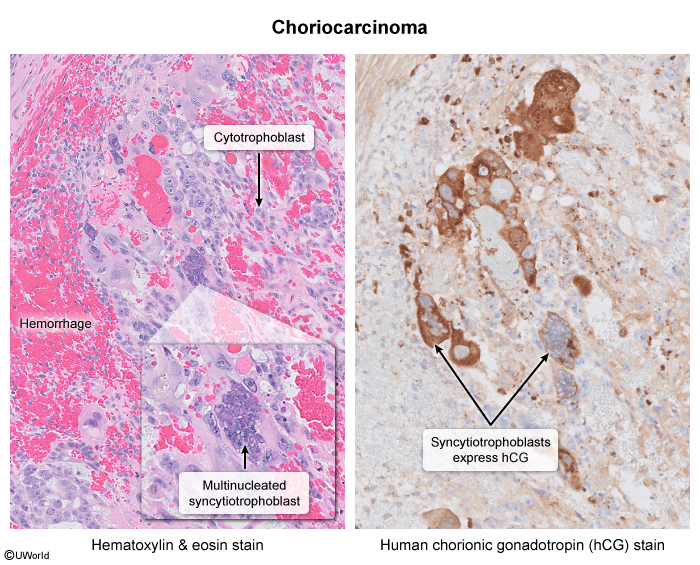
CT/MRI and pelvic ultrasound: Used for assessing myometrial invasion, uterine mass, and organ metastases (brain, liver) when indicated by clinical presentation or elevated β-hCG post-treatment.
Management & Complications
Management of Molar Pregnancy
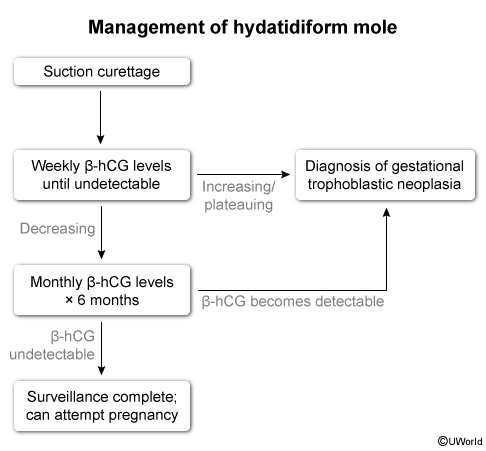
Surgical evacuation: Suction curettage is first-line for both complete and non-viable partial molar pregnancies. Avoid medical management (misoprostol) to reduce trophoblastic embolisation risk.
Anti-D immunoglobulin: Administer to all Rh-negative women post-evacuation (standard dose 500 IU per mL of fetal RBCs).
Serial β-hCG monitoring (mandatory): Weekly measurement until undetectable, followed by monthly monitoring for 6–12 months. This is critical for early detection of persistent GTD or malignant transformation.
Contraception during surveillance: Highly effective contraception is recommended during the entire monitoring period to avoid confusion between a new pregnancy and persistent GTD (which would elevate β-hCG further).
GTD referral centre registration: Recommended in many countries (UK, Australia) for standardised surveillance protocols and rapid access to chemotherapy if needed.
Management of Gestational Trophoblastic Neoplasia (GTN)
Chemotherapy (cornerstone of treatment):
- Low-risk disease: Single-agent methotrexate or actinomycin D.
- High-risk disease: Multi-agent chemotherapy (e.g., EMA/CO — etoposide, methotrexate, actinomycin D alternating with cyclophosphamide and vincristine).
Surgery: Hysterectomy or excision of metastases considered in selected cases (e.g., isolated brain or liver lesions, or when chemotherapy fails).
Cure rates: >95% for good-prognosis GTN; ~65% for poor-prognosis metastatic disease (historically, now improving with multi-agent therapy).
Complications
Associated with molar pregnancy:
- Haemorrhage and anaemia (may require transfusion).
- Uterine perforation and infection during curettage.
- Thyrotoxicosis crisis (severe β-hCG-mediated thyrotoxicosis requiring beta-blockers and antithyroid drugs).
- Preeclampsia/eclampsia (can occur before 20 weeks, unusually early).
- Disseminated intravascular coagulation (rare but life-threatening).
- Pulmonary trophoblastic embolisation during evacuation.
Malignant transformation: Complete mole → 15–20% risk of GTN; partial mole → <5% risk.
Prognosis & Follow-up
Molar pregnancy: With early diagnosis and specialist care, most women achieve complete remission and retain full fertility. Risk of repeat molar pregnancy in a subsequent pregnancy is ~1–2%.
GTN: Most cases are curable with chemotherapy, even when metastatic. Patients who achieve remission can become pregnant again, though careful surveillance with β-hCG is essential in subsequent pregnancies.
| Important - Question Idea | |
|
A post-partum patient presenting with hemoptysis and dyspnea? The first thing you must think of is choriocarcinoma causing cannonball metastases in the lungs. Request β-hCG immediately — if elevated post-partum, this is the biggest red flag. |
تذكر |
Key Points for Exams – نقاط مهمة للامتحانات
Overview of Gestational Trophoblastic Disease
| Overview of Gestational Trophoblastic Disease | ||||||
|---|---|---|---|---|---|---|
| Type | Etiology | Key Features | β-hCG | Ultrasound | Risk of Malignancy | Management |
| Complete mole | Fertilisation of empty ovum by 1 sperm (duplication) or 2 sperm → 46,XX/XY paternal only | No fetus, vesicular villi, large uterus, severe symptoms | Very high | Snowstorm / honeycomb | 15–20% | Suction curettage + β-hCG monitoring |
| Partial mole | Fertilisation of normal ovum by 2 sperm → triploidy (69,XXY/XXX/XYY) | Abnormal fetus, thickened placenta | Moderately raised | Swiss cheese, may show fetus | <5% | Suction curettage; histology |
| Invasive mole | Malignant transformation of mole | Myometrial invasion, persistent bleeding | Persistently high | Uterine mass | Variable | Chemotherapy ± surgery |
| Choriocarcinoma | Malignant trophoblast, post-mole/pregnancy | Aggressive, metastasises (lungs, brain, liver) | Very high | Variable, hypervascular | High | Chemotherapy (curative in most) |
| PSTT | From intermediate trophoblast | Often post-normal pregnancy | Normal/mild ↑ | Solid uterine mass | Moderate | Surgery ± chemotherapy |
| ETT | Rare, mimics squamous carcinoma | Slow-growing, uterine mass | Mild ↑ | Solid mass | Moderate | Surgery ± chemotherapy |
High-Yield Exam Pearls
- Molar pregnancy = β-hCG alarm: Levels are disproportionately high for dates. Serial monitoring is mandatory post-evacuation.
- The "VLHHP" mnemonic: Vaginal bleeding, Large uterus for dates, Hyperemesis, Hyperthyroidism, Preeclampsia (<20 weeks) are all driven by excessive β-hCG.
- Complete vs. Partial at a glance: Complete = no fetus, paternal DNA only, 15–20% malignant risk, p57 negative. Partial = abnormal fetus present, triploid (2n+n), <5% risk, p57 positive.
- Theca lutein cysts: Present in 30–60% of complete moles; regress spontaneously post-evacuation (no surgery needed).
- p57 immunostain: Maternal imprinted gene → negative in complete mole, positive in partial and normal pregnancy. Gold-standard ancillary test for borderline cases.
- Surveillance is non-negotiable: Weekly β-hCG until undetectable, then monthly for 6–12 months. Persistent elevation or rise = GTN (start chemotherapy).
- Choriocarcinoma metastases: Lungs (80%) → "cannonball" nodules; brain, liver, and vagina also common. Chest X-ray is essential screening.
- Cure rates are excellent: >95% for good-prognosis disease; ~65% for poor-prognosis metastatic disease. Fertility preserved in most remitted cases.
- Post-partum hemoptysis and dyspnea → suspect choriocarcinoma with cannonball lung metastases. Order β-hCG immediately — persistent elevation post-partum is the critical red flag for GTN.
- Contraception mandatory during surveillance: A new pregnancy would confound β-hCG interpretation and delay GTN diagnosis.
- Risk of recurrence: After one molar pregnancy, ~1–2% chance of another molar pregnancy in the next gestation (not >50%).
احصل على التجربة الكاملة
اشترك للوصول لفيديوهات الشرح التفصيلي والبطاقات التعليمية التفاعلية وأسئلة الممارسة مع تتبع التقدم.