شرح المدرسين

Summary
The evaluation of amniotic fluid volume (AFV) plays a pivotal role in assessing fetoplacental health. Abnormal AFV levels are indicative of various pregnancy complications, such as prelabor rupture of membranes, congenital anomalies, placental insufficiency, twin-twin transfusion syndrome, and certain chromosomal anomalies like trisomy 18.
These abnormalities can lead to significant adverse outcomes, including umbilical cord issues, fetal malpresentation, or even postpartum uterine atony.
Consequently, ultrasound assessment of AFV is critical in monitoring fetal well-being and managing high-risk pregnancies.
Sonographic Assessment of AFV
- Qualitative Assessment: This involves a subjective evaluation by the sonographer, categorizing the AFV as oligohydramnios, normal, or polyhydramnios without specific measurements. Despite its subjective nature, it has shown comparable accuracy to semiquantitative methods in studies.
- Semiquantitative Techniques:
- Single Deepest Pocket (SDP): This measures the vertical dimension of the largest amniotic fluid pocket, setting thresholds for oligohydramnios (<2 cm), normal (≥2 cm and <8 cm), and polyhydramnios (≥8 cm).
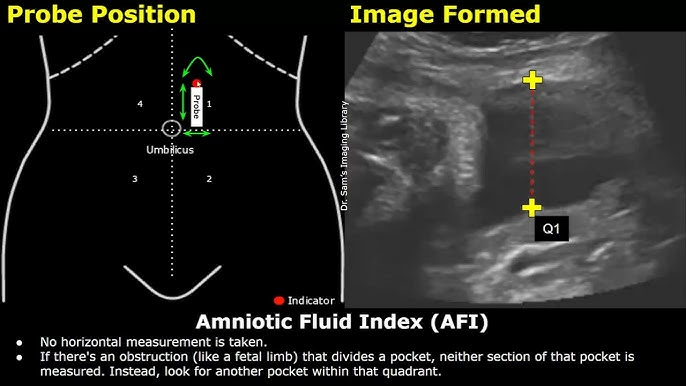
- Amniotic Fluid Index (AFI): This calculates the sum of the maximum vertical pocket diameters in each of the uterus's four quadrants, with <5 cm indicating oligohydramnios, >5 cm and <24 cm as normal, and ≥24 cm as polyhydramnios.
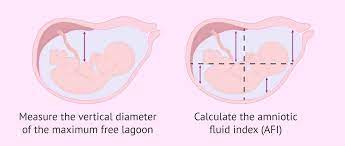
- Single Deepest Pocket (SDP): This measures the vertical dimension of the largest amniotic fluid pocket, setting thresholds for oligohydramnios (<2 cm), normal (≥2 cm and <8 cm), and polyhydramnios (≥8 cm).
Sources and Composition of Amniotic Fluid
- Early Gestation: Initially, the embryo is surrounded by the exocoelomic cavity and the amniotic cavity, with the fluid likely derived from maternal plasma and embryonic secretions.
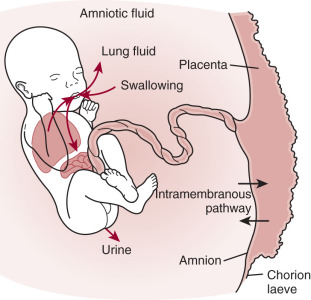
- Mid to Late Gestation: The major sources of AF production include fetal urine and lung liquid, with minor contributions from fetal oral and nasal secretions. Clearance mechanisms involve fetal swallowing and intramembranous pathways, with minor roles played by the transmembranous pathway.
- Daily Amniotic Volume Flows: Estimates suggest significant daily exchanges, including 800 to 1200 mL/day from fetal urine production and 500 to 1000 mL/day from fetal swallowing, highlighting the dynamic nature of AFV.
Normal Amniotic Fluid Volume Across Gestation
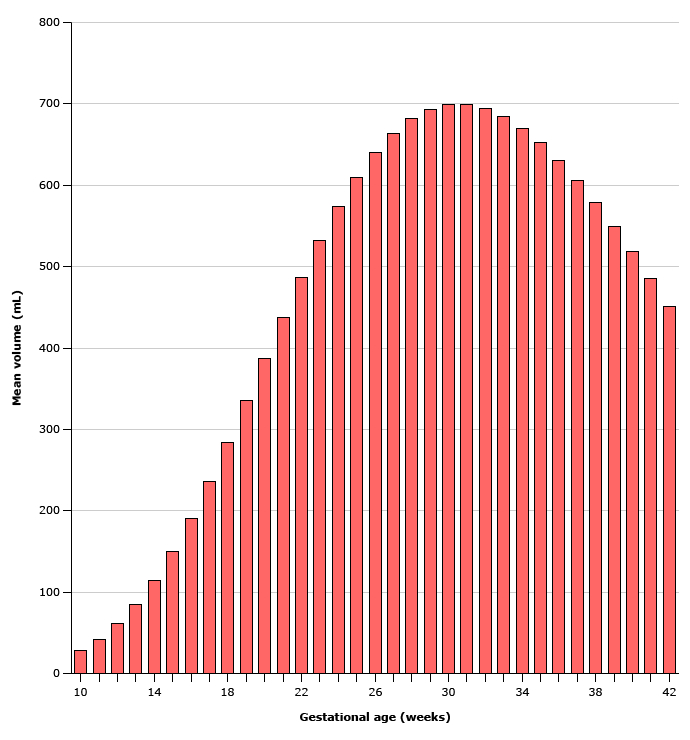
Studies indicate a characteristic pattern of AFV changes across gestation, with a progressive increase from 8 weeks, peaking at 34 weeks( 800 ml ) , and then declining. This pattern reflects the balance between fetal fluid production and consumption, with variations in the third trimester due to changes in fetal urine production and swallowing rates.
Conclusion
The assessment of AFV is a crucial component of prenatal care, offering valuable insights into fetal health and guiding the management of complex pregnancies. Through a combination of qualitative and semiquantitative ultrasound techniques, clinicians can effectively monitor and address abnormalities in AFV, ensuring optimal outcomes for both the mother and fetus.
احصل على التجربة الكاملة
اشترك للوصول لفيديوهات الشرح التفصيلي والبطاقات التعليمية التفاعلية وأسئلة الممارسة مع تتبع التقدم.