شرح المدرسين

Summary — الملخص
The esophagus is a specialized muscular conduit with four core jobs: (1) transport of food and liquid from the pharynx to the stomach, (2) maintenance of an antireflux barrier against retrograde gastric flow, (3) rapid clearance of any refluxed material, and (4) airway protection during swallowing.
Normal swallowing (deglutition) is a tightly coordinated neuromuscular sequence linking the cerebral cortex, the medullary swallowing center, cranial nerves V–XII, the pharyngeal muscles, the upper esophageal sphincter (UES), the esophageal body, the lower esophageal sphincter (LES), the diaphragm, and the stomach. It occurs roughly 600–1000 times per day, mostly unconsciously.
This lesson moves through the four phases of swallowing, esophageal peristalsis, LES neuromuscular control, and the antireflux barrier — then shows why small volumes of physiologic reflux are entirely normal, and how failure of these mechanisms produces the classic motility disorders (achalasia, diffuse esophageal spasm, GERD, and hiatal hernia).
Physiology of Swallowing (Deglutition)
Deglutition is the coordinated neuromuscular process that moves a bolus from the mouth to the stomach while simultaneously preventing three unwanted events: aspiration, nasal regurgitation, and uncontrolled esophageal reflux.
Swallowing proceeds through four sequential phases. The first two (oral) are voluntary; once the bolus reaches the oropharynx, the pharyngeal and esophageal phases become involuntary reflexes that cannot be consciously interrupted.
| PHASES OF SWALLOWING | ||
|---|---|---|
| Phase | Control | Duration |
| Oral preparatory | Voluntary | Variable |
| Oral propulsive | Voluntary | < 1 sec |
| Pharyngeal | Reflex (involuntary) | ≈ 1 sec |
| Esophageal | Reflex (involuntary) | 8–20 sec |
The Four Phases of Swallowing
I. Oral preparatory phase (voluntary)
Food is taken into the mouth, chewed (mastication), mixed with saliva, and shaped into a cohesive bolus on the dorsum of the tongue. The muscles of mastication (masseter, temporalis, medial and lateral pterygoids) work with the buccinator, orbicularis oris, and intrinsic tongue muscles. Saliva (1–1.5 L/day) provides lubrication, bolus cohesion, initial carbohydrate digestion via salivary amylase, and antibacterial protection.
II. Oral propulsive phase (voluntary)
The tongue presses against the hard palate and drives the bolus posteriorly into the oropharynx. Contact of the bolus with oropharyngeal sensory receptors triggers the involuntary swallowing reflex, transferring control to the brainstem.
III. Pharyngeal phase (reflex — the key protective phase)
Lasting ≈1 second, this phase is coordinated by the medullary swallowing center (nucleus tractus solitarius and nucleus ambiguus). Six events fire in a rapid, stereotyped sequence:
- Step 1: Soft palate elevates → closes the nasopharynx → prevents nasal regurgitation.
- Step 2: Larynx elevates and moves anteriorly.
- Step 3: Epiglottis folds posteriorly over the laryngeal inlet.
- Step 4: True and false vocal cords adduct → airway sealed.
- Step 5: Respiration briefly halts (deglutition apnea).
- Step 6: The upper esophageal sphincter (UES) relaxes → bolus enters the esophagus.
The UES is formed mainly by the cricopharyngeus muscle (resting tone ≈ 30–100 mmHg). It prevents air from entering the esophagus and blocks pharyngoesophageal reflux, relaxing only transiently to admit the bolus.
| Cranial Nerves in Swallowing | |
| CN V (trigeminal) | Mastication; sensation to anterior tongue |
| CN VII (facial) | Lip closure, salivation |
| CN IX (glossopharyngeal) | Sensory limb of the pharyngeal reflex |
| CN X (vagus) | Motor limb; peristalsis, LES relaxation |
| CN XI (accessory) | Pharyngeal / soft-palate musculature |
| CN XII (hypoglossal) | Tongue movement |
IV. Esophageal phase (reflex)
The bolus is delivered to the stomach by peristalsis — a reflex wave (detailed in the next section) that terminates in LES relaxation.
Esophageal Peristalsis & Muscle Physiology
The esophageal body has a defined muscular gradient: the upper third is striated (skeletal) muscle, the middle third is mixed, and the lower third is smooth muscle under autonomic control. Cortical voluntary control transitions to reflex control along this gradient.
Primary peristalsis
Initiated by a swallow. A single coordinated wave begins at the UES and sweeps the entire esophagus in ~8–10 seconds, ending in LES relaxation and bolus delivery into the stomach.
Secondary peristalsis
Triggered by esophageal wall distension from residual food or refluxate — without a new swallow. Its job is to clear retained material and return it to the stomach, and it is a key esophageal defense against reflux.
Tertiary contractions
Non-propulsive, simultaneous, disorganized contractions. They are not part of normal swallowing and are seen in the elderly ("presbyesophagus") and in esophageal dysmotility.
The Lower Esophageal Sphincter: Physiology & Neural Control
The LES is a physiologic high-pressure zone in the distal esophagus — not a discrete anatomic sphincter. Its resting pressure is normally 10–30 mmHg, which keeps it closed against intragastric pressure and prevents reflux at rest.
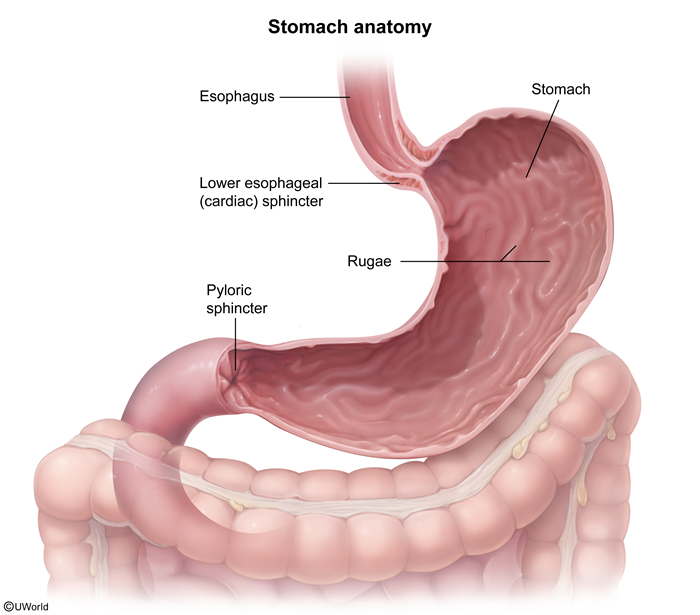
LES behavior during a swallow
A swallow triggers vagal stimulation, which releases the inhibitory transmitters nitric oxide (NO) and vasoactive intestinal peptide (VIP) onto LES smooth muscle. The result is an orderly sequence: vagal stimulation → NO + VIP release → LES relaxation → bolus enters the stomach → LES re-contracts → reflux prevented.
| Mnemonic – جملة تذكرية | |
|
"NO VIP gets in" — NO (nitric oxide) and VIP are the inhibitory transmitters that relax the LES so the bolus can enter the stomach. Excitatory ACh + Substance P then re-contract it to restore the barrier. |
جملة تذكرية |
Neural control
Central: the medullary swallowing center coordinates the UES, pharynx, esophageal body, and LES. Parasympathetic: the vagus nerve drives peristalsis, LES relaxation, and secretion. The enteric myenteric (Auerbach) plexus organizes the peristaltic wave locally.
| Enteric Neurotransmitters Controlling Esophageal Motility | ||
|---|---|---|
| Property | Excitatory neurons | Inhibitory neurons |
| Neurotransmitters | Acetylcholine, Substance P | Nitric oxide (NO), VIP |
| Effect on smooth muscle | Contraction | Relaxation |
| Functional role | Generate the peristaltic wave | LES + distal esophageal relaxation |
Physiologic Reflux & the Antireflux Barrier (Master Section)
Physiologic gastroesophageal reflux — small volumes of gastric contents normally reflux into the esophagus, mainly after meals and during transient LES relaxations. This is entirely normal and asymptomatic provided clearance is rapid and there is no mucosal injury.
The antireflux barrier
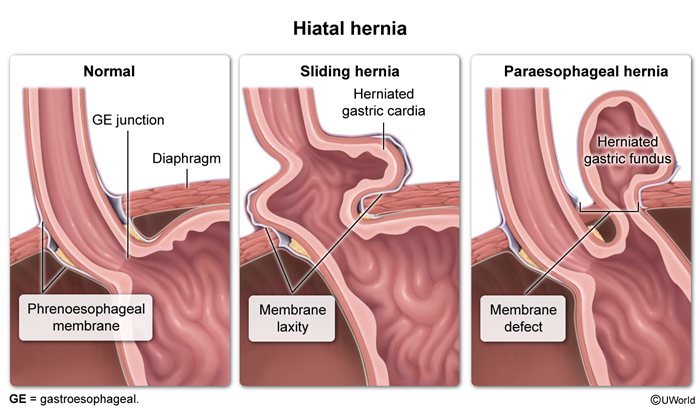
Reflux prevention depends on five complementary components acting together at the gastroesophageal junction. The illustration below contrasts the normal junction (GE junction below the diaphragm, intact phrenoesophageal membrane) with the hiatal hernias that dismantle this barrier.
| ANTIREFLUX BARRIER | |
|---|---|
| Component | Role in the antireflux barrier |
| LES (most important) | Tonic contraction; resting pressure 10–30 mmHg exceeds intragastric pressure |
| Diaphragmatic crura | External sphincter; contract on inspiration to pinch the distal esophagus |
| Intra-abdominal esophagus | 2–4 cm segment; positive abdominal pressure compresses the lumen — shortened / lost in hiatal hernia |
| Angle of His | Acute angle between esophagus and gastric fundus → flap-valve mechanism |
| Phrenoesophageal ligament |
Anchors the LES below the diaphragm |
| Mnemonic – جملة تذكرية | |
|
"A CLIP" seals the gastroesophageal junction — the five components of the antireflux barrier:
|
جملة تذكرية |
Transient LES relaxation (TLESR)
Most physiologic reflux episodes occur during transient LES relaxations — brief, vagally mediated relaxations that are independent of swallowing and triggered by gastric fundic distension. They permit belching (venting of swallowed gas) and allow occasional physiologic reflux.
| Exam Trap – فخ امتحاني | |
|
Transient LES relaxation (TLESR) — not a hypotensive baseline LES — is the principal mechanism of physiologic reflux. It is vagally mediated, independent of swallowing, and triggered by gastric fundic distension to permit belching. الارتخاء العابر للعضلة العاصرة المريئية السفلية (TLESR)، وليس انخفاض الضغط القاعدي للعضلة، هو الآلية الأساسية للارتجاع الفسيولوجي الطبيعي، ويحدث بعد الوجبات للسماح بالتجشؤ. |
تذكر |
Factors maintaining normal esophageal function
A competent system requires all of the following working together: an intact swallowing reflex, coordinated peristalsis, normal UES and LES resting tone, appropriate LES relaxation during swallowing, intact diaphragmatic crura, adequate salivary secretion, effective esophageal clearance, efficient gastric emptying, and competent gastroesophageal junction anatomy.
Esophageal Clearance & Mucosal Defense
Even when reflux occurs, injury is normally prevented by rapid clearance plus intrinsic mucosal resistance. Three overlapping mechanisms do this work:
Mechanical clearance
Primary peristalsis (swallow-induced) followed by secondary peristalsis (distension-induced, no new swallow) sweeps the bulk of refluxate back into the stomach within seconds.
Chemical clearance
Saliva neutralizes residual acid. It is rich in bicarbonate and also contains epidermal growth factor (EGF) and mucins that buffer and protect the mucosa — which is why swallowing (and therefore salivary delivery) is central to acid neutralization.
Mucosal defense
Normal esophageal mucosa resists brief acid contact through tight epithelial junctions, a surface mucus + bicarbonate layer, rapid epithelial regeneration, and adequate mucosal blood flow. When these defenses are overwhelmed by prolonged acid exposure, physiologic reflux crosses over into pathologic disease (GERD).
Physiologic vs Pathologic Reflux
Physiologic reflux crosses into pathologic disease (GERD) when acid exposure becomes excessive, the antireflux barrier fails, or clearance is impaired. The transition is promoted by a small set of high-yield, frequently tested factors:
- Delayed gastric emptying / large meals → high gastric volume and intragastric pressure
- Hiatal hernia → loss of the diaphragmatic pinch and shortening of the intra-abdominal esophagus
- Obesity → raised intra-abdominal pressure
- Pregnancy → raised intra-abdominal pressure plus hormonal LES relaxation
| Physiologic Reflux vs Pathologic Reflux (GERD) | ||
|---|---|---|
| Feature | Physiologic reflux | Pathologic reflux (GERD) |
| Frequency | Occasional | Frequent |
| Symptoms | None ('happy' after meals) | Heartburn, regurgitation |
| Mucosal injury | None | Esophagitis may develop |
| Acid exposure | Brief | Prolonged |
| Esophageal clearance | Normal | Impaired |
| LES | Normal, with transient relaxations | Hypotensive LES and/or excessive TLESRs |
| Treatment | None | Lifestyle changes, acid suppression, surgery in selected cases |
See the GERD pathophysiology and risk factors reference for how reduced LES tone and excessive transient relaxations translate into symptomatic reflux, its manifestations, and initial treatment.
Clinical Correlations
Each classic esophageal disorder maps onto failure of one physiologic step covered above. The illustration below compares the major motor and structural abnormalities against normal anatomy.
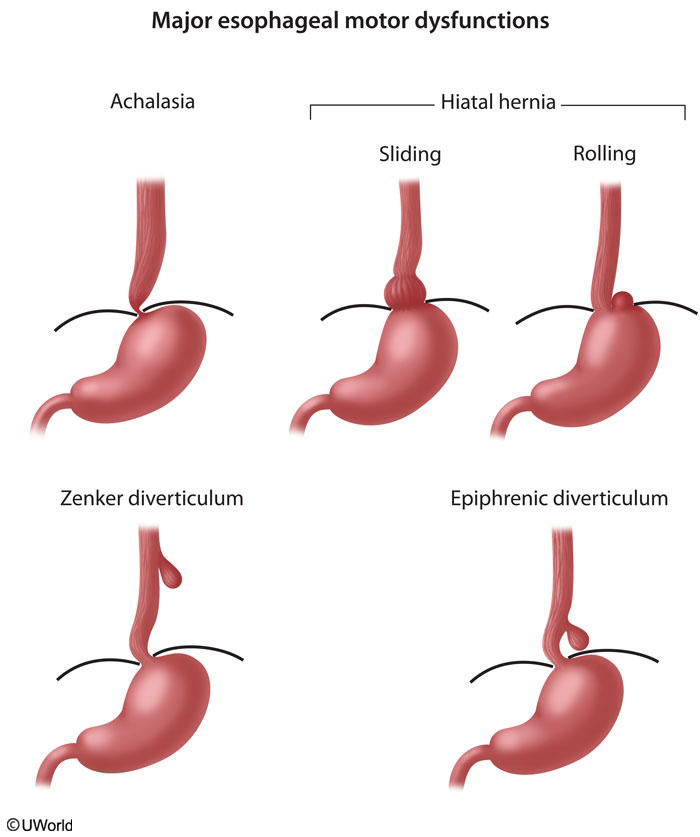
Achalasia
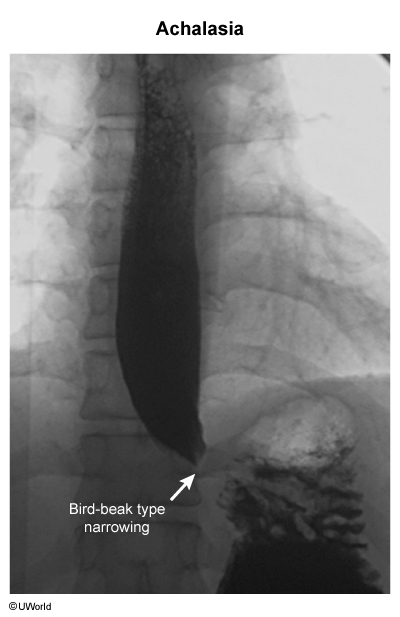
Failure of LES relaxation from selective loss of inhibitory (NO/VIP) myenteric neurons, combined with loss of esophageal peristalsis (aperistalsis). This produces ↑ resting LES pressure, a dilated esophagus, and progressive dysphagia to both solids and liquids. Barium swallow shows the classic "bird-beak" tapering at the GE junction; esophageal manometry confirms incomplete LES relaxation with aperistalsis.
| Exam Trap – فخ امتحاني | |
Achalasia = failure of LES relaxation from selective loss of inhibitory NO/VIP neurons in the myenteric (Auerbach) plexus, producing ↑ resting LES pressure and aperistalsis. The board answer is the loss of inhibitory neurons — not a mechanical obstruction. في الأكالازيا يكون سبب فشل ارتخاء العضلة العاصرة السفلية هو فقدان الخلايا العصبية المثبّطة المُفرِزة لأكسيد النيتريك (NO) والـ VIP في الضفيرة العضلية المعوية — وهي الآلية المطلوبة في الامتحان. |
تذكر |
Diffuse esophageal spasm
Simultaneous, non-propulsive (tertiary-type) contractions producing intermittent dysphagia and chest pain that can mimic cardiac pain; barium may show a "corkscrew" esophagus. The diffuse esophageal spasm summary lays out the manometry and 'corkscrew' esophagram findings alongside calcium-channel-blocker, nitrate, and tricyclic therapy.
GERD
Excessive acid reflux from an incompetent antireflux barrier and impaired esophageal clearance. Left unchecked, it may progress to erosive esophagitis, peptic stricture, and Barrett esophagus.
Hiatal hernia
Separation of the LES from the diaphragmatic hiatus with loss of the diaphragmatic pinch and shortening of the intra-abdominal esophagus → increased reflux (the sliding type illustrated above is the most common variant).
Mnemonics — جمل تذكرية
| Mnemonic – جملة تذكرية | |
The 4 P's of swallowing — the four phases in order:
|
جملة تذكرية |
| Mnemonic – جملة تذكرية | |
"A CLIP" seals the gastroesophageal junction — the five components of the antireflux barrier:
|
جملة تذكرية |
| Mnemonic – جملة تذكرية | |
"NO VIP gets in" — NO (nitric oxide) and VIP are the inhibitory transmitters that relax the LES so the bolus can enter the stomach. Excitatory ACh + Substance P then re-contract it to restore the barrier. |
جملة تذكرية |
Key Points for Exams — نقاط مهمة للامتحانات
- Swallowing has four phases: the two oral phases are voluntary; the pharyngeal and esophageal phases are reflex-mediated.
- The UES = cricopharyngeus (resting ≈ 30–100 mmHg); it blocks air entry and pharyngoesophageal reflux, relaxing transiently to admit the bolus.
- Primary peristalsis is swallow-initiated and delivers the bolus to the stomach; secondary peristalsis is triggered by esophageal distension and clears retained food or refluxate without a new swallow.
- The LES is a physiologic high-pressure zone (10–30 mmHg) that relaxes during swallowing via vagal NO + VIP release; excitatory ACh + Substance P restore its tone.
- The antireflux barrier = LES + diaphragmatic crura + intra-abdominal esophagus + angle of His + phrenoesophageal ligament (mnemonic "A CLIP").
- TLESRs are the principal mechanism of physiologic reflux (not a hypotensive baseline LES) and normally vent gastric gas (belching) after meals.
- Effective clearance — coordinated peristalsis plus bicarbonate-rich saliva — rapidly neutralizes and removes refluxate, preventing injury.
- GERD develops when the barrier fails, acid exposure is excessive, or clearance is impaired; complications include erosive esophagitis, peptic stricture, and Barrett esophagus.
- Achalasia = loss of inhibitory NO/VIP myenteric neurons → failed LES relaxation + aperistalsis → dysphagia to solids and liquids with a "bird-beak" barium esophagram.
احصل على التجربة الكاملة
اشترك للوصول لفيديوهات الشرح التفصيلي والبطاقات التعليمية التفاعلية وأسئلة الممارسة مع تتبع التقدم.