Summary
Intestinal motility disorders are conditions of impaired propulsion of intestinal contents caused by abnormal neuromuscular function of the gut without a fixed mechanical obstruction.
This lesson covers five entities: postoperative ileus (POI), acute colonic pseudo-obstruction (Ogilvie syndrome), chronic intestinal pseudo-obstruction (CIPO), colonic inertia, and Hirschsprung disease.
The single unifying rule to carry through every section: a functional motility disorder shows diffuse dilation, no transition point, and preserved rectal gas, whereas mechanical obstruction shows a discrete transition point with distal decompression.
Normal Intestinal Motility
Normal gut propulsion depends on coordinated interaction of four systems. Disruption of any one can produce ileus or pseudo-obstruction.
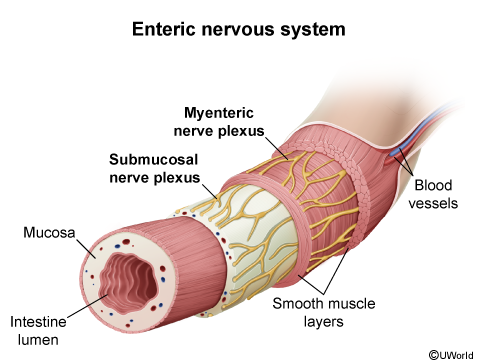
- Enteric nervous system (ENS) — the gut's intrinsic "brain":
- Myenteric (Auerbach) plexus — between the muscle layers; controls peristalsis and smooth-muscle contraction.
- Submucosal (Meissner) plexus — within the submucosa; controls secretion and local blood flow.
- Autonomic nervous system:
- Parasympathetic → stimulates motility and secretion.
- Sympathetic → inhibits motility and contracts sphincters.
- Smooth muscle function — requires intact muscle cells, normal electrolytes, and coordinated neuronal input.
- Gastrointestinal hormones — key regulators include motilin, serotonin, CCK, and gastrin.
Two recurring principles fall out of this anatomy: sympathetic overdrive (or parasympathetic withdrawal) stalls the gut, and electrolyte derangements paralyze smooth muscle — both are central to the functional disorders that follow.
Postoperative Ileus (POI)
Definition: temporary inhibition of gastrointestinal propulsion after surgery in the absence of a mechanical obstruction. POI is the most common cause of delayed GI recovery after abdominal surgery.
Pathophysiology
Four overlapping mechanisms suppress peristalsis:
- Neural reflex inhibition — surgical trauma activates the sympathetic system and spinal inhibitory reflexes, suppressing enteric neuronal activity.
- Inflammatory response — bowel manipulation activates macrophages, neutrophils, and mast cells, releasing TNF-α, IL-1β, IL-6, nitric oxide, and prostaglandins that suppress smooth muscle.
- Opioid-induced gut dysfunction — peripheral μ-opioid receptor binding reduces acetylcholine release, delays gastric emptying, slows transit, and increases fluid absorption.
- Electrolyte abnormalities — hypokalemia, hypomagnesemia, and hyponatremia impair smooth-muscle contraction.
Risk factors (highest-yield)
- Surgical: open surgery, extensive bowel manipulation, peritonitis.
- Patient: advanced age, sepsis.
- Medication: opioids (chief culprit), anticholinergics.
Normal recovery of bowel function
| Normal Recovery of Bowel Function After Abdominal Surgery | |
|---|---|
| Small bowel | |
| Recovery time | Clinical note |
| 6–24 hours | First segment to regain motility |
| Stomach | |
| Recovery time | Clinical note |
| 24–48 hours | Gastric emptying normalizes next |
| Colon | |
| Recovery time | Clinical note |
| 48–72 hours | Last to recover; return of flatus/stool marks resolution |
Persistence of symptoms beyond these windows defines prolonged POI.
| Recovery order of bowel function — "SSC" | |
|
Small bowel (6–24 h) → Stomach (24–48 h) → Colon (48–72 h). Small bowel sprints back first; the colon is the slowpoke that recovers last — return of flatus/stool signals resolution. |
جملة تذكرية |
| Note | |
| جملة تذكرية: الـ small bowel أول واحد بيصحى، والـ colon آخر واحد بيرجع يشتغل. | ملاحظة |
Clinical presentation
Abdominal distention, nausea, vomiting, delayed passage of flatus/stool, and inability to tolerate oral intake.
The abdomen is distended and tympanitic with absent or hypoactive bowel sounds — unlike SBO, high-pitched sounds are uncommon.
Diagnosis
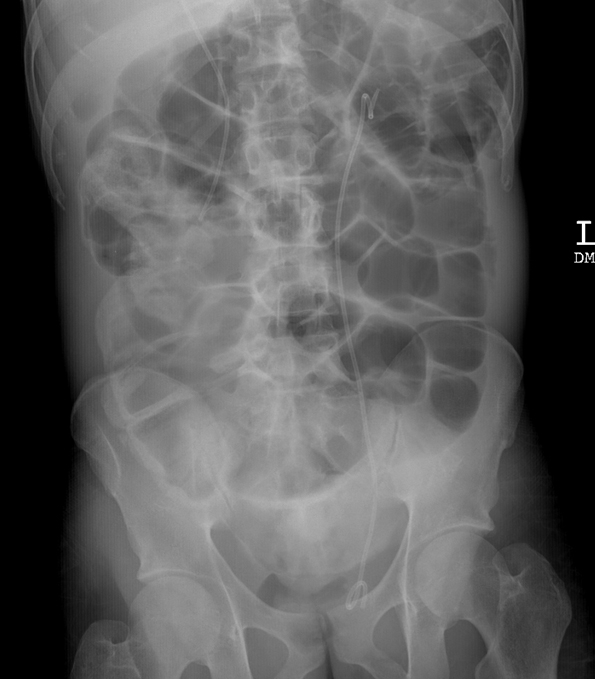
Serum: check electrolytes, renal function, and leukocytosis (screen for underlying sepsis). Imaging: abdominal radiograph shows diffuse gaseous distention of small bowel and colon with gas preserved in the rectum; CT (for prolonged symptoms or to exclude obstruction) shows diffuse dilation with no transition point.
| Important – فكرة سؤال | |
|
New enteral-feeding intolerance + abdominal distention + reduced bowel sounds in a febrile, tachycardic post-op or burn patient points to sepsis-induced ileus — an end-organ sign of hypoperfusion, not a primary GI problem. Treat the underlying sepsis, don’t just decompress the gut. |
تذكر |
Ileus vs mechanical small bowel obstruction
| Ileus vs Mechanical Small Bowel Obstruction | ||
|---|---|---|
| Feature | Ileus | Mechanical SBO |
| Pain | Mild, constant | Colicky |
| Bowel sounds | Absent / hypoactive | Hyperactive early |
| Transition point | Absent | Present |
| Colon gas | Present | Minimal |
| Rectal gas | Present | Usually absent |
See the Small Bowel Obstruction vs Ileus comparison table for the full breakdown of etiology, bowel sounds, and the presence or absence of large-bowel dilation that separate the two.
| فخ امتحاني – Exam Trap | |
|
فخ امتحاني: دايماً تذكر إن الـ transition point على الـ CT scan هو اللي بيحسم التشخيص وبفرّق الـ mechanical SBO عن الـ paralytic ileus؛ بالـ ileus بيكون في gas موزّع على كل الأمعاء لَحدّ الـ rectum بدون transition point. |
ملاحظة |
Treatment
Supportive care is the mainstay: NPO, IV fluids, electrolyte correction, opioid minimization, and early ambulation.
Nasogastric decompression is reserved for severe vomiting or significant distention — routine NG tubes are no longer recommended.
Enhanced Recovery After Surgery (ERAS) — early mobilization and feeding, opioid-sparing analgesia, and laparoscopic technique — significantly reduces POI.
Alvimopan (a peripheral μ-opioid receptor antagonist) accelerates GI recovery and shortens hospitalization without reversing central analgesia.
| ملاحظة سريرية – Clinical Note | |
|
Clinical note: Opioids are major culprits in POI; therefore, opioid-sparing analgesia is preferred. |
ملاحظة |
Acute Colonic Pseudo-Obstruction (Ogilvie Syndrome)
Definition: massive colonic dilatation without mechanical obstruction, most prominent in the cecum and right colon.
Pathophysiology
Believed to result from autonomic dysfunction — increased sympathetic tone plus decreased parasympathetic activity → colonic atony → progressive colonic dilation.
Risk factors (highest-yield)
- Surgical / trauma: orthopedic and pelvic surgery, major trauma.
- Medical: MI or stroke, sepsis.
- Metabolic: electrolyte abnormalities.
Clinical presentation
Progressive abdominal distention with mild pain, nausea, and constipation.
Examination shows a markedly distended abdomen with minimal tenderness — peritoneal signs signal ischemia or perforation.
Diagnosis
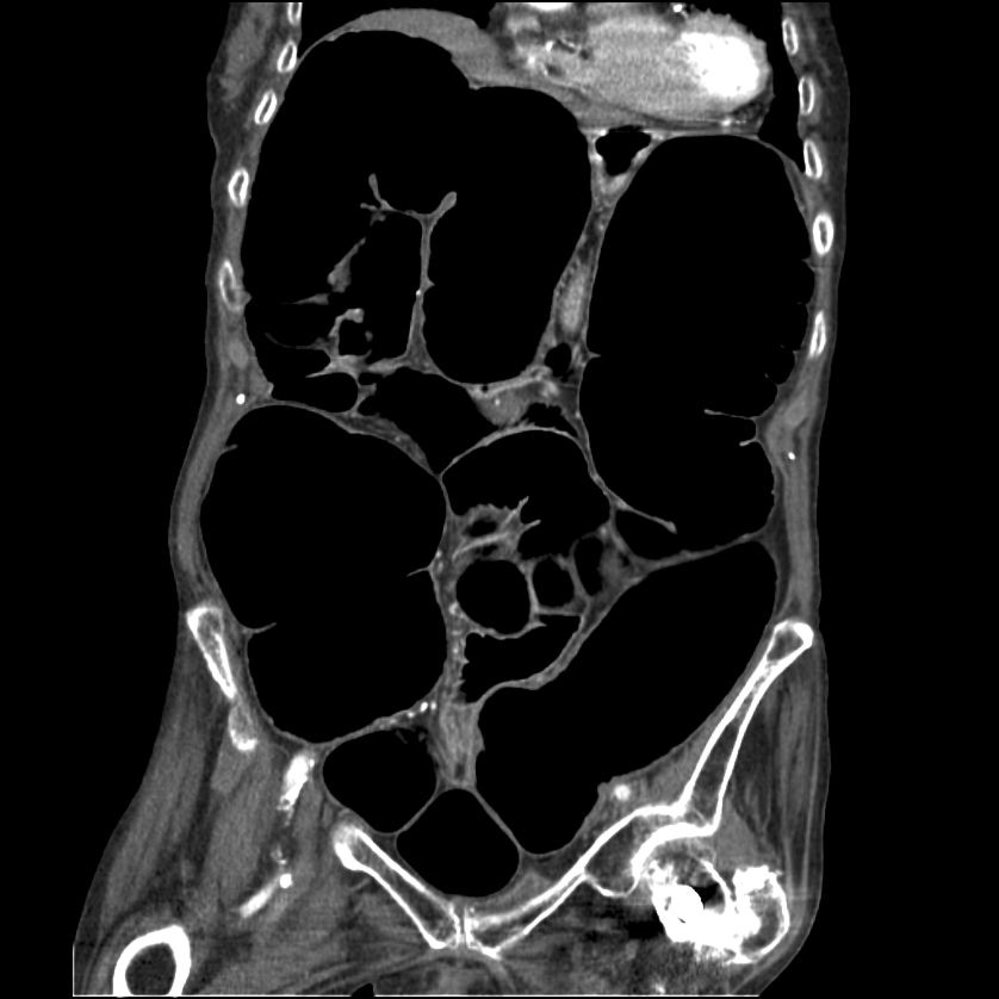
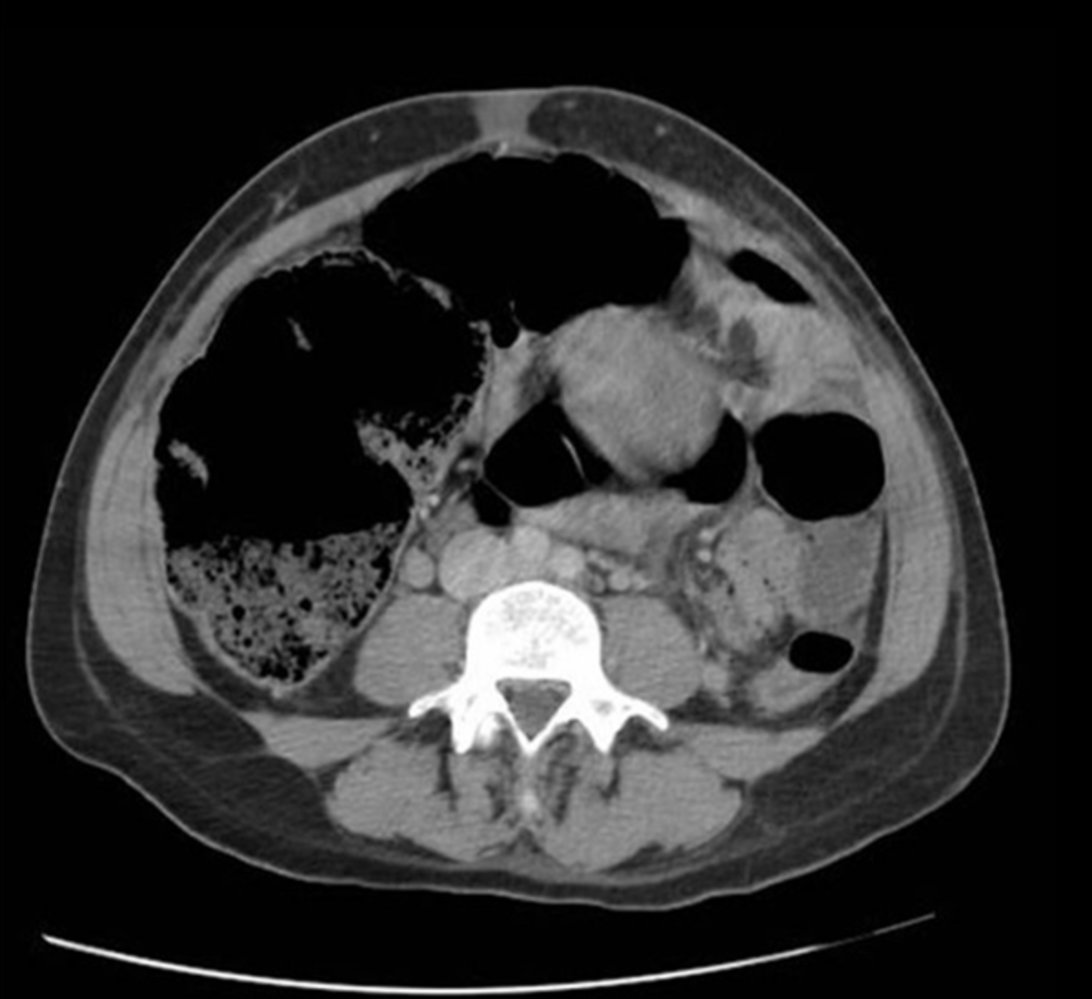
Imaging: abdominal X-ray shows massive colonic dilation, most prominent at the cecum. CT is used to exclude mechanical obstruction, volvulus, and tumor (no transition point in Ogilvie).
Complications
Cecal ischemia and perforation. Risk rises sharply when cecal diameter >12 cm or distention persists >6 days.
| ملاحظة سريرية – Clinical Note | |
|
ملاحظة سريرية: أول ما تشوف الـ cecal diameter صار أكثر من 12 cm، لازم تخاف من الـ perforation وتفكّر بالـ intervention فوراً (neostigmine أو colonoscopic decompression). |
ملاحظة |
Treatment
- Step 1 — Conservative (stable patients): NPO, IV fluids, correct electrolytes, stop narcotics. Escalate if dilation persists.
- Step 2 — Neostigmine: an acetylcholinesterase inhibitor that raises acetylcholine to stimulate colonic motility; success rate >80% for persistent dilation without perforation.
- Step 3 — Colonoscopic decompression: when neostigmine fails or is contraindicated.
- Step 4 — Surgery: for ischemia, perforation, or failed decompression.
| Important – فكرة سؤال | |
|
Neostigmine is the first-line pharmacologic therapy for Ogilvie syndrome that fails conservative measures (success rate >80%). Give it only after mechanical obstruction and perforation are excluded, with continuous cardiac monitoring at the bedside — it can cause profound bradycardia, so keep atropine ready. |
تذكر |
Chronic Intestinal Pseudo-Obstruction (CIPO)
Chronic intestinal pseudo-obstruction (CIPO)
Definition: a syndrome of recurrent intestinal obstruction from severe neuromuscular dysfunction without a mechanical lesion.
Pathophysiology falls into two categories:
- Neuropathic — damage to enteric neurons (e.g., Parkinson disease, diabetes, Hirschsprung disease).
- Myopathic — damage to smooth muscle (e.g., scleroderma, muscular dystrophy).
Presentation: chronic abdominal distention, pain, nausea, vomiting, weight loss, and malnutrition.
Diagnosis: Imaging demonstrates diffuse bowel dilation without an obstructing lesion; manometry may reveal abnormal motility patterns.
Therapy:
- Nutritional support (enteral nutrition preferred; TPN if severe)
- Prokinetic agents (metoclopramide, erythromycin).
Surgery has a limited role because disease is diffuse.
Colonic Inertia
Colonic inertia
Definition: severe slow-transit constipation caused by impaired colonic motor activity.
Pathophysiology: reduced high-amplitude propagated contractions → delayed stool transport → chronic constipation.
Presentation: severe constipation, bloating, and infrequent bowel movements.
Diagnosis: a colonic transit study shows radiopaque markers retained throughout the colon.
Therapy: fiber, osmotic and stimulant laxatives; for refractory disease, total abdominal colectomy with ileorectal anastomosis.
Hirschsprung Disease
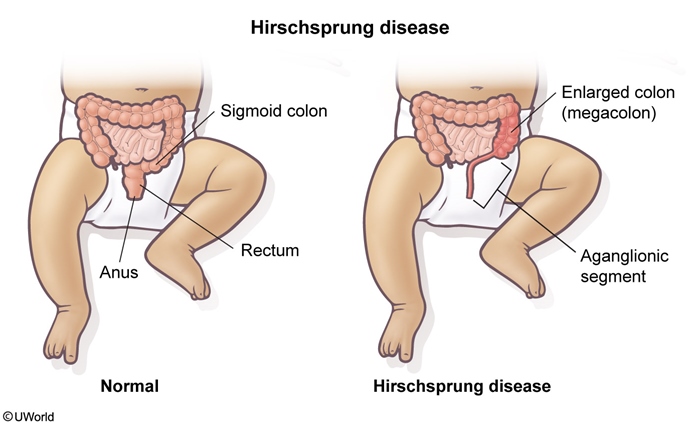
Definition: congenital absence of ganglion cells in the distal bowel causing functional obstruction.
Pathophysiology
Failure of neural crest cell migration during embryogenesis → aganglionosis of the Auerbach and Meissner plexuses → persistent contraction of the affected segment → functional obstruction with proximal dilation (megacolon).
Clinical presentation
Neonates present with the classic triad below. Older children present with chronic constipation, failure to thrive, and recurrent enterocolitis.
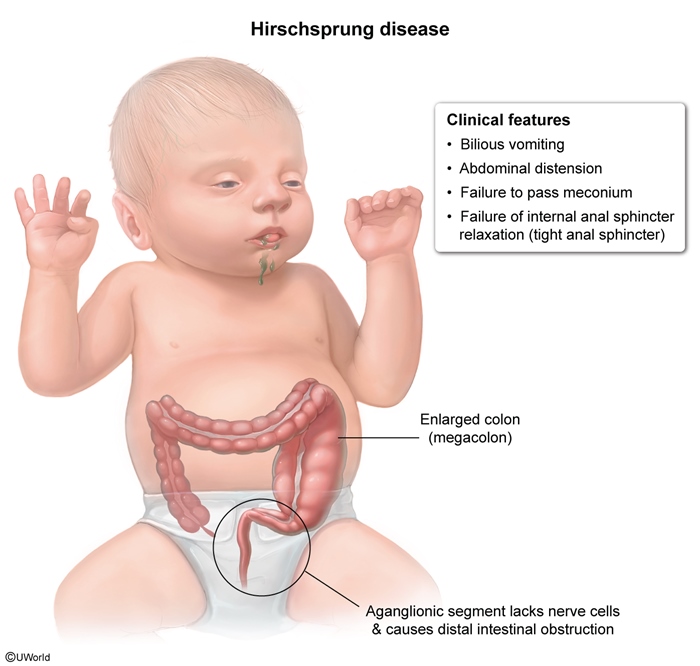
| Hirschsprung neonatal triad — "MDB" | |
|
Meconium not passed within 48 h + abdominal Distention + Bilious vomiting. |
جملة تذكرية |
Diagnosis
Imaging: a contrast enema shows a transition zone — a narrow distal (aganglionic) segment abruptly widening into dilated proximal colon.
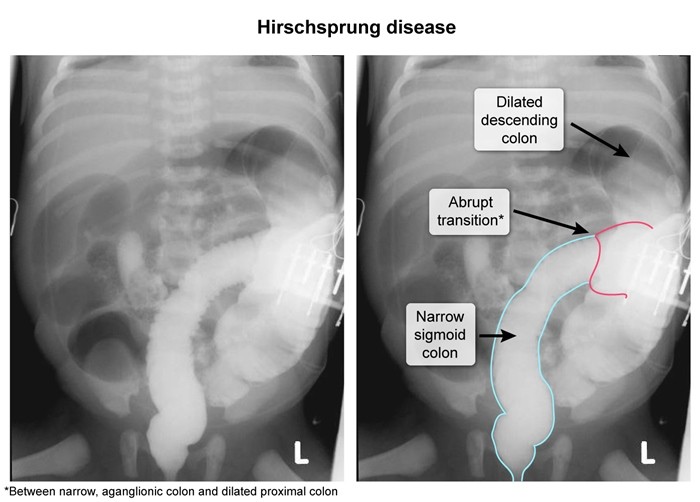
Biopsy (gold standard): rectal suction biopsy shows absence of ganglion cells with hypertrophied nerve trunks.
| فخ امتحاني – Exam Trap | |
|
Exam Trap: Although contrast enema demonstrates the transition zone, the gold standard for diagnosis is rectal suction biopsy showing absence of ganglion cells—do not select enema as the definitive diagnostic test. |
ملاحظة |
Treatment
Definitive treatment is a surgical pull-through procedure: resection of the aganglionic segment with anastomosis of normal bowel to the anus.
See the Differentiating Features of Hirschsprung Disease and Meconium Ileus Comparison Table.
Key Points for Exams – نقاط مهمة للامتحانات
- Most common motility disorder after abdominal surgery = postoperative ileus.
- Bowel recovery order: small bowel recovers first (6–24 h), colon last (48–72 h) — mnemonic SSC.
- Opioids are a major contributor to POI; alvimopan is a peripheral μ-opioid receptor antagonist used to reduce it.
- Ogilvie syndrome = acute colonic pseudo-obstruction with predominant cecal dilation.
- Neostigmine is the first-line pharmacologic treatment for Ogilvie syndrome (after excluding perforation).
- Cecal diameter >12 cm (or distention >6 days) predicts perforation risk.
- Hirschsprung disease is diagnosed by rectal biopsy showing absence of ganglion cells (gold standard); the neonatal triad is MDB — Meconium delay, Distention, Bilious vomiting.
- CT is the best imaging study to differentiate ileus from mechanical obstruction — look for the transition point.
| High-Yield Summary Table | ||||
|---|---|---|---|---|
| Disorder | Pathophysiology | Presentation | Diagnosis | Treatment |
| Postoperative ileus | Neural, inflammatory, opioid-mediated inhibition | Distention, nausea, absent bowel sounds | X-ray, CT | Supportive care, ERAS, alvimopan |
| Ogilvie syndrome | Autonomic dysfunction causing colonic atony | Massive distention | X-ray, CT | Neostigmine, decompression |
| CIPO | Neuromuscular dysfunction | Chronic obstruction symptoms | Imaging, manometry | Nutrition, prokinetics |
| Colonic inertia | Slow-transit colon | Severe constipation | Transit study | Colectomy if refractory |
| Hirschsprung disease | Congenital aganglionosis | Neonatal obstruction | Rectal biopsy | Pull-through surgery |
| Important – فكرة سؤال | |
|
The one discriminator that decides the whole vignette: a transition point means mechanical obstruction; diffuse dilation with preserved rectal gas and no transition point means a functional disorder (ileus / pseudo-obstruction). Functional disease is managed conservatively — reserve surgery for ischemia, perforation, or failed decompression. |
تذكر |
احصل على التجربة الكاملة
اشترك للوصول لفيديوهات الشرح التفصيلي والبطاقات التعليمية التفاعلية وأسئلة الممارسة مع تتبع التقدم.