SUMMARY
Crohn's disease (CD) is a chronic, relapsing, transmural inflammatory bowel disease (IBD) that can affect any part of the GI tract from mouth to anus, most commonly the terminal ileum. It is defined by segmental ("skip") lesions and full-thickness inflammation that progressively damages the bowel, producing fibrosis, strictures, fistulas, abscesses, and perforation.
- Etiology (Rule of 3):
1. genetic susceptibility (NOD2/CARD15) + 2. environmental trigger (smoking — the strongest modifiable factor) + 3. a dysregulated Th1/Th17 immune response driven by TNF-α. - Hallmarks: skip lesions, transmural inflammation, cobblestone mucosa, creeping fat, and noncaseating granulomas.
- Presentation: chronic (usually non-bloody) diarrhea, RLQ crampy pain, weight loss, and perianal disease.
- Diagnosis: ileocolonoscopy with biopsy (first-line) + CT/MR enterography for transmural disease and complications.
- Management: step-up medical therapy to induce and maintain remission; surgery treats complications but is not curative.
Definition
Definition
Crohn's disease is a chronic, relapsing, transmural inflammatory bowel disease that may involve any segment of the GI tract from mouth to anus.
It is characterized by:
- Segmental ("skip") lesions
- Transmural inflammation
- Progressive bowel damage leading to fibrosis, strictures, fistulas, abscesses, and perforation.
| Distribution in Crohn's Disease | |
|---|---|
| Location / Pattern | Frequency & Characteristics |
| Terminal ileum | Single most affected site |
| Ileocolic pattern | Most common overall pattern |
| Colon | Common involvement |
| Jejunum | Less frequent |
| Upper GI tract | Less frequent |
| Isolated perianal disease | Progressively less frequent; strong clinical clue |
Key point: unlike ulcerative colitis, Crohn's disease is not cured by surgery because inflammation may recur in previously normal bowel segments.
| ملاحظة سريرية – Clinical Note | |
| Surgery in Crohn's disease never provides a cure because inflammation can recur in any location due to skip lesions. | ملاحظة |
Epidemiology
| Epidemiology | |
|---|---|
| Feature | Description |
| Peak age | 15–35 years (second peak 50–70 years) |
| Sex | Equal male : female distribution |
| Geography | Higher in North America and Northern Europe |
| Family history | Present in 10–20% of patients |
| Smoking | Strongest environmental risk factor; worsens disease and post-operative recurrence |
Epidemiology
| Epidemiology | |
|---|---|
| Feature | Description |
| Peak age | 15–35 years (second peak 50–70 years) |
| Sex | Equal male : female distribution |
| Geography | Higher in North America and Northern Europe |
| Family history | Present in 10–20% of patients |
| Smoking | Strongest environmental risk factor; worsens disease and post-operative recurrence |
Etiology & Pathophysiology
Crohn's disease results from the interaction of three forces — a useful "Rule of 3" for etiology and risk factors:
- Genetic susceptibility. Over 200 loci are implicated, but the highest-yield gene is NOD2/CARD15 (with ATG16L1 and IL23R). These regulate bacterial recognition, autophagy, and innate immunity; loss of function → defective clearance of luminal bacteria and persistent mucosal immune activation.
- Environmental trigger. Smoking is the single most important modifiable factor — it worsens disease severity and drives post-operative recurrence. (Note the paradox: smoking harms Crohn's but is protective in ulcerative colitis.)
- Dysregulated immune response. A predominantly Th1 / Th17 reaction sustains chronic inflammation, with TNF-α as the pivotal effector cytokine (alongside IL-12 and IL-23). This axis drives macrophage activation, granuloma formation, tissue destruction, and fibrosis — and is the direct target of biologic therapy.
Two downstream features define the phenotype:
- Transmural inflammation — involvement of the full bowel-wall thickness produces deep linear ulcers, fissures, fibrosis, muscular hypertrophy, strictures, fistulas, abscesses, and perforation.
- Skip lesions — inflamed segments alternate with normal bowel, a hallmark that distinguishes CD from the continuous involvement of ulcerative colitis.
| Important – فكرة سؤال | |
| A classic vignette shows skip lesions on CT with biopsy revealing noncaseating granulomas and asks which molecule to target — the answer is TNF-α (infliximab / adalimumab). | تذكر |
Pathological Hallmarks (Gross & Histology)
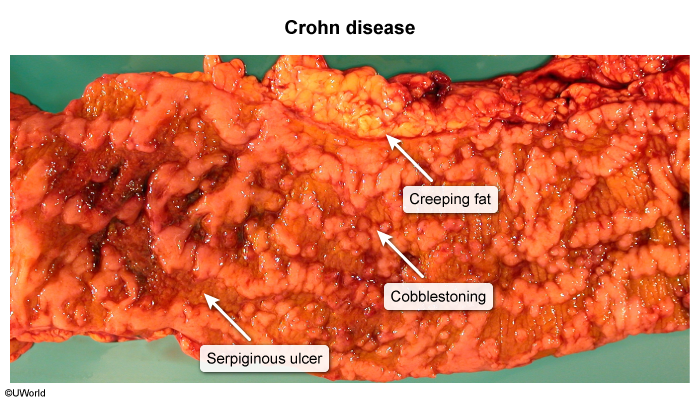
Gross pathology evolves along a characteristic sequence: Aphthous Ulcer → deep longitudinal ulcers → Cobblestone Mucosa → Bowel wall thickening → creeping fat → fibrotic strictures.
Creeping fat — mesenteric fat wrapping around the inflamed bowel — is highly characteristic of Crohn's disease.
Histology reflects the transmural, granulomatous nature of the disease:
- Transmural inflammation with lymphoid aggregates
- Fissuring ulcers, fibrosis, and neural hypertrophy
- Noncaseating granulomas — present in only 25–50% of cases
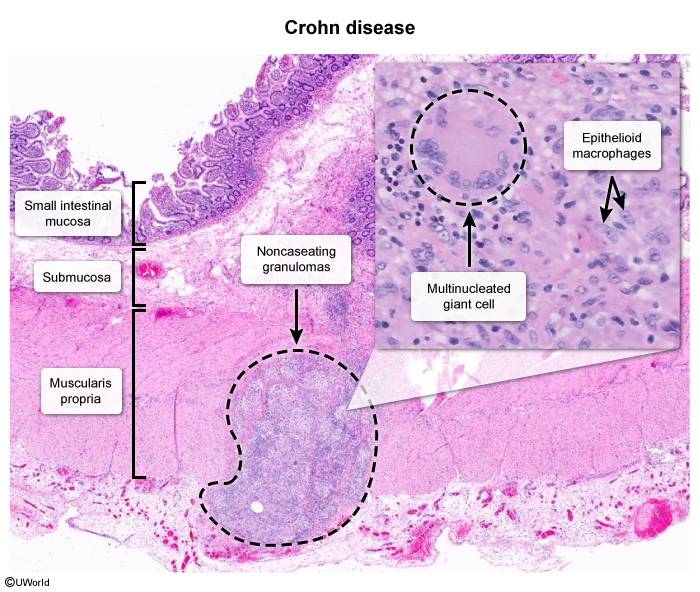
Exam pearl: the absence of granulomas does not exclude Crohn's disease. For the full quick-reference, see the Crohn disease feature summary covering skip lesions, transmural inflammation, cobblestoning, creeping fat, fistulae, and strictures.
| Crohn's gross & micro hallmarks — "Skip To Cobblestone Cafés for Granola" | |
|
جملة تذكرية |
| فخ امتحاني – Exam Trap | |
|
Always associate creeping fat and transmural inflammation with Crohn's disease — these findings are impossible to see in UC, and absence of granulomas does not exclude the diagnosis.
|
تذكر |
Clinical Presentation, Complications & Extraintestinal Manifestations
Presentation depends on disease location and complications.
- Intestinal symptoms:
- chronic diarrhea (usually non-bloody; may be bloody with colonic disease),
- crampy RLQ pain (often postprandial),
- weight loss (malabsorption + reduced intake + increased metabolic demand), fatigue, and fever. - Obstructive symptoms (from fibrotic strictures): colicky pain, nausea, vomiting, and distention.
- Perianal disease (up to one-third of patients): skin tags, fissures, perianal fistulas, and abscesses. Perianal disease strongly suggests Crohn's over ulcerative colitis.
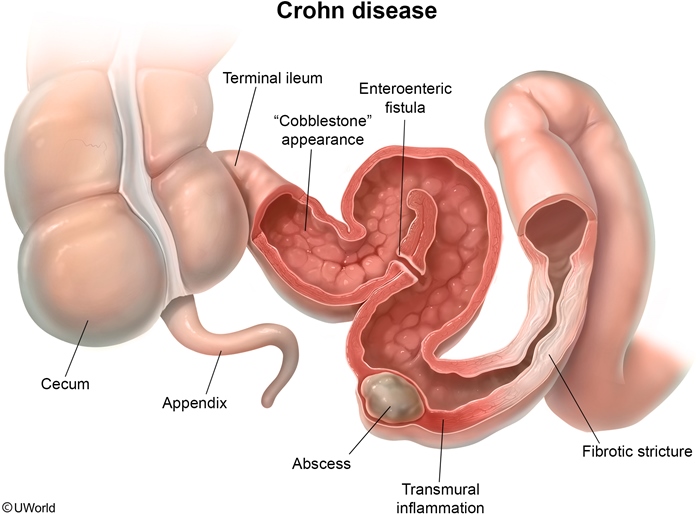
Fistulas: Transmural inflammation predisposes to enteroenteric, enterovesical, enterovaginal, enterocutaneous, and perianal fistulas.
Clues include pneumaturia, fecaluria, recurrent UTIs, and persistent cutaneous drainage.
Complications:
Intestinal: strictures, small-bowel obstruction, perforation, intra-abdominal abscess, fistulas, malnutrition, and short bowel syndrome after repeated resections.
Malignancy: increased risk of small-bowel adenocarcinoma and colorectal cancer (with long-standing colonic involvement).
| Important – فكرة سؤال | |
| Terminal ileal disease (or resection) impairs vitamin B12 and bile-salt absorption → macrocytic anemia and, if untreated, subacute combined degeneration of the spinal cord. Bile-salt malabsorption also drives gallstones and calcium-oxalate renal stones. |
تذكر |
| Extraintestinal Manifestations of Crohn Disease | |
| Musculoskeletal | Most common EIM group |
| Peripheral arthritis | Parallels bowel activity |
| Sacroiliitis/ Ankylosing spondylitis | Axial; independent of bowel activity, HLA-B27 linked |
| Skin | Dermatologic |
| Erythema Nodosum | Tender red shin nodules; tracks disease activity |
| Pyoderma gangrenosum | Ulcerating lesion; independent of activity |
| Eyes | Ophthalmologic |
| Episcleritis | Tracks bowel activity |
| Uveitis | Independent of bowel activity |
| Hepatobiliary | Liver / biliary |
| Primary sclerosing cholangitis | Less common than in ulcerative colitis |
| Gallstones | From bile-salt malabsorption in ileal disease |
| Renal | Stones |
| Calcium oxalate stones | Enteric hyperoxaluria from fat malabsorption |
| Uric acid stones | Volume depletion / chronic diarrhea |
Diagnosis & Differential (CD vs UC)
Diagnosis combines laboratory, endoscopic, imaging, and histologic data.
- Serum: elevated CRP and ESR, anemia, leukocytosis, hypoalbuminemia; vitamin B12 deficiency (terminal ileal disease) and iron deficiency.
- Stool: elevated fecal calprotectin and lactoferrin (marker of mucosal inflammation; rule out infection).
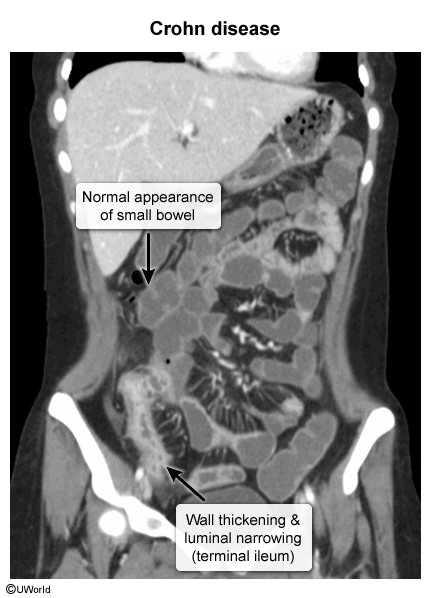
- Endoscopy — first-line: ileocolonoscopy with biopsy shows aphthous and longitudinal ulcers, cobblestoning, skip lesions, and frequent rectal sparing. Biopsy both affected and normal-appearing mucosa.
- Imaging — preferred cross-sectional study: CT or MR enterography reveals bowel-wall thickening, mucosal hyperenhancement, mesenteric fat stranding, fistulas, abscesses, and strictures.
- Histology: transmural inflammation, lymphoid aggregates, fissuring ulcers, and noncaseating granulomas (when present).
Differential diagnosis: Crohn Disease vs Ulcerative Colitis
The single most tested differential is CD versus ulcerative colitis. The following is a Medical Comparison of the discriminating features:
| Crohn Disease vs Ulcerative Colitis | ||
|---|---|---|
| Feature | Crohn Disease | Ulcerative Colitis |
| Distribution | Mouth → anus (terminal ileum most common) | Colon only |
| Rectum | Often spared | Always involved |
| Pattern | Skip lesions | Continuous |
| Inflammation | Transmural | Mucosal / submucosal |
| Granulomas | May be present (25–50%) | Absent |
| Fistulas | Common | Rare |
| Strictures | Common | Rare |
| Perianal disease | Common | Uncommon |
| Toxic megacolon | Less common | More common |
| Surgery | Not curative | Curative (proctocolectomy) |
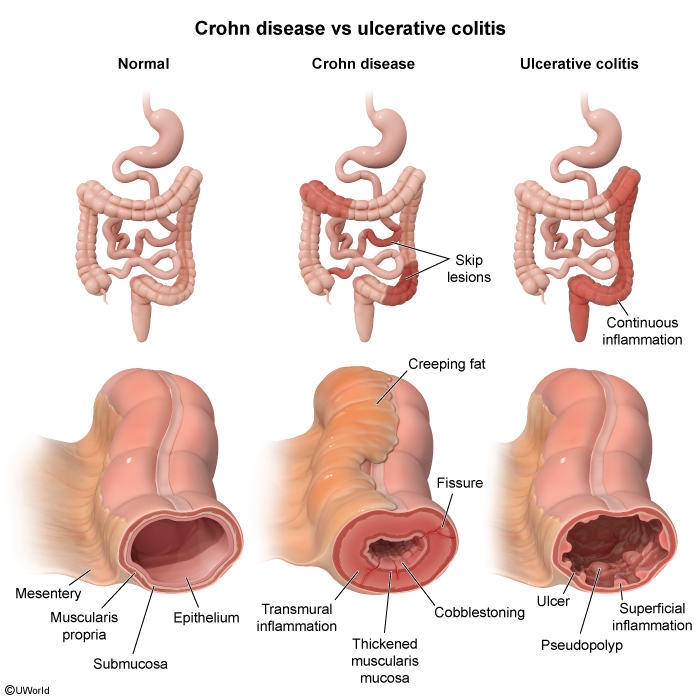
See the Crohn disease vs ulcerative colitis comparison for the full breakdown across anatomy, microscopy, gross findings, clinical features, and complications.
Management & Prognosis
Goals: induce remission, maintain remission, prevent complications, avoid surgery where possible, and improve quality of life.
Medical therapy — step-up progression
Step 1 — Mild disease:
- budesonide (oral controlled-ileal-release 9 mg daily) is preferred for localized ileocecal disease because of high first-pass metabolism and few systemic effects.
- Aminosalicylates (5-ASA/mesalamine) have a limited role in Crohn's and are not recommended for induction or maintenance in current guidance.
Step 2 — Moderate–severe disease:
- Systemic corticosteroids (e.g., prednisone ~40 mg/day, then taper) to induce remission — never for long-term maintenance.
- Add a steroid-sparing immunomodulator for maintenance: azathioprine or 6-mercaptopurine, or methotrexate.
Step 3 — Biologics (moderate–severe or fistulizing disease):
- anti-TNF agents infliximab (5 mg/kg IV at weeks 0, 2, 6 then every 8 weeks) or adalimumab; anti-integrin vedolizumab; or anti-IL-12/23 ustekinumab.
Antibiotics (metronidazole, ciprofloxacin) are reserved mainly for perianal disease and intra-abdominal abscess.
Surgical therapy — decision framework
Principle: surgery treats complications but does not cure Crohn's disease; bowel preservation is the central goal because recurrence is common.
- Obstruction (most common indication) — usually a fibrotic stricture.
- Perforation — emergency surgery.
- Abscess — percutaneous drainage if feasible, delayed resection if needed.
- Fistula — operate if symptomatic, medically refractory, or associated with sepsis.
- Massive hemorrhage, and cancer/dysplasia (oncologic resection).
- Failure of optimized medical therapy.
Procedures:
- Ileocecal resection — most common operation; indicated for terminal ileal disease.
- Segmental small-bowel resection — for localized disease and fibrotic strictures.
- Stricturoplasty — preferred for multiple short fibrotic strictures in patients at risk for short bowel syndrome because it preserves bowel length; contraindicated with perforation, phlegmon, cancer, or severe active inflammation.
- Percutaneous abscess drainage — often performed before definitive surgical resection.
- Diversion/stoma — reserved for severe perianal disease, sepsis, or complex fistulas.
| ملاحظة سريرية – Stricturoplasty | |
| بنفضل نعمل stricturoplasty للمرضى اللي عندهم multiple strictures عشان نحافظ على الـ bowel length ونمنع الـ short bowel syndrome. | ملاحظة |
Post-operative recurrence & prognosis
Recurrence is common — endoscopic recurrence often within 1 year and clinical recurrence within 5 years.
Risk factors: smoking, penetrating disease, young age at diagnosis, and multiple prior resections.
Approximately 70–80% of patients require surgery during their lifetime, and many need more than one operation.
Poor-prognosis features include young age at onset, extensive small-bowel involvement, perianal disease, penetrating phenotype, smoking, and early corticosteroid need. Modern biologic therapy and multidisciplinary care improve symptom control and reduce steroid exposure and hospitalization, but lifelong surveillance is usually required.
Key Points for Exams
High-yield surgical pearls — نقاط مهمة للامتحانات:
- The terminal ileum is the most common site of Crohn's disease.
- Transmural inflammation explains fistulas, abscesses, strictures, and perforation.
- Skip lesions, cobblestoning, creeping fat, and longitudinal ulcers are the classic gross findings.
- Noncaseating granulomas support the diagnosis but are absent in many patients (present in only 25–50%).
- CT or MR enterography is preferred for evaluating transmural disease and complications.
- Medical therapy induces and maintains remission; corticosteroids are for induction, not maintenance.
- Surgery is indicated for complications — obstruction, perforation, abscess, fistula, hemorrhage, dysplasia/cancer, or refractory disease.
- Ileocecal resection is the most common operation.
- Stricturoplasty preserves bowel length and is useful for multiple fibrotic strictures.
- Smoking is the strongest modifiable risk factor for disease progression and post-operative recurrence.
- Crohn's disease recurs after surgery, making bowel preservation a central surgical principle.
احصل على التجربة الكاملة
اشترك للوصول لفيديوهات الشرح التفصيلي والبطاقات التعليمية التفاعلية وأسئلة الممارسة مع تتبع التقدم.