Neck masses

سجل دخولك لتتبع تقدمك اشترك الآن
12 أقسام

سجل دخولك لإضافة ملاحظات خاصة لكل قسم  · اشترك الآن

Background

  • Neck masses can either be inflammatory/infectious, congenital or neoplastic
  • Lymphadenopathy is the most common neck mass
  • Neck masses in adults are cancer until proven otherwise (fine needle aspiration must be performed)
Neck masses
Inflammatory/infectious
  • Reactive lymphadenopathy
  • Cat scratch fever
  • Sarcoidosis
  • Kawasaki
  • HIV
Congenital Midline
  • Thyroglossal duct cyst
  • Thyroid tumor
  • Ranula
Lateral
  • Branchial cleft cyst
  • Cystic hygroma
Neoplastic Malignant
  • Lymphoma
  • Sarcoma
  • Salivary gland neoplasm
  • Neuroblastoma
Benign
  • Salivary gland neoplasm
  • Lipoma
  • Fibroma
  • Vascular


Version 2

Definition: Neck masses are abnormal swellings in the neck that can be inflammatory/infectious, congenital, or neoplastic in origin.

Epidemiology:


  • Most common neck mass overall: Lymphadenopathy (reactive)
  • Most common congenital neck mass: Thyroglossal duct cyst
  • Age-specific patterns:
    • Children: 90% benign (mostly inflammatory/congenital)
    • Adults >40 years: 80% malignant until proven otherwise ★
    • Rule of 80s: In adults, 80% of non-thyroid neck masses are neoplastic, 80% of neoplastic masses are malignant, 80% of malignancies are metastatic, and 80% of metastases are from primary sites above the clavicle


⚠️ High-Yield Clinical Pearl: Any neck mass in an adult (especially >40 years) requires fine needle aspiration (FNA) to rule out malignancy ★

Classification of Neck Masses
Inflammatory/Infectious
  • Most common: Reactive lymphadenopathy ★
  • Cat scratch disease (Bartonella henselae)
  • Infectious mononucleosis (EBV)
  • Mycobacterial infections (TB, atypical mycobacteria)
  • Sarcoidosis
  • Kawasaki disease
  • HIV lymphadenopathy
Congenital Midline
  • Thyroglossal duct cyst (most common) ★
  • Dermoid cyst
  • Thyroid masses
  • Ranula
Lateral
  • Branchial cleft cyst (most common lateral) ★
  • Cystic hygroma (lymphangioma)
  • Torticollis (fibromatosis colli)
Neoplastic Malignant
  • Adults: Metastatic squamous cell carcinoma (most common) ★
  • Children: Lymphoma (most common malignancy) ★
  • Thyroid carcinoma
  • Salivary gland malignancies
  • Neuroblastoma
  • Rhabdomyosarcoma
Benign
  • Pleomorphic adenoma (most common salivary tumor)
  • Lipoma
  • Fibroma
  • Hemangioma
  • Paraganglioma
سجل دخولك لإضافة ملاحظات خاصة لكل قسم  · اشترك الآن

DIAGNOSTIC APPROACH -- Was not included in version 1

High-Yield Diagnostic Algorithm
Best Initial Test
  • Ultrasound with Doppler
    • Differentiates solid vs cystic
    • Evaluates vascularity
    • Guides FNA
Most Accurate Test
  • Tissue diagnosis (FNA or excisional biopsy)
  • CT with contrast for deep masses
  • MRI for soft tissue detail
Additional Studies
  • CBC with differential
  • ESR/CRP
  • Thyroid function tests
  • EBV titers (if mononucleosis suspected)
  • PPD/QuantiFERON Gold (if TB suspected)
  • HIV testing (if risk factors)
سجل دخولك لإضافة ملاحظات خاصة لكل قسم  · اشترك الآن

Pediatric neck masses

Pediatric neck masses
Diagnosis Location Distinguishing features
Thyroglossal duct cyst Midline
  • Tract between foramen cecum and base of anterior neck
  • Cystic, moves with swallowing or tongue protrusion
Dermoid cyst Midline
  • Cystic mass with trapped epithelial debris
  • Occurs along embryologic fusion planes
  • No displacement with tongue protrusion
Branchial cleft cyst Lateral
  • Tract may extend to the tonsillar fossa (2nd branchial arch) or pyriform recess (3rd branchial arch)
  • Often associated with sinus tract/fistula
  • Anterior to the sternocleidomastoid muscle
Reactive adenopathy Lateral
  • Firm, often tender
  • Multiple nodules
Lymphadenitis Lateral
  • Tender, warm, erythematous
Cystic hygroma Posterior
  • Dilated lymphatic vessels


Version 2

Pediatric Neck Masses - High-Yield Features
Diagnosis Location Classic Features ★ Diagnostic Test
Thyroglossal duct cyst Midline
  • Moves with swallowing AND tongue protrusion
  • Most common at hyoid level (65%)
  • May become infected after URI
Ultrasound (shows cystic mass)
Dermoid cyst Midline
  • Does NOT move with swallowing
  • Doughy consistency
  • Contains epithelial debris
CT (shows fat density)
Branchial cleft cyst Lateral
  • Anterior to SCM muscle
  • 2nd cleft most common (95%)
  • May have sinus opening
Ultrasound or CT
Cystic hygroma Posterior triangle
  • Transilluminates
  • Soft, compressible
  • Associated with Turner syndrome
Ultrasound (shows multiloculated cysts)
Reactive lymphadenopathy Lateral (usually)
  • Multiple, mobile nodes
  • <2cm, soft
  • Tender if acute
Clinical observation
سجل دخولك لإضافة ملاحظات خاصة لكل قسم  · اشترك الآن

Thyroglossal duct cyst

Thyroglossal duct cyst
Embryology
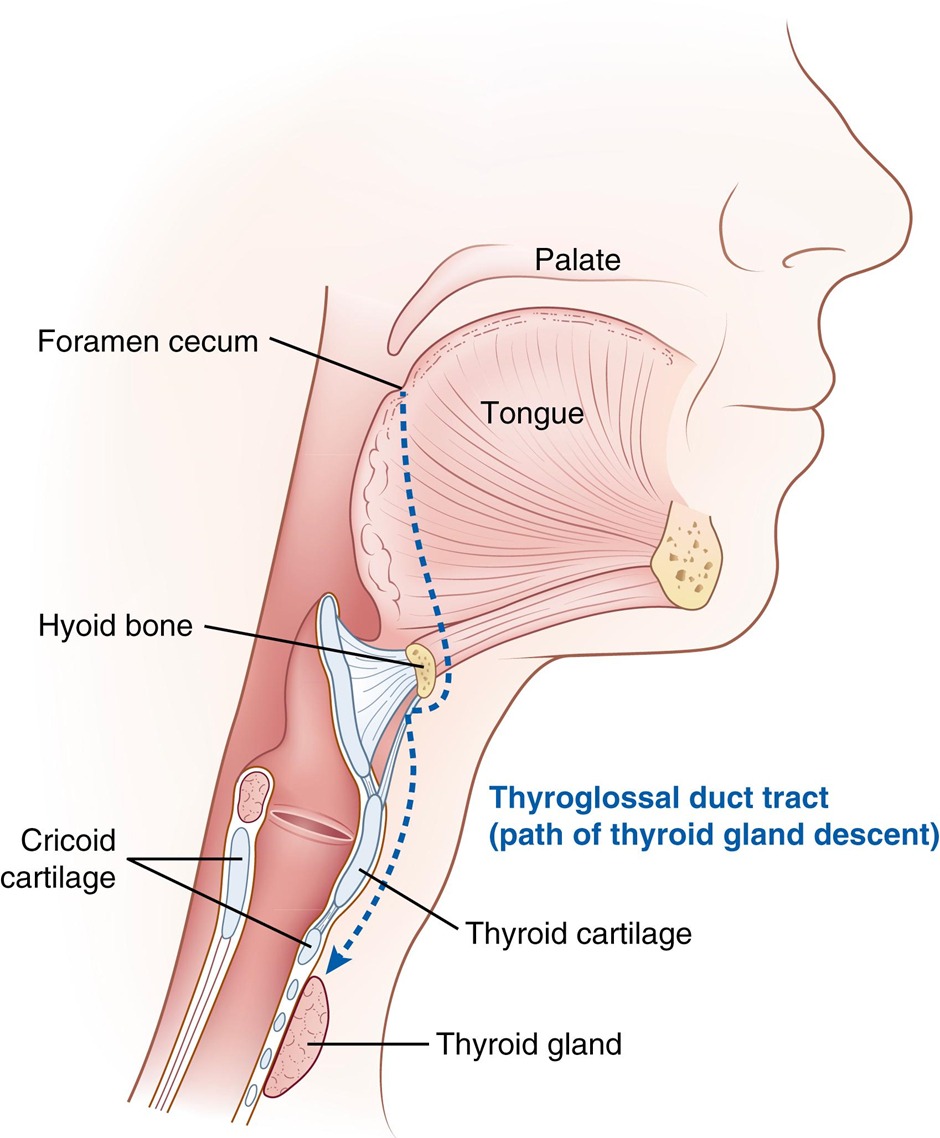
  • Forms along path of thyroid descent
  • Foramen cecum (base of the tongue) to base of anterior neck
Clinical presentation
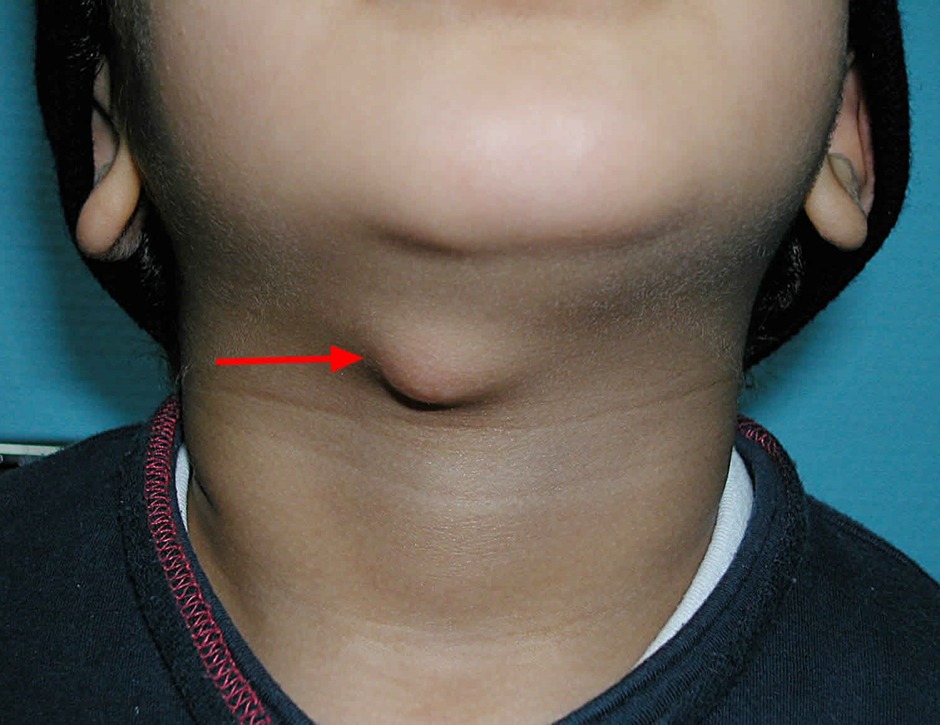
  • Midline cystic neck mass (second most common congenital anterior neck mass)
  • Moves superiority with swallowing or tongue protrusion
  • Often presents after upper respiratory tract infection (secondary infection)
  • Associated with ectopic thyroid tissue
  • Male predominance
Diagnosis
  • Ultrasonography (appears cyst)
Management
  • Confirm presence of normal thyroid tissue
  • Surgical resection of cyst, associated track and central portion of hyoid bone


version 2

Thyroglossal Duct Cyst
Embryology
  • Thyroid descends from foramen cecum to lower neck via thyroglossal duct
  • Duct normally involutes by 7-10 weeks gestation
  • Failure of involution → cyst formation
Epidemiology
  • Incidence: 7% of population
  • Most common congenital neck mass
  • Male:Female = 1.5:1
  • Bimodal: <5 years and 20-30 years
Clinical Features
  • Classic triad ★:
    1. Midline location
    2. Moves with swallowing
    3. Moves with tongue protrusion
  • 65% at hyoid level, 20% suprahyoid, 15% infrahyoid
  • Usually asymptomatic unless infected
  • 1-2% risk of malignancy (papillary thyroid carcinoma)
Diagnosis
  • Ultrasound: First-line imaging ★
    • Well-defined, anechoic cystic mass
    • Must confirm normal thyroid gland present
  • Thyroid scan: If thyroid not visualized on ultrasound
Management
  • Sistrunk procedure ★:
    • Excision of cyst
    • Excision of entire tract
    • Central portion of hyoid bone (prevents recurrence)
  • If infected: Antibiotics first, then surgery after resolution
  • Recurrence rate: 3-5% with proper technique


سجل دخولك لإضافة ملاحظات خاصة لكل قسم  · اشترك الآن

Branchial cleft cyst

Branchial cleft cyst
Embryology
  • Remnants of the second Branchial cleft or cervical sinus
Clinical presentation
  • Painless, firm mass lateral to the midline
  • Anterior to sternocleidomastoid
Diagnosis
  • Ultrasonography
Management
  • Surgical resection of cyst
  • If infected, it should be incised and drained and then should be subsequently resected (after the resolution of the infection)


Version 2

Branchial Cleft Cyst
Embryology
  • Failure of obliteration of branchial apparatus
  • 2nd branchial cleft: 95% of cases
  • 1st cleft: 1%, 3rd/4th cleft: 4%
Clinical Features
  • Location: Lateral neck, anterior to SCM
  • Smooth, fluctuant, non-tender mass
  • May have fistula to skin or pharynx
  • Often presents after URI (secondary infection)
Type-Specific Features
  • 1st cleft: Near ear, may involve facial nerve
  • 2nd cleft: Classic location at mandible angle ★
  • 3rd/4th cleft: Lower neck, may present as thyroiditis
Diagnosis
  • Ultrasound: Well-defined cystic mass
  • CT/MRI: For surgical planning
  • Fistulogram: If sinus tract present
Management
  • Complete surgical excision including tract ★
  • If infected: I&D + antibiotics, then excision later
  • Recurrence: 3% with complete excision, 20% if tract remains


سجل دخولك لإضافة ملاحظات خاصة لكل قسم  · اشترك الآن

Lymphadenopathy

Lymphadenopathy 
Reassuring  Worrisome
Palpation
  • Soft
  • Mobile
  • <2 cm (normal <1 cm)
  • Firm or hard
  • Immobile
  • >2 cm
Location
  • Localized
  • Generalized or supraclavicular (palpable supraclavicular lymph nodes are malignant until proven otherwise)
Systemic symptoms
  • Absent
  • Present
Further investigations
  • CBC
  • Viral titers
  • Inflammatory markers


Version 2

Lymphadenopathy Assessment
Reassuring Features Worrisome Features ★
Size <1 cm (normal)
<2 cm (reactive)
>2 cm
Consistency Soft, mobile Hard, fixed, matted
Location Localized
Cervical chain
Supraclavicular
Generalized
Duration <2 weeks >4 weeks
Associated Symptoms URI symptoms
Tender nodes
B symptoms
Weight loss
Night sweats
Action Required
  • Supraclavicular nodes: Always pathologic, require immediate FNA ★
  • Persistent >4 weeks: FNA indicated
  • Hard, fixed nodes: Urgent evaluation for malignancy


سجل دخولك لإضافة ملاحظات خاصة لكل قسم  · اشترك الآن

Cervical Lymphadenitis

Cervical lymphadenitis in children
Category Pathogen Key clinical findings
Unilateral
  • Staphylococcus aureus
  • Streptococcus pyogenes
  • Acute
  • Most common
  • Suppurative
  • Anaerobic bacteria
  • Acute
  • History of periodontal disease or dental caries
  • Francisella tularensis
  • Acute
  • History of contact with infected animal (eg, rabbit)
  • Mycobacterium avium
  • Chronic
  • Bartonella henselae
  • Chronic
  • Papule at site of cat scratch/bite
Content
  • Viral
  • Acute (eg, adenovirus) associated with self-limited URI
  • Subacute/chronic (eg, EBV, CMV) associated with mononucleosis symptoms


Version 2

Cervical Lymphadenitis in Children - High-Yield Pathogens
Category Pathogen Key Clinical Features ★
Unilateral S. aureus/S. pyogenes
(Most common) ★
  • Acute onset
  • Suppurative (may form abscess)
  • Overlying erythema
  • Fever present
Anaerobes
  • Associated with dental disease
  • Foul-smelling discharge
  • Submandibular location
Bartonella henselae
(Cat scratch disease)
  • Papule at inoculation site
  • Regional lymphadenopathy 2-4 weeks later
  • Low-grade fever
  • Cat exposure history
Mycobacterium avium
(Atypical mycobacteria)
  • Violaceous skin discoloration
  • Non-tender
  • No systemic symptoms
  • Age 1-5 years
Francisella tularensis
(Tularemia)
  • Rabbit/tick exposure
  • Ulceroglandular form most common
  • High fever
  • Painful adenopathy
Bilateral Viral
(Most common bilateral) ★
  • EBV: Posterior cervical, splenomegaly ★
  • CMV: Similar to EBV, heterophile negative
  • Adenovirus: Pharyngitis, conjunctivitis
  • HIV: Persistent generalized


سجل دخولك لإضافة ملاحظات خاصة لكل قسم  · اشترك الآن

Squamous cell carcinoma of the head and neck

Squamous cell carcinoma of the head and neck summary
Pathogenesis
  • Significant history of alcohol and tobacco smoking
Clinical presentation
  • Persistent (>2 weeks), palpable (>1.5 cm), firm neck mass
Diagnosis
  • CT with contrast
  • Fine needle aspiration is preferred over open biopsy to avoid tumor seeding
Treatment
  • <2 cm: resection
  • >2 cm: resection and neck dissection


Version 2

Squamous Cell Carcinoma - High-Yield Facts
Risk Factors
  • Major risks ★:
    • Tobacco (6x risk)
    • Alcohol (synergistic with tobacco - 15x risk)
    • HPV (especially type 16) - oropharyngeal
  • Betel nut chewing
  • Prior radiation
Clinical Presentation
  • Classic patient: Male >50 years with smoking/drinking history ★
  • Red flags ★:
    • Firm neck mass >1.5 cm
    • Persistent >3 weeks
    • Associated hoarseness
    • Dysphagia/odynophagia
    • Otalgia (referred pain)
Most Common Sites
  1. Larynx (most common overall) ★
  2. Oropharynx (increasing due to HPV)
  3. Oral cavity
  4. Hypopharynx (worst prognosis)
Diagnosis
  • Best initial test: CT with contrast ★
  • Tissue diagnosis:
    • FNA preferred (avoids tumor seeding)
    • Core needle if FNA non-diagnostic
    • Avoid open biopsy
  • Panendoscopy: To find primary if unknown
Treatment
  • Early stage (T1-T2): Surgery OR radiation ★
  • Advanced stage (T3-T4): Combined modality ★
    • Surgery + adjuvant radiation
    • Concurrent chemoradiation
  • Neck dissection: If nodes >3 cm or multiple
Prognosis
  • HPV-positive: Better prognosis (70-90% 5-year survival) ★
  • HPV-negative: Worse prognosis (30-50% 5-year survival)
  • Early stage: 80-90% cure rate
  • Advanced stage: 40-50% cure rate


سجل دخولك لإضافة ملاحظات خاصة لكل قسم  · اشترك الآن

HIGH-YIELD EXAM FACTS BOX

★ MUST-KNOW FACTS FOR EXAMS ★

  1. Adult with neck mass = cancer until proven otherwise (especially if >40 years)
  2. Thyroglossal duct cyst: Moves with swallowing AND tongue protrusion
  3. Branchial cleft cyst: Lateral, anterior to SCM
  4. Supraclavicular lymphadenopathy: Always pathologic
    • Right = lung, esophagus, mediastinum
    • Left (Virchow's node) = GI malignancy below diaphragm
  5. Sistrunk procedure: Must remove central hyoid bone
  6. Most common neck infections:
    • Acute bacterial: S. aureus/S. pyogenes
    • Chronic: Mycobacteria or cat scratch disease
  7. HPV-associated SCC: Better prognosis than smoking-related
سجل دخولك لإضافة ملاحظات خاصة لكل قسم  · اشترك الآن

CLINICAL PEARLS

⚠️ HIGH-YIELD CLINICAL PEARLS

  • Cystic hygroma: Only neck mass that transilluminates
  • Dermoid cyst: Midline but does NOT move with swallowing (unlike thyroglossal)
  • Cat scratch disease: Look for papule at inoculation site
  • Atypical mycobacteria: Violaceous skin, no systemic symptoms
  • Rule of 7s: Lymph node concerning if >1 cm for >1 month in patient >40 years
  • Never do open biopsy of neck mass before imaging - risk of tumor seeding
سجل دخولك لإضافة ملاحظات خاصة لكل قسم  · اشترك الآن

MEMORY AIDS

MEMORY AIDS

THYROGLOSSAL duct cyst moves with:

  • Tongue protrusion
  • Swallowing

Branchial Cleft Cyst Location - "BEAST":

  • Branchial
  • Exterior (lateral)
  • Anterior to
  • SCM
  • Triangle

Worrisome Lymph Nodes - "HELPS":

  • Hard
  • Enlarged (>2cm)
  • Lasting (>4 weeks)
  • Persistent
  • Supraclavicular
سجل دخولك لإضافة ملاحظات خاصة لكل قسم  · اشترك الآن

احصل على التجربة الكاملة

اشترك للوصول لفيديوهات الشرح التفصيلي والبطاقات التعليمية التفاعلية وأسئلة الممارسة مع تتبع التقدم.

فيديوهات الشرح بطاقات تفاعلية أسئلة ممارسة
اشترك الآن

المساعد الطبي الذكي

اسأل أسئلة حول المحتوى الطبي واحصل على إجابات فورية مدعومة بالذكاء الاصطناعي

اشترك الآن

سجل دخولك لاستخدام أدوات الدراسة

اشترك الآن