شرح المدرسين

Summary
Endometriosis is a complex, estrogen-driven condition marked by ectopic endometrial tissue leading to chronic pain, infertility, and multi-organ involvement. Early diagnosis through clinical suspicion and imaging, followed by tailored medical or surgical treatment, is essential to improve quality of life and preserve fertility.
Definition & Epidemiology
Definition
Endometriosis is a chronic, estrogen-dependent condition characterized by the presence of endometrial-like tissue outside the uterine cavity. These ectopic implants commonly involve pelvic organs such as the ovaries, fallopian tubes, and peritoneum, but may also affect extrapelvic sites including the bowel, bladder, diaphragm, and, rarely, the lungs. The ectopic endometrial tissue responds to cyclic hormonal changes, leading to inflammation, pain, and fibrosis, and is a major contributor to infertility in women of reproductive age.
Epidemiology
- Age of onset: Typically between 20 and 40 years
- Prevalence: Estimated to affect 2–10% of women of reproductive age
- Diagnosis: Often delayed by several years due to variability in presentation
- Ethnicity: No clear ethnic predilection, though access to diagnosis and treatment may differ globally
Etiology & Risk Factors
Etiology & Pathophysiology
The exact cause of endometriosis remains unclear, but several theories predominate:
- Retrograde menstruation: Endometrial cells flow backward through the fallopian tubes and implant in the pelvis. This is the most widely accepted mechanism.
- Coelomic metaplasia: Peritoneal cells transform into endometrial-like cells under hormonal influence.
- Lymphatic or hematogenous spread: Dissemination of endometrial tissue to distant sites, accounting for extrapelvic lesions.
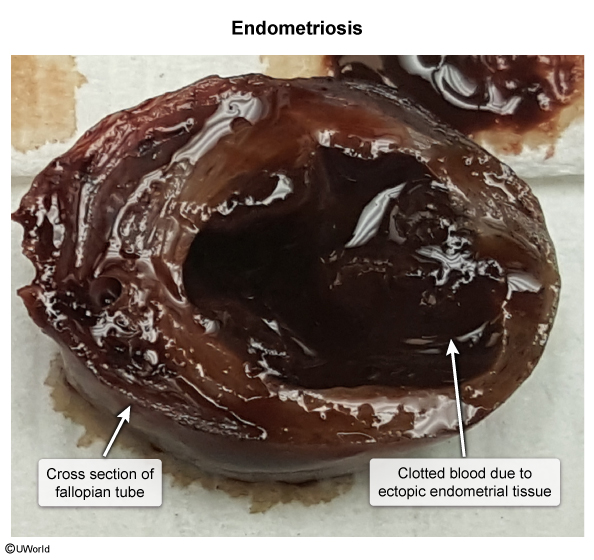
Once implanted, ectopic endometrial tissue proliferates under estrogenic stimulation, provoking chronic inflammation, angiogenesis, and fibrosis. Over time, this leads to adhesions, anatomical distortion, and potential compromise of organ function.
Risk Factors
- Early menarche
- Late menopause
- Nulliparity
- Short menstrual cycles (<27 days)
- Heavy or prolonged menstrual bleeding
- Family history of endometriosis
- Congenital uterine or tubal anomalies
Common Sites of Involvement
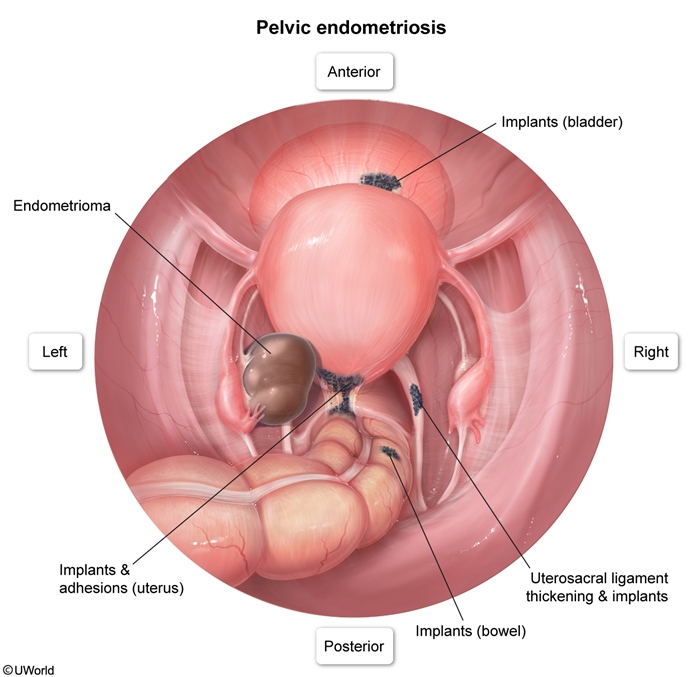
Endometriosis most commonly affects the pelvis, with a characteristic distribution:
- Pelvic organs (most common): Ovaries (endometriomas/"chocolate cysts" — most common site), uterus, fallopian tubes, uterosacral ligaments, pouch of Douglas
- Urinary tract: Bladder, ureters
- Gastrointestinal tract: Rectum, sigmoid colon
- Extrapelvic sites (rare): Diaphragm, abdominal wall, lungs
Clinical Features
Up to 25% of individuals with endometriosis may be asymptomatic and discovered incidentally. However, the classic presentation includes cyclic pain symptoms:
| 4 D's of Endometriosis – جملة تذكرية | |
|
Dysmenorrhea (painful periods) Memory aid: When a patient presents with cyclic "pain with" symptoms, think endometriosis until proven otherwise. |
جملة تذكرية |
Location-Specific Symptoms
| Location-Specific Symptoms | |
|---|---|
| Location | Symptoms |
| General | Chronic pelvic pain, premenstrual spotting, infertility |
| Ovaries | Lateral pelvic or back pain, palpable masses (endometriomas) |
| Urinary tract | Dysuria, hematuria, recurrent UTIs, suprapubic pain |
| Gastrointestinal tract | Dyschezia, constipation, diarrhea, rectal bleeding |
| Abdominal wall | Painful, palpable nodule |
| Thorax (rare) | Cyclic chest or shoulder pain, hemoptysis during menses, spontaneous pneumothorax |
Physical Examination
On examination, findings may include adnexal tenderness, uterosacral ligament nodularity, fixed retroverted uterus, or palpable adnexal masses. Severity of examination findings does not correlate with disease extent.
| فخ امتحاني | |
|
The ovary (chocolate cyst) is the most common site of endometriosis, but the patient may complain of dyschezia if the pouch of Douglas is affected. The location determines the symptoms: urinary tract involvement presents with dysuria and hematuria, and rectal involvement presents with dyschezia and rectal bleeding. |
ملاحظة |
Diagnosis
Imaging Studies
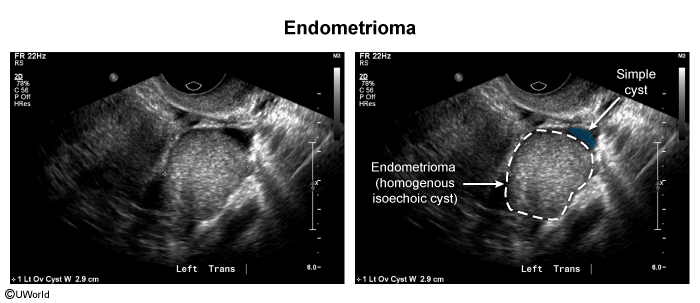
Transvaginal ultrasound (TVUS): First-line imaging modality with high sensitivity for endometriomas and deep infiltrating disease. Findings include homogeneous isoechoic (ground-glass) cysts, ovarian endometriomas, or nodular lesions in the pouch of Douglas.
MRI pelvis: Used when ultrasound is inconclusive, when deep infiltrating disease is suspected, or to assess bowel involvement prior to surgery. Superior soft-tissue resolution allows characterization of lesion depth and extent.
Laparoscopy (Gold Standard)
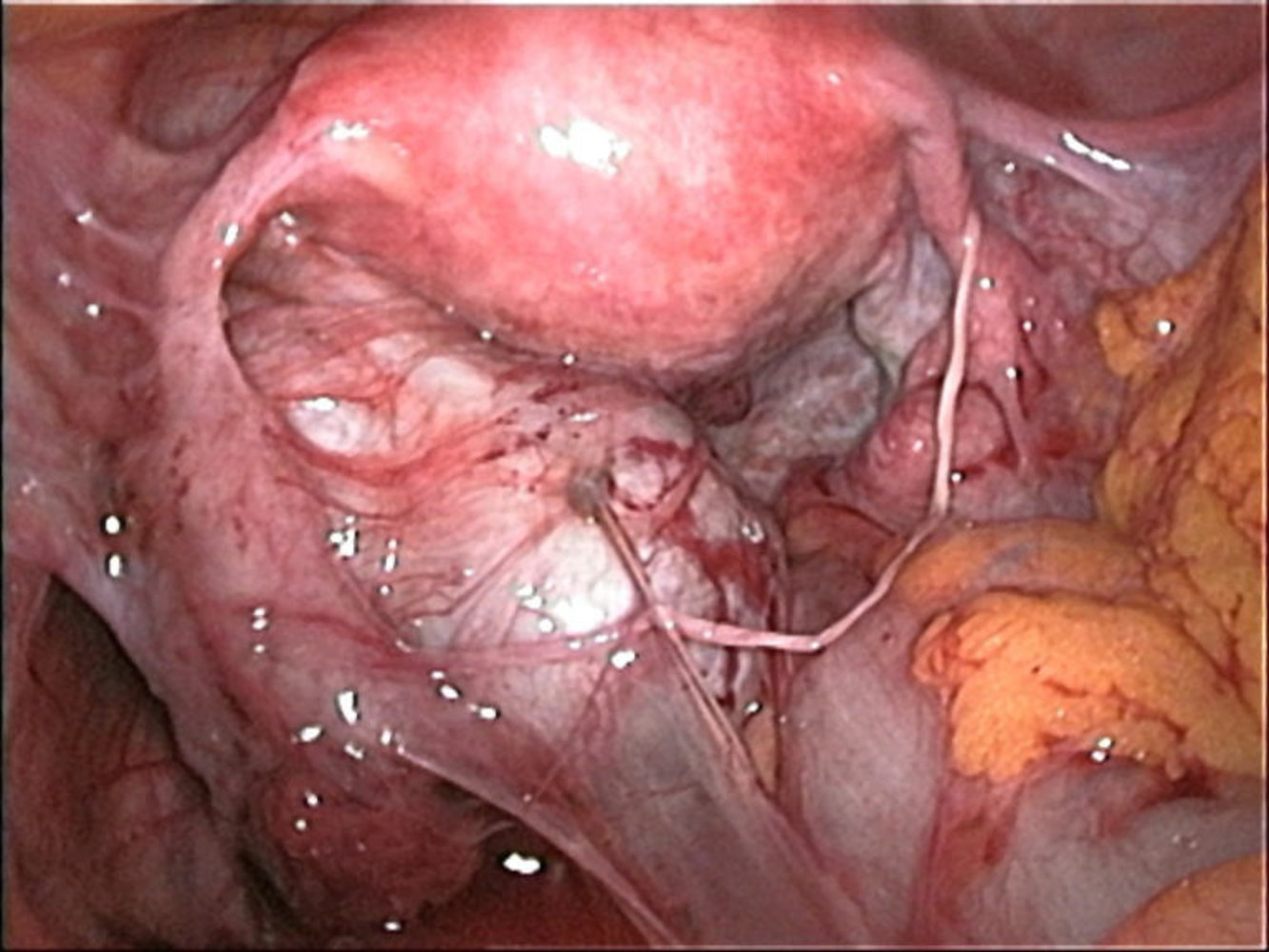
Laparoscopy with direct visualization and biopsy remains the gold standard for definitive diagnosis:
- Allows direct inspection of all pelvic organs
- Permits biopsy for histological confirmation
- Enables simultaneous therapeutic intervention (excision or ablation)
- Typical findings include "powder-burn" lesions (dark petechial lesions), clear/red/blue nodules, adhesions, and chocolate cysts (endometriomas)
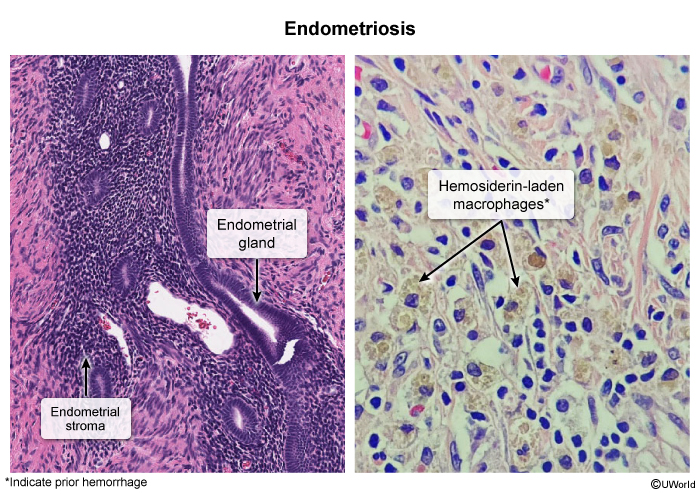
Histopathology (Diagnostic Confirmation)
Biopsy is required for definitive diagnosis. The pathognomonic triad includes:
- Endometrial glands (columnar epithelium)
- Endometrial stroma (basophilic, spindle-cell)
- Hemosiderin-laden macrophages (evidence of prior hemorrhage from cyclic bleeding)
| ملاحظة سريرية | |
|
TVUS is the initial examination for suspected endometriosis, but laparoscopy with biopsy is the gold standard for definitive diagnosis. TVUS has high sensitivity for endometriomas and deep disease, but superficial peritoneal disease may be negative. |
ملاحظة |
Management
| Medical Management of Endometriosis Pain | ||
|---|---|---|
| Agent | Mechanism | Indication/Use |
| NSAIDs (e.g., naproxen, ibuprofen) | Inhibit prostaglandin synthesis | First-line for pain relief; take starting before menses |
| Combined oral contraceptives (COCs) | Suppress FSH/LH; suppress ovulation; reduce menstrual volume | Continuous use preferred to suppress menstruation and breakthrough bleeding |
| Progestins (norethindrone, megestrol, IUD-levonorgestrel) | Induce decidualization and atrophy of ectopic endometrium | Alternative for patients with estrogen contraindications; excellent for pain control |
| GnRH agonists (leuprolide, goserelin) | Suppress gonadotropins and ovarian estrogen production (create pseudo-menopausal state) | Refractory cases; typically limited to 6 months due to side effects; add-back therapy (HRT) often required to minimize bone loss |
| Aromatase inhibitors (letrozole, anastrozole) | Inhibit local estrogen production in endometrial tissue | Refractory cases; must be used with progestin or GnRH agonist to suppress ovulation; off-label use |
| Danazol | Suppress LH/FSH; weak androgenic effects on endometrial tissue | Rarely used due to androgenic side effects (virilization, lipid changes) |
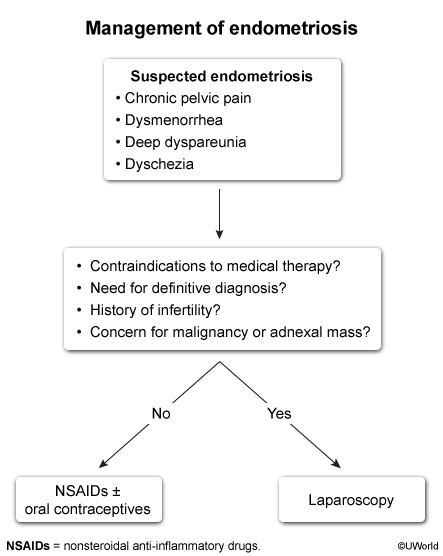
Surgical Management (Indicated for Infertility or Refractory Pain)
- Laparoscopic excision or ablation: Indicated in patients with refractory pain despite medical therapy or those seeking to improve fertility. Excision is preferred over ablation when feasible, as it allows for histological confirmation and may have better pregnancy outcomes.
- Definitive surgery (hysterectomy with or without bilateral salpingo-oophorectomy): Reserved for severe, refractory cases in women who have completed childbearing and desire permanent resolution. Provides the most durable pain relief.
| Note | |
|
Medical therapy is excellent for pain (pain relief) but does not improve fertility at all. A patient desiring pregnancy should be referred to surgical management (laparoscopic excision) to improve reproductive outcomes. |
ملاحظة |
Complications
-
Infertility: Due to adhesions, distorted anatomy, or tubal dysfunction
-
Chronic pelvic pain
-
Adhesions and organ entrapment: Bowel obstruction, urinary retention
-
Ectopic pregnancy: Increased risk due to tubal involvement
-
Ovarian cancer: Slightly elevated risk, particularly with long-standing disease
Key Points for Exams – نقاط مهمة للامتحانات
- Endometriosis is estrogen-dependent and cyclic: Symptoms and lesions follow menstrual cycles. Menarche to menopause peak incidence is 25–40 years; prevalence 2–10% of reproductive-age women.
- The "4 D's" mnemonic captures cardinal symptoms: Dysmenorrhea, dyspareunia, dyschezia, dysuria — recognize cyclic pain patterns with any bodily "pain with" complaint.
- Location determines presentation: Ovarian involvement (chocolate cyst, most common) → lateral pelvic pain; pouch of Douglas → dyschezia; bladder → dysuria/hematuria; bowel → dyschezia/rectal bleeding.
- TVUS is first-line imaging; laparoscopy is gold standard: TVUS excellent for endometriomas and deep disease but insensitive for superficial peritoneal lesions. Definitive diagnosis requires laparoscopic visualization and biopsy.
- Histological triad is pathognomonic: Endometrial glands + endometrial stroma + hemosiderin-laden macrophages = diagnostic proof of endometriosis. No two of three is sufficient.
- Medical therapy treats pain, NOT infertility: NSAIDs, COCs, progestins, and GnRH agonists all effectively control pain by suppressing menstruation and inflammation. However, none improve pregnancy rates. Patients desiring pregnancy require surgery.
- Surgical management (laparoscopic excision) improves fertility: Most effective intervention for infertility and refractory pain. Hysterectomy reserved only for completed-childbearing women with severe disease.
- Complications include infertility, chronic pain, and bowel obstruction: Adhesions from ectopic foci can entrap bowel or urinary organs. Long-standing endometriosis carries slight increased ovarian cancer risk (clear-cell, endometrioid subtypes).
- Exam pitfall: Do not confuse endometriosis with adenomyosis (adenomyosis = ectopic endometrium INTO myometrium; endometriosis = ectopic endometrium outside uterus). Adenomyosis presents with diffuse uterine tenderness and boggy uterus on exam; endometriosis presents with localized adnexal or ligament nodularity.
- GnRH agonists require add-back therapy: To prevent bone loss and vasomotor symptoms, combine with low-dose estrogen-progestin add-back when using GnRH agonists for >3–6 months. This does not significantly reduce efficacy for endometriosis pain.
احصل على التجربة الكاملة
اشترك للوصول لفيديوهات الشرح التفصيلي والبطاقات التعليمية التفاعلية وأسئلة الممارسة مع تتبع التقدم.