شرح المدرسين

Summary
Adenomyosis is a benign condition where endometrial tissue grows within the myometrium, causing uterine enlargement, heavy bleeding, and dysmenorrhea, with localized forms called adenomyomas. It mainly affects multiparous women aged 40–50, often linked to prior uterine surgery. Diagnosis is best made with MRI; treatment ranges from NSAIDs and hormonal therapy (especially LNG-IUS) to interventional procedures, with hysterectomy as the definitive cure. Symptoms typically resolve after menopause.
Definition
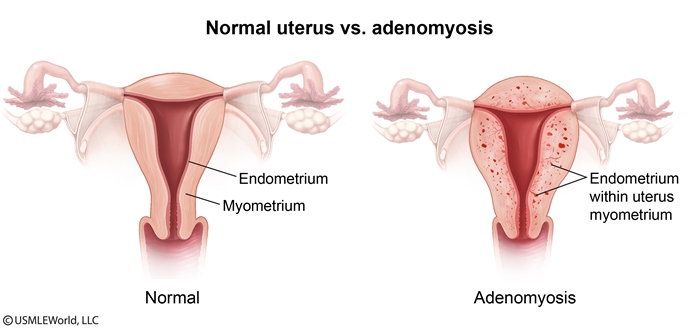
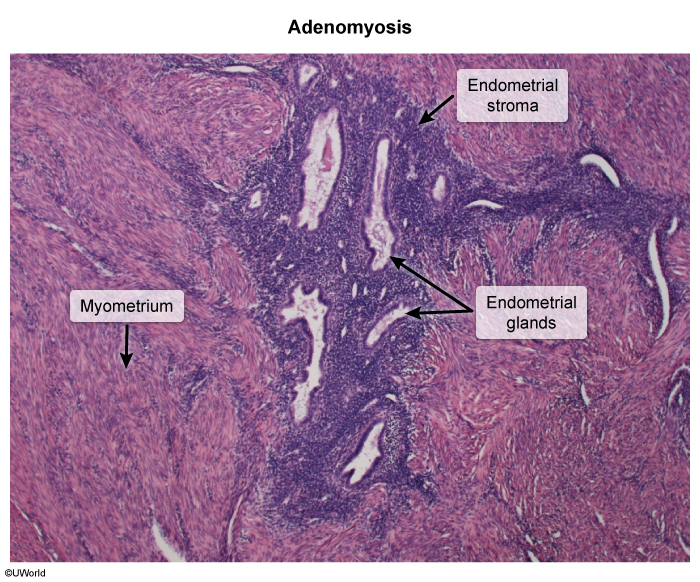
Adenomyosis is a benign gynecological condition characterized by the presence of functional endometrial glands and stroma within the myometrium, at least 2.5 mm below the endometrial–myometrial junction. This ectopic tissue undergoes cyclic bleeding, causing hypertrophy and hyperplasia of surrounding smooth muscle, resulting in diffuse or focal uterine enlargement. When localized, it forms a nodular lesion termed an adenomyoma.
Pathophysiology
Pathophysiology
Adenomyosis develops when functional endometrial glands and stroma infiltrate the myometrium, usually due to disruption of the endometrial–myometrial junction (junctional zone). This disruption can result from mechanical trauma (e.g., uterine surgery, cesarean section, curettage) or chronic micro-injuries over time. Once embedded in the myometrium, the ectopic endometrial tissue remains hormonally responsive: it proliferates and bleeds cyclically, triggering smooth muscle hypertrophy, hyperplasia, and local inflammation. The cyclic bleeding within the myometrial wall perpetuates pain and bleeding symptoms characteristic of adenomyosis.
Epidemiology & Risk Factors
Prevalence: Adenomyosis is found in 20–40% of hysterectomy specimens, most often in multiparous women aged 40–50.
Risk Factors
1. Parity and Uterine Surgery
- High parity (multiparity is the strongest risk factor)
- Prior dilation and curettage (D&C)
- Cesarean section
- Endometrial ablation or hysteroscopic procedures
2. Estrogen Exposure
- Early menarche
- Obesity (increased local estrogen production)
- Prolonged menstrual exposure throughout reproductive years
3. Genetic and Coexisting Conditions
- Possible genetic predisposition and epigenetic changes
- Frequent coexistence with fibroids (50–60% of cases)
- Frequent coexistence with endometriosis (15–20% of cases)
Clinical Features & Differential Diagnosis
- Asymptomatic: ~30% of cases have no symptoms despite histological adenomyosis on hysterectomy.
- Symptomatic presentations:
- Heavy menstrual bleeding (menorrhagia): ~50% of symptomatic patients; can lead to iron-deficiency anemia
- Secondary dysmenorrhea: ~30%; often progressive and more severe with advancing disease
- Deep dyspareunia, chronic pelvic pain, or infertility: Less common but significant in some patients
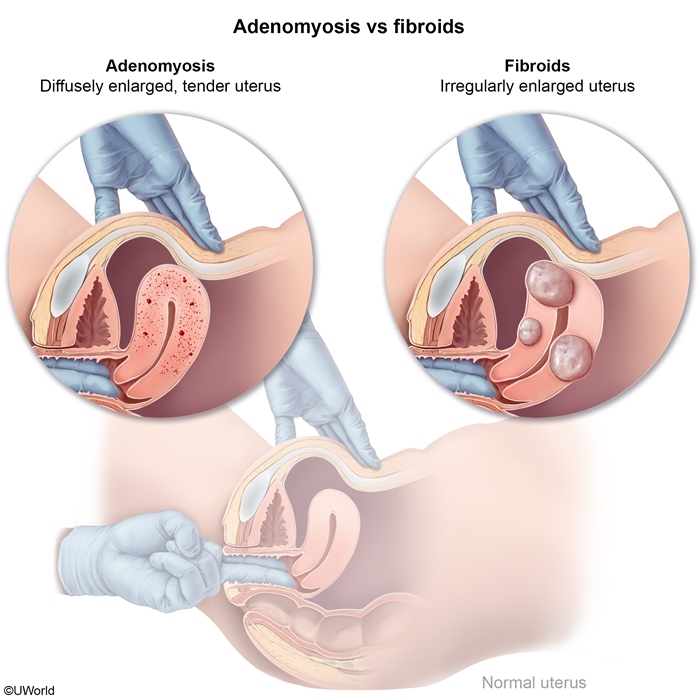
- On physical examination: The uterus is symmetrically enlarged, soft to boggy, and tender to palpation, typically <14 cm in size (mild to moderate enlargement). This diffuse enlargement is a key distinguishing feature from fibroids.
| Note – Adenomyosis vs. Fibroids on Exam | |
|
In adenomyosis, the uterus is diffusely enlarged, soft, and tender on bimanual exam. Distinguish this from fibroids where the uterus is irregularly enlarged, firm/rubbery, and you may palpate discrete nodules beneath your hand — this distinction is a key exam differentiator. |
ملاحظة |
Differential Diagnosis
| Adenomyosis vs. Fibroids vs. Endometriosis | |||
|---|---|---|---|
| Feature | Adenomyosis | Fibroid (Leiomyoma) | Endometriosis |
| Location | Endometrial tissue within myometrium | Benign smooth muscle tumor | Endometrial tissue outside uterus |
| Uterine size & texture | Diffusely enlarged, soft, tender | Irregularly enlarged, firm, rubbery | Usually normal |
| Pain pattern | Non-cyclical or progressively cyclical | Variable (often menorrhagia without pain) | Classically cyclical (dysmenorrhea) |
| Best diagnostic modality | MRI (junctional zone >12 mm) | Ultrasound | Laparoscopy |
Investigations
Imaging
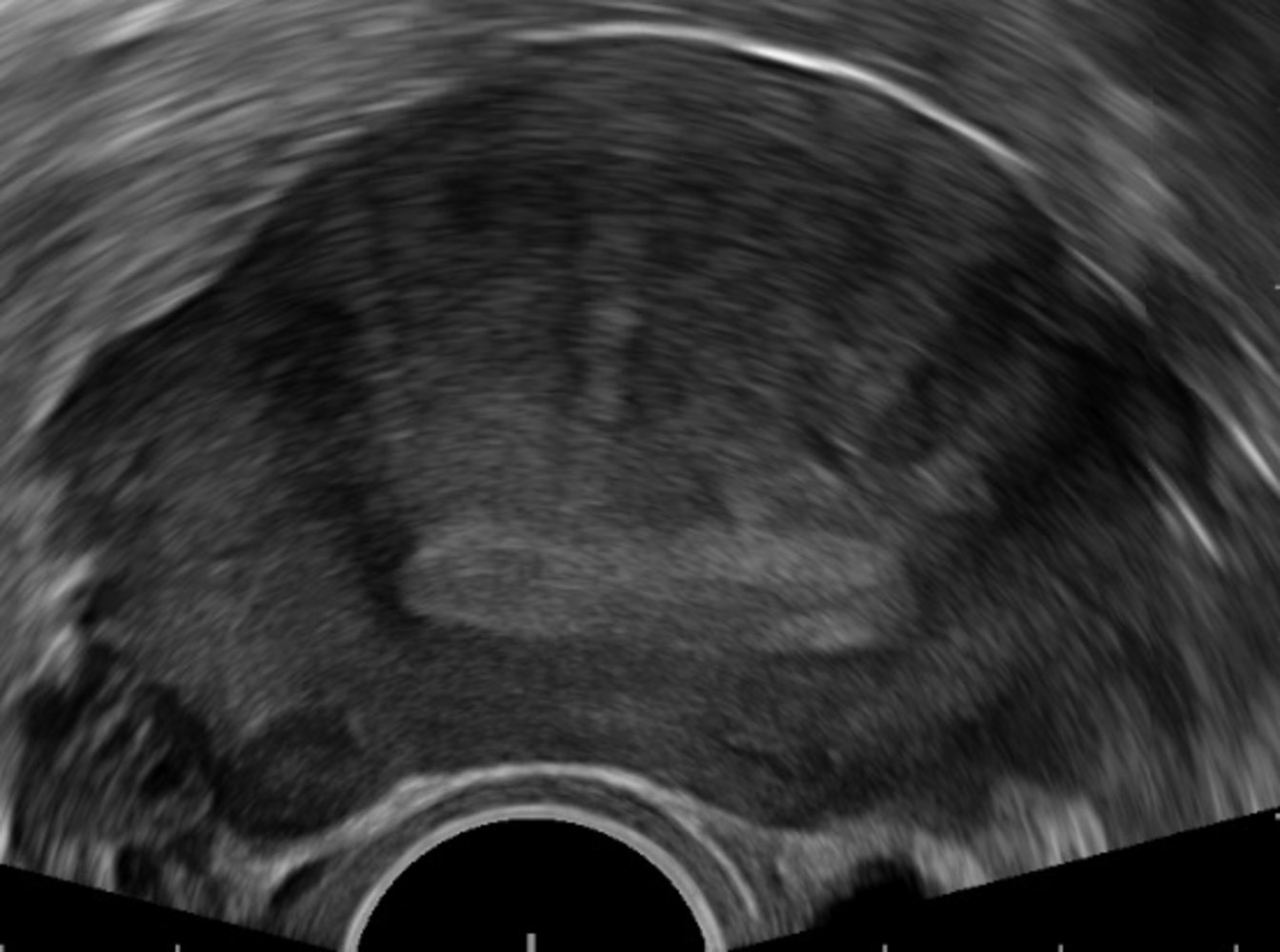
Transvaginal/Transabdominal Ultrasound: First-line imaging in most clinical settings. May reveal:
- Globular uterine contour (diffuse symmetric enlargement)
- Heterogeneous myometrial echotexture
- Myometrial cysts (small, scattered fluid-filled lesions)
- Poor definition of the endometrial–myometrial interface
The following ultrasound image demonstrates characteristic features:
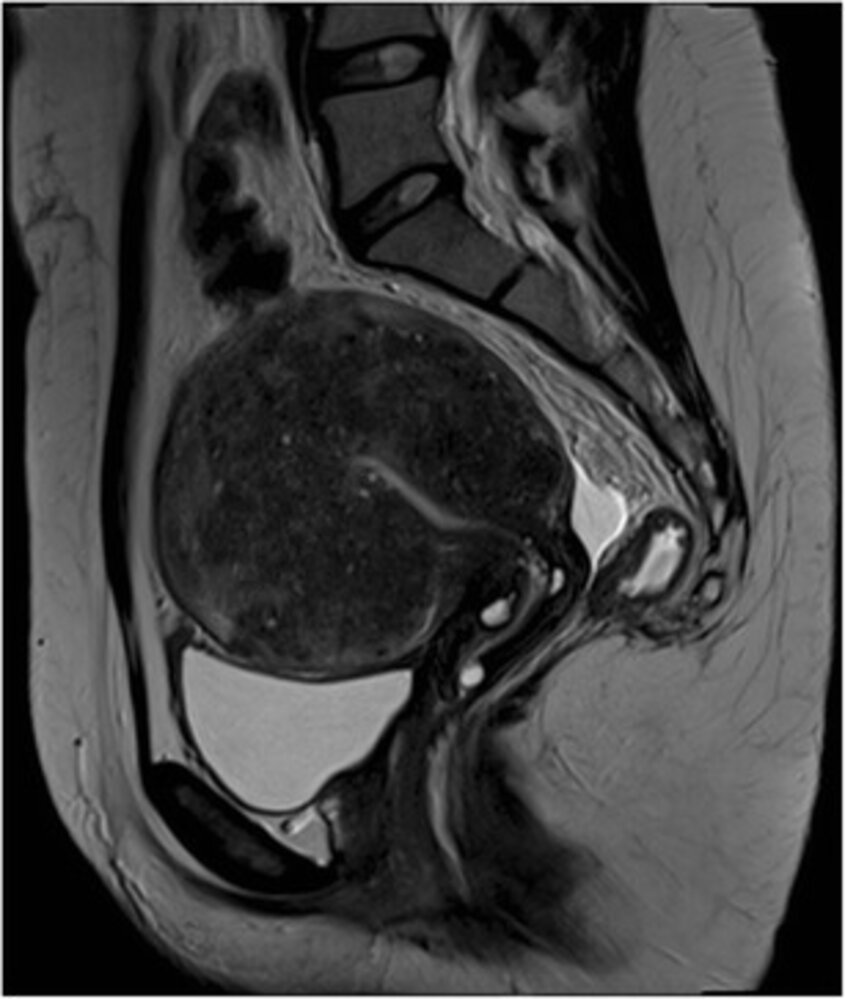
MRI (Magnetic Resonance Imaging) – Gold Standard: Most accurate modality for diagnosing adenomyosis, especially diffuse disease. Key findings include:
- Junctional zone thickening >12 mm – the hallmark diagnostic finding
- Junctional zone disruption or irregularity
- Multiple small high-signal foci on T2-weighted images indicating ectopic endometrial implants within myometrium
- Myometrial heterogeneity and edema
The following T2-weighted MRI image demonstrates the diagnostic hallmark:
Definitive Diagnosis
Histopathological confirmation: Adenomyosis can only be definitively confirmed by histological examination of a hysterectomy specimen, showing endometrial glands and stroma invasion ≥2.5 mm into the myometrium. In clinical practice, diagnosis is made presumptively based on imaging (especially MRI) combined with clinical presentation, as hysterectomy is curative and the diagnosis then becomes moot.
Management & Prognosis
Management Approach
1. Medical Management (First-line for symptom control)
- NSAIDs: Ibuprofen 400–600 mg TID or naproxen 500 mg BID for dysmenorrhea and pelvic pain.
- Hormonal therapies:
- Combined oral contraceptives: Cyclic or continuous dosing to suppress menstruation and reduce endometrial proliferation
- Oral or injectable progestins: Medroxyprogesterone acetate (Depo-Provera 150 mg IM every 12 weeks) or oral norethindrone
- LNG-IUS (levonorgestrel-releasing intrauterine system): Most effective non-surgical option; delivers high local progestin concentration, reduces menstrual flow by 80–90%, and provides symptom relief for 3–5 years per device
- GnRH agonists: Leuprolide 3.75 mg IM monthly or goserelin; effective but limited to 6 months due to hypoestrogenic side effects (hot flashes, vaginal dryness, bone loss)
- Aromatase inhibitors: Letrozole or anastrozole for short-term use (off-label); suppress local estrogen production in adenomyotic lesions
2. Interventional/Minimally Invasive Options (Uterine-sparing)
- Uterine artery embolization (UAE): Percutaneous catheterization and embolization of uterine arteries; effective for symptom reduction and uterine volume reduction, though adenomyosis may persist
- Endometrial ablation or resection: Hysteroscopic destruction of endometrium; less effective in diffuse adenomyosis (higher recurrence rates) but useful for adenomyomas
- MRI-guided focused ultrasound (HIFU): Non-invasive thermal ablation of adenomyotic foci; emerging technology with limited long-term data
3. Surgical Management (Definitive)
- Hysterectomy: Total or subtotal removal of the uterus – definitive and curative in women who have completed childbearing. Provides complete symptom resolution.
- Adenomyomectomy: Surgical excision of focal adenomyoma; considered in young women desiring fertility preservation, though recurrence is possible.
| ملاحظة سريرية – Imaging vs. Treatment Hierarchy | |
|
MRI is the gold standard for diagnosis (junctional zone >12 mm), but LNG-IUS remains the most effective first-line option for non-surgical medical treatment. |
ملاحظة |
Prognosis
Symptom resolution is common after menopause due to declining hormonal stimulation of adenomyotic tissue. Untreated adenomyosis can significantly impact quality of life due to chronic pelvic pain, menorrhagia, and associated anemia. With appropriate medical or surgical management, most women experience substantial symptom improvement. Hysterectomy remains the only truly curative option, though it eliminates the possibility of future pregnancy.
Key Points for Exams – نقاط مهمة للامتحانات
| AGED – Adenomyosis Presentation | |
|
A = Age 40–50 years; multiparous women G = Globular, soft, tender uterus (diffusely enlarged) E = Estrogen-dependent condition (symptom improvement post-menopause) D = Dysmenorrhea, Diffuse menorrhagia, Dyspareunia |
جملة تذكرية |
High-Yield Exam Pearls
-
- Adenomyosis is estrogen-dependent: Symptoms improve post-menopause; age >40 is a key risk factor.
- Bimanual exam distinction: Diffusely enlarged, soft, tender uterus (adenomyosis) vs. irregularly enlarged, firm, nodular uterus (fibroids).
- MRI is diagnostic gold standard: Junctional zone thickness >12 mm on T2-weighted imaging is the hallmark finding.
- LNG-IUS is first-line medical management: Reduces menstrual flow by 80–90%.
- Hysterectomy is the only curative treatment: All other options provide symptom control only.
- Adenomyosis frequently coexists with fibroids and endometriosis: Always consider concurrent pathology.
- 30% of adenomyosis is asymptomatic: May be found incidentally on imaging.
- Dysmenorrhea in adenomyosis is progressive: Unlike primary dysmenorrhea, it worsens over time in women >35 years.
احصل على التجربة الكاملة
اشترك للوصول لفيديوهات الشرح التفصيلي والبطاقات التعليمية التفاعلية وأسئلة الممارسة مع تتبع التقدم.