Summary
Vitamin K deficiency causes an acquired coagulopathy by impairing gamma-carboxylation of factors II, VII, IX, X, and proteins C/S. Common in newborns (sterile gut, low breast milk content), malabsorption (celiac, biliary disease), and broad-spectrum antibiotic use, it presents with mixed mucocutaneous and deep bleeding. Laboratory testing demonstrates an initial isolated prolonged PT/INR (due to Factor VII's short 4–6 hour half-life) followed later by prolonged aPTT, while platelets, fibrinogen, and Factor VIII remain normal (distinguishing it from DIC). Gold-standard diagnosis relies on PT correction within 24 hours of phytonadione administration. Management involves oral or slow IV vitamin K, with 4-factor PCC or FFP added for active bleeding; routine IM vitamin K within one hour of birth prevents neonatal vitamin K deficiency bleeding (VKDB).
Overview & Pathophysiology
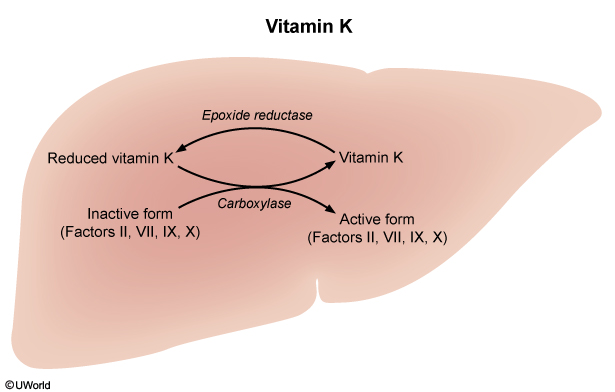
Vitamin K deficiency is a common cause of an acquired coagulopathy. Vitamin K is a fat-soluble vitamin that acts as a cofactor for γ-glutamyl carboxylase in the liver. This enzyme carboxylates glutamate residues on certain clotting proteins, allowing them to bind Ca²⁺ and phospholipid surfaces and become functionally active. The vitamin K–dependent proteins are the procoagulant factors II, VII, IX, X and the natural anticoagulants Protein C and Protein S.
| Mnemonic – Vitamin K-dependent factors | |
|
"1972" — Vitamin K activates clotting factors 10, 9, 7, 2 (read the year 1972), plus the natural anticoagulants Protein C and Protein S. فيتامين K يفعّل العوامل ١٠، ٩، ٧، ٢ (سنة ١٩٧٢) بالإضافة إلى بروتين C و S. |
جملة تذكرية |
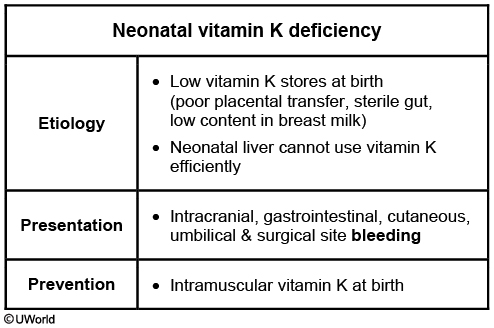
Vitamin K comes from two sources: K1 (phylloquinone) from green leafy vegetables and K2 (menaquinone) synthesized by colonic bacteria. Deficiency develops whenever intake, fat absorption, or bacterial production is disrupted.
Top clinical scenarios
- Newborns — poor placental transfer, sterile gut (no bacterial K2), and low vitamin K in breast milk (formula is fortified) → Vitamin K Deficiency Bleeding (VKDB), formerly hemorrhagic disease of the newborn.
- Fat malabsorption — cholestasis/obstructive jaundice (no bile salts), celiac disease, cystic fibrosis, chronic pancreatitis, or short-bowel syndrome; any cause of steatorrhea.
- Drugs — warfarin (inhibits vitamin K epoxide reductase, VKOR) and broad-spectrum antibiotics (kill the colonic flora that make K2).
- Poor intake — severe malnutrition, prolonged TPN without supplementation, alcoholism.
The full risk-factor and laboratory profile is consolidated in the Vitamin K deficiency risk factors, clinical features, and laboratory findings, and the malabsorption causes overlap with other deficiencies summarised in the nutrient deficiencies associated with malabsorption.
Core mechanism
Without active vitamin K, the liver still synthesizes factors II, VII, IX, X — but they remain non-functional (PIVKA: Proteins Induced by Vitamin K Absence). They cannot bind Ca²⁺, cannot localize to platelet phospholipid surfaces, and the cascade fails. Factor VII has the shortest half-life (~4–6 h), so its activity falls first → the extrinsic pathway fails earliest → PT/INR prolongs before PTT. As factors II, IX, and X subsequently decline, the aPTT prolongs too. Because platelets and fibrinogen are not vitamin K–dependent, their values stay normal — the feature that separates this from DIC.
| Important – فكرة سؤال | |
|
The first lab abnormality in vitamin K deficiency or warfarin therapy is ↑ PT/INR — remember "7 falls first": Factor VII has the shortest half-life (~4–6 h), so the extrinsic pathway fails before the intrinsic. PTT prolongs only later, as factors II, IX, and X decline. |
تذكر |
| ملاحظة سريرية | |
|
الوارفارين يثبّط إنزيم epoxide reductase (VKOR) فيُحدث صورة مطابقة تمامًا لنقص فيتامين K. ولأن بروتين C المضاد للتخثر قصير العمر يُستهلك باكرًا، قد يحدث فرط تخثر عابر في بداية العلاج (سبب نخر الجلد الوارفاريني — warfarin skin necrosis). |
ملاحظة |
Clinical Presentation
Bleeding is the only manifestation. The pattern is mixed — both mucocutaneous and deep-tissue bleeding — because both the extrinsic (PT) and intrinsic (PTT) pathways are eventually affected.
In adults
- Easy bruising and ecchymoses.
- Mucosal bleeding: epistaxis, gum bleeding, hematuria.
- GI bleeding: melena, hematemesis.
- Prolonged bleeding after minor cuts, surgery, or venipuncture.
- Severe cases: intracranial or retroperitoneal hemorrhage.
In newborns — Vitamin K Deficiency Bleeding (VKDB)
Three patterns classified by timing of onset:
- Early VKDB (< 24 h): mother on warfarin, phenytoin, or rifampin during pregnancy. Presents with cephalhematoma or intracranial bleeding.
- Classic VKDB (days 2–7): the most common form — umbilical stump bleeding, GI bleeding (hematemesis, melena), circumcision-site bleeding, and bruising.
- Late VKDB (2 weeks–6 months): an exclusively breastfed infant who missed the IM vitamin K dose; classically presents with intracranial hemorrhage and carries high mortality.
| Important – فكرة سؤال | |
An exclusively breastfed infant who missed the IM vitamin K dose presenting at 2 weeks–6 months with intracranial hemorrhage = late VKDB until proven otherwise. It is the most feared form (high mortality and neurologic morbidity). |
تذكر |
Diagnostic Approach
Diagnosis rests on coagulation studies plus the response to vitamin K. The hallmark is an isolated prolonged PT/INR initially, followed by a prolonged aPTT, with normal platelets and fibrinogen.
- PT / INR — markedly prolonged (the first abnormality; reflects Factor VII).
- aPTT — prolonged later, as factors IX and X fall.
- Platelets — normal.
- Fibrinogen and D-dimer — normal (distinguishes from DIC).
- Bleeding time — normal.
- Mixing study — corrects (a factor deficiency, not an inhibitor).
Confirmatory test: the PT corrects within ~24 hours of vitamin K administration, which confirms deficiency and excludes liver failure as the primary cause.
| Differentiating bleeding disorders by laboratory pattern | ||||
|---|---|---|---|---|
| Parameter | Vitamin K deficiency | Liver failure | DIC | Hemophilia A/B |
| PT/INR | ↑↑ (first) | ↑↑ | ↑ | Normal |
| aPTT | ↑ (later) | ↑ | ↑ | ↑↑ |
| Platelets | Normal | Normal or ↓ | ↓↓ | Normal |
| Fibrinogen | Normal | ↓ | ↓↓ | Normal |
| D-dimer | Normal | Normal/↑ | ↑↑ | Normal |
| Factor VIII | Normal | Normal/↑ | ↓ | ↓ (Hem A) |
| Response to vitamin K | Corrects PT | No correction | No correction | No effect |
For the full side-by-side reference across additional bleeding disorders, see the laboratory characteristics of coagulopathies, which lays out PT, aPTT, platelet count, and bleeding time for the major entities. The three discriminators that pin the diagnosis are:
- Factor VIII normal in vitamin K deficiency but low in DIC (Factor VIII is not vitamin K–dependent and behaves as an acute-phase reactant).
- Normal fibrinogen + normal platelets → rules out DIC.
- PT corrects with vitamin K → rules out liver failure.
| Important – فكرة سؤال | |
|
Factor VIII is the key discriminator from DIC. Factor VIII is NOT vitamin K–dependent and is an acute-phase reactant, so it stays normal/high in vitamin K deficiency and liver disease, but falls in DIC (consumption). Normal fibrinogen + normal platelets also exclude DIC. |
تذكر |
| فخ امتحاني | |
|
للتفريق عن فشل الكبد: في نقص فيتامين K يتصحّح الـ PT خلال ٢٤ ساعة بعد إعطاء فيتامين K، بينما لا يتصحّح في فشل الكبد. كذلك يبقى الفيبرينوجين والصفائح طبيعيًا في نقص فيتامين K، وينخفضان في DIC. |
ملاحظة |
Management & Prevention
1. Vitamin K replacement (phytonadione)
- Oral 2.5–10 mg — mild deficiency, no active bleeding, intact absorption.
- IV / subcutaneous 5–10 mg — when oral route is unavailable or absorption is impaired. IV must be infused slowly (diluted) because rapid infusion can cause anaphylactoid reactions.
- IM is avoided in coagulopathic patients (risk of hematoma).
- PT begins to correct within 6–12 hours; full correction by ~24 hours.
2. Active or severe bleeding
- Fresh Frozen Plasma (FFP) — immediate replacement of all clotting factors.
- 4-factor Prothrombin Complex Concentrate (PCC) — preferred for rapid reversal of life-threatening or intracranial bleeding; faster and smaller volume than FFP.
- Always give vitamin K together with FFP/PCC so the effect persists after the transfused factors decay.
| ملاحظة سريرية | |
|
أعطِ فيتامين K مع الـ FFP أو الـ PCC معًا؛ فالعوامل المنقولة تتلاشى خلال ساعات، بينما يحتاج الكبد إلى فيتامين K لإنتاج عوامل وظيفية دائمة. ويُعطى فيتامين K الوريدي ببطء لتجنّب التفاعل التأقّي (anaphylactoid). |
ملاحظة |
3. Warfarin reversal (by INR and bleeding status)
- INR 4.5–10, no bleeding — hold warfarin; routine vitamin K not required.
- INR > 10, no bleeding — hold warfarin + oral vitamin K 2.5–5 mg.
- Any serious/life-threatening bleeding — IV vitamin K 5–10 mg + 4-factor PCC (use FFP if PCC unavailable).
The management of supratherapeutic INR details the vitamin K dosing and PCC thresholds by INR range, and the warfarin vs. heparin overdose reversal comparison clarifies why vitamin K and FFP correct warfarin but protamine is reserved for heparin.
4. Treat the underlying cause
- Correct malabsorption (bile salts, gluten-free diet, pancreatic enzyme replacement).
- Stop the offending drug where possible.
- Long-term: low-dose oral vitamin K supplementation.
5. Newborn prophylaxis (universal standard of care)
- Single IM dose of vitamin K1 (phytonadione) 0.5–1 mg to every newborn within 1 hour of birth.
- This single dose prevents all three forms of VKDB (early, classic, late).
- Oral vitamin K is less reliable (requires multiple doses; residual risk of late VKDB).
IM vitamin K sits alongside erythromycin eye ointment and hepatitis B vaccine in routine newborn preventive care.
| Note – ملاحظة | |
|
Parental refusal of the newborn vitamin K injection is a recognized risk factor for late VKDB with intracranial hemorrhage. Counsel families that the injection is safe and is not a vaccine. |
ملاحظة |
احصل على التجربة الكاملة
اشترك للوصول لفيديوهات الشرح التفصيلي والبطاقات التعليمية التفاعلية وأسئلة الممارسة مع تتبع التقدم.