Summary
Thrombocytopenia (platelets < 150,000/mcL) manifests as mucocutaneous bleeding and is broadly categorized by peripheral smear and coagulation panel findings. Isolated autoimmune anti-GpIIb/IIIa IgG destruction defines immune thrombocytopenic purpura (ITP), characterized by large platelets with normal PT/PTT; treatment is observed until platelets fall < 30,000/mcL or bleeding occurs, starting with corticosteroids or IVIG. Thrombotic microangiopathies present with schistocytes and normal PT/PTT: TTP (adults, ADAMTS13 deficiency < 10%, neuro-predominant) requires urgent plasma exchange, whereas HUS (children post-Shiga toxin E. coli O157:H7, renal-predominant) requires supportive care (avoid antibiotics). HIT (type II) involves anti-heparin-PF4 IgG antibodies causing paradoxical thrombosis; diagnosis uses the 4T score and serotonin release assay, requiring immediate heparin cessation and switching to argatroban or fondaparinux. Platelet transfusions are strictly contraindicated in TTP, HUS, and HIT.
Overview & Initial Approach to Thrombocytopenia
Thrombocytopenia = platelet count <150,000/mm³. Bleeding risk is threshold-driven:
- <50,000/mm³ → bleeding with trauma/surgery; petechiae, purpura, easy bruising.
- <20,000/mm³ → risk of spontaneous bleeding.
- <10,000/mm³ → risk of spontaneous severe / intracranial bleeding.
Signs are mucocutaneous (vs the deep joint/muscle bleeds of coagulation-factor disorders): 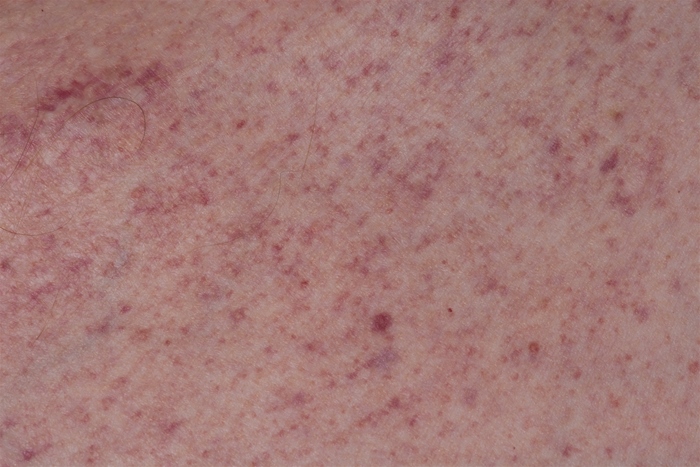 petechiae, purpura, epistaxis, gum bleeding, menorrhagia, and easy bruising.
Initial approach — three questions
- Is it real? Exclude pseudothrombocytopenia (EDTA-induced clumping) by repeating in a citrate tube.
- Are other cell lines affected?
- Isolated low platelets → ITP, drug-induced, HIT.
- Low platelets + anemia + schistocytes → microangiopathic hemolytic anemia (MAHA): TTP, HUS, DIC.
- Pancytopenia → bone-marrow problem (aplastic anemia, leukemia, B12/folate deficiency).
- Coagulation normal or abnormal?
- Normal PT/PTT/fibrinogen → ITP, TTP, HUS, HIT.
- Prolonged PT/PTT + low fibrinogen → DIC (consumptive coagulopathy).
| ملاحظة سريرية – نقطة التفرّع الأساسية | |
| السؤال الأهم في أي نقص صفيحات: هل هو معزول أم مصحوب بانحلال دم وكسور كريات حمراء (schistocytes)؟ النقص المعزول يوجّه نحو ITP، بينما وجود schistocytes يعني TTP / HUS / DIC. | ملاحظة |
This lesson covers the four most exam-tested causes — ITP (isolated, immune destruction), TTP and HUS (thrombotic microangiopathies with MAHA), and HIT (drug-induced, paradoxically pro-thrombotic). For the broader differential, refer to the common causes of thrombocytopenia by mechanism for the bone-marrow vs splenic vs peripheral-destruction breakdown.
| Important – فكرة سؤال: Pseudothrombocytopenia | |
|
تذكر |
Isolated Thrombocytopenia: Immune Thrombocytopenic Purpura (ITP)
Definition: Acquired autoimmune disorder in which IgG autoantibodies against platelet surface glycoproteins (GpIIb/IIIa) opsonize platelets for destruction by splenic macrophages.
Pathophysiology
- Antibody-coated platelets are cleared in the spleen → isolated thrombocytopenia.
- Marrow compensates → increased megakaryocytes and release of large/young platelets (megathrombocytes) into the blood.
Presentation — child vs adult
- Children: acute, self-limited; follows a viral infection (URI, EBV, varicella) by 1–4 weeks. Resolves in most within weeks.
- Adults: chronic; women > men. May be associated with SLE, HIV, HCV, CLL, or H. pylori — screen for these.
- Sudden mucocutaneous bleeding; patient otherwise looks well — no fever, no organomegaly, no neurologic signs.
| ملاحظة سريرية – ITP | |
| في ITP يبدو المريض بصحة جيدة بدون حمى أو أعراض عصبية. وجود تضخم الطحال أو فقر دم أو schistocytes ينفي تشخيص ITP ويستدعي البحث عن سبب آخر. | ملاحظة |
Diagnosis (diagnosis of exclusion)
- Isolated thrombocytopenia (often <30,000/mm³); Hb and WBC normal.
- Peripheral smear:
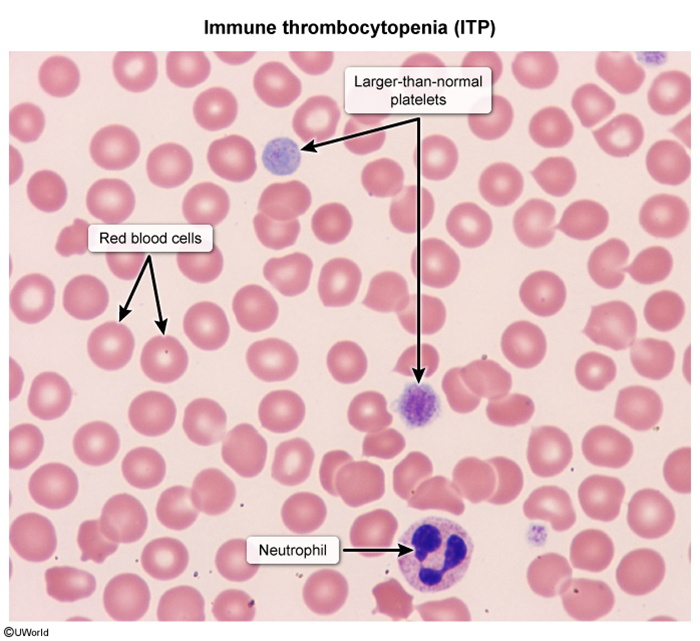 large platelets, no schistocytes.
 - Normal PT, PTT, fibrinogen.
- Bone marrow (not routinely needed): increased megakaryocytes.
The clinical features of immune thrombocytopenia (ITP) lays out the antecedent viral trigger, the isolated-thrombocytopenia lab pattern, and the bleeding-severity-based treatment thresholds.
Tiered management
- Platelets >30,000/mm³ & no bleeding → observe (especially children).
- Platelets <30,000 or bleeding → corticosteroids (prednisone) first-line.
- Severe bleeding / need rapid rise → IVIG or anti-D immunoglobulin (Rh+ only).
- Refractory / chronic adult ITP → splenectomy, rituximab, or TPO-receptor agonists (romiplostim, eltrombopag).
- Platelet transfusion only for life-threatening bleeding (transfused platelets are destroyed quickly).
| Important – فكرة سؤال: ITP Pitfalls | |
|
تذكر |
Thrombotic Microangiopathies: TTP & HUS
TTP and HUS are thrombotic microangiopathies — platelet-rich microthrombi in small vessels consume platelets and shear passing RBCs, producing MAHA (schistocytes, ↑LDH, ↑indirect bilirubin, ↓haptoglobin, negative Coombs). Key shared rule: PT/PTT/fibrinogen are normal — this separates them from DIC. The discriminator is the question "neuro or renal predominant?"
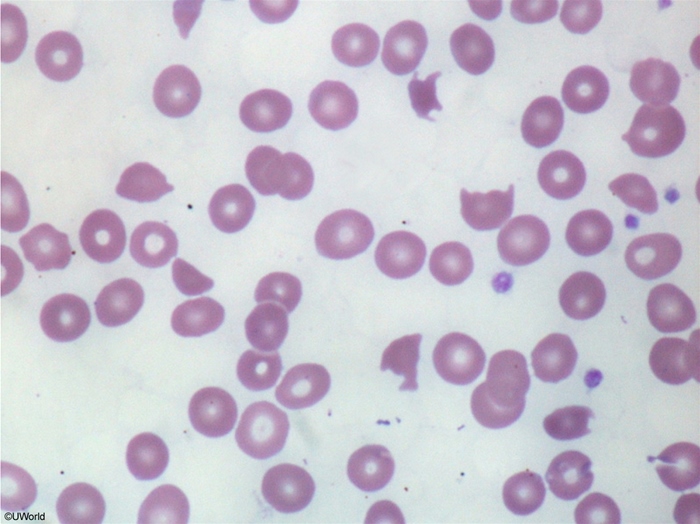 Schistocytes (helmet cells, triangular fragments) are the hallmark smear finding for both TTP and HUS.
TTP — ADAMTS13 deficiency (neuro-predominant)
- Mechanism: deficiency of ADAMTS13 (autoantibody = acquired; or genetic = Upshaw-Schulman) → uncleaved ultra-large vWF multimers → platelet-rich microthrombi.
- Patient: adult woman 30–50 y. Triggers: pregnancy, HIV, drugs (clopidogrel, quinine, cyclosporine).
- Clinical: neurologic signs predominate — confusion, headache, focal deficits, seizures; plus fever, jaundice, fatigue.
- Diagnosis: severe thrombocytopenia + MAHA; confirmatory ADAMTS13 activity <10%. Normal PT/PTT/fibrinogen.
- Management: urgent plasma exchange (plasmapheresis) — start immediately on clinical suspicion (replaces ADAMTS13, removes autoantibody). Add corticosteroids ± rituximab; caplacizumab (anti-vWF) in refractory cases. Avoid platelet transfusion.
The TTP pathophysiology, clinical features, and management summary lays out the ADAMTS13 mechanism and the plasma-exchange protocol.
HUS — Shiga toxin (renal-predominant)
- Mechanism: Typical (90%) = Shiga toxin-producing E. coli O157:H7 (also Shigella) binds Gb3 receptors on renal endothelium → injury → microthrombi. ADAMTS13 is normal. Atypical = complement dysregulation (factor H mutation), no diarrhea.
- Patient: child <5 y with bloody diarrhea 5–10 days earlier (undercooked beef, unpasteurized milk).
- Clinical: the classic triad = MAHA + thrombocytopenia + acute kidney injury (oliguria, hematuria, hypertension, edema). Neuro signs less prominent than TTP.
- Diagnosis:
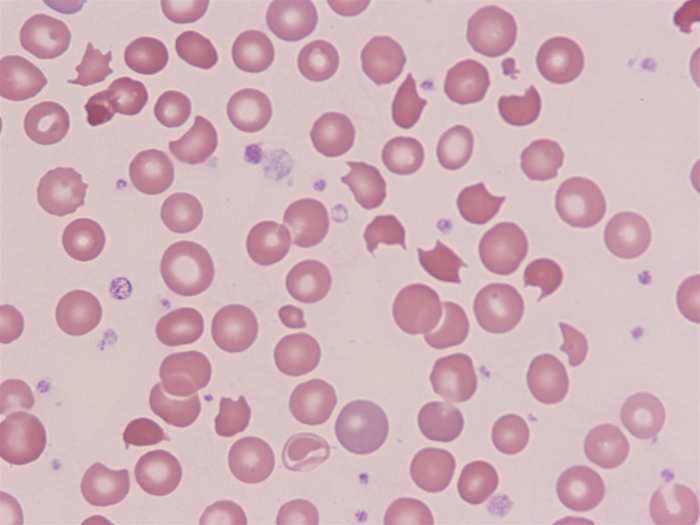 schistocytes + hemolysis labs; ↑BUN/creatinine; stool Shiga-toxin PCR. Normal PT/PTT/fibrinogen.
 - Management: supportive (IV fluids, electrolytes, dialysis if needed, RBC transfusion). Avoid antibiotics and anti-motility agents in STEC-HUS (increase toxin release). Atypical HUS → eculizumab. Plasma exchange is not first-line for typical HUS.
The HUS etiology and clinical-features summary details the Shiga-toxin mechanism and the MAHA + thrombocytopenia + AKI triad.
| Mnemonic – TTP & HUS | |
|
جملة تذكرية |
| ملاحظة سريرية – TTP / HUS | |
| لا تُعطِ نقل صفيحات في TTP أو HUS إلا عند نزف مهدد للحياة، لأنه يُغذّي الجلطات الدقيقة (microthrombi). وفي HUS الناتج عن E. coli O157:H7 تجنّب المضادات الحيوية ومضادات الإسهال لأنها قد تزيد إطلاق السم وتفاقم المرض. | ملاحظة |
Drug-Induced Thrombocytopenia: Heparin-Induced Thrombocytopenia (HIT)
Definition: Immune-mediated, drug-induced thrombocytopenia from IgG antibodies against the heparin–platelet factor 4 (PF4) complex. Platelets are activated, not merely destroyed — so HIT causes thrombosis, not bleeding.
Type I vs Type II
- Type I — non-immune, mild (platelets >100,000), within 1–2 days, resolves spontaneously; no clinical significance.
- Type II — immune-mediated, the dangerous form; this is what "HIT" refers to.
Pathophysiology — the paradoxical clot (Type II)
The 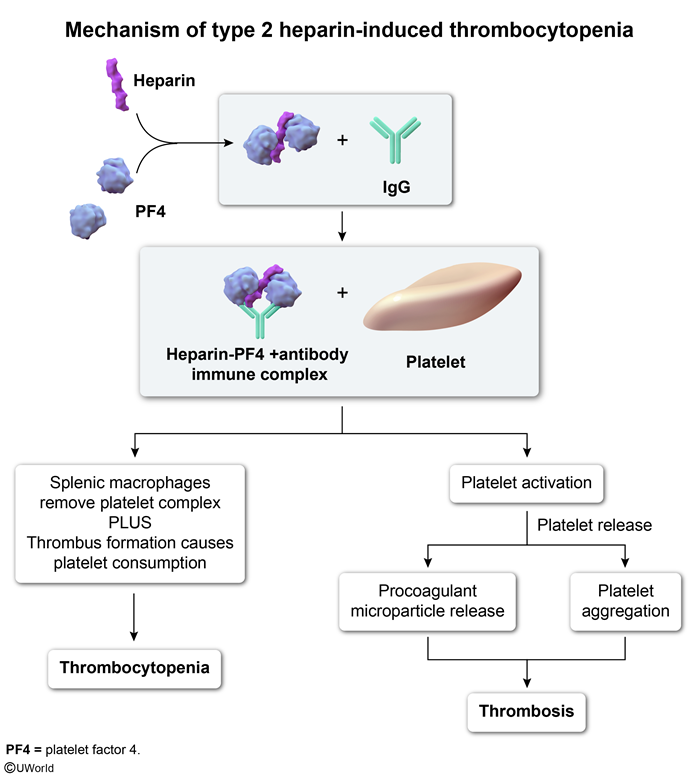 sequence:
- Heparin binds PF4 → heparin–PF4 complex.
- IgG antibodies form against the complex.
- Immune complex binds platelet FcγRIIa receptors → massive platelet activation and aggregation.
- Result: platelet consumption (thrombocytopenia) + thrombin generation (paradoxical thrombosis).
Clinical features
- Platelet drop >50% from baseline (nadir often 30,000–70,000) 5–10 days after starting heparin (rapid <24 h if heparin exposure within 100 days).
- Thrombosis (~50%): DVT, PE, arterial limb ischemia, stroke, MI, skin necrosis at injection sites.
- More common with unfractionated heparin than LMWH.
| ملاحظة سريرية هامة – HIT | |
| على الرغم من نقص الصفيحات، فإن الخطر الأكبر في HIT هو التخثر الشرياني والوريدي، وليس النزف. لذلك العلاج هو إيقاف الهيبارين فوراً والبدء بمضاد تخثر بديل (argatroban). | ملاحظة |
Diagnosis
- Start with the 4T score (pretest probability): Thrombocytopenia magnitude, Timing of platelet fall, Thrombosis/sequelae, oTher causes excluded.
- Score 4–8 (intermediate/high) → test for anti-PF4 antibodies by ELISA (sensitive screen).
- Serotonin release assay (SRA) — gold-standard confirmatory test (high specificity).
Use the 4T score for pretest probability of HIT for the point values across the four criteria, and the clinical features of type 2 HIT for the diagnostic and treatment pathway.
Urgent management
- Step 1: Stop ALL heparin immediately — including flushes and LMWH.
- Step 2: Start a non-heparin anticoagulant: argatroban (direct thrombin inhibitor, continuous IV 2 µg/kg/min, titrate to aPTT 1.5–3× baseline; preferred in renal failure), bivalirudin, or fondaparinux (7.5 mg SC daily; 5 mg if <50 kg, 10 mg if >100 kg).
- Step 3: Once platelets recover to >150,000, overlap and transition to warfarin. Never give warfarin alone early.
| Important – فكرة سؤال: HIT Pitfalls | |
|
تذكر |
Master Comparison & Management Principles
This is the single most important review for thrombocytopenia questions — most stems are solved by matching the patient profile + smear finding to one column.
| ITP vs TTP vs HUS vs HIT — Master Comparison | ||||
|---|---|---|---|---|
| Feature | ITP | TTP | HUS | HIT |
| Typical patient | Child post-viral / adult woman | Adult woman, 30–50 y | Child <5 y after bloody diarrhea | Any patient on heparin 5–10 days |
| Mechanism | Anti-platelet IgG (GpIIb/IIIa) → splenic destruction | ADAMTS13 deficiency → ultra-large vWF multimers | Shiga toxin (E. coli O157:H7) → endothelial injury | IgG vs heparin–PF4 → platelet activation |
| Main clue | Isolated bleeding, well-appearing | Neurologic signs + fever | Bloody diarrhea + AKI | New thrombosis on heparin |
| Schistocytes / MAHA | No | Yes | Yes | No |
| Renal failure | No | Mild | Severe (hallmark) | No |
| Neurologic signs | No | Prominent | Mild / absent | Only if stroke from clot |
| PT / PTT / fibrinogen | Normal | Normal | Normal | Normal |
| Treatment | Steroids → IVIG → splenectomy | Plasma exchange + steroids | Supportive; eculizumab (atypical) | Stop heparin → argatroban / fondaparinux |
| Platelet transfusion | Only if life-threatening bleed | Avoid | Avoid (unless bleeding) | Avoid (contraindicated) |
Absolute management rules
- Never transfuse platelets in TTP, HUS, or HIT (except life-threatening bleeding) — it fuels microthrombosis. In ITP, transfuse only for life-threatening bleeding (platelets destroyed rapidly).
- TTP → start plasma exchange immediately on suspicion — do not wait for ADAMTS13 results.
- STEC-HUS → supportive only; no antibiotics, no anti-motility agents (increase Shiga-toxin release). Atypical HUS → eculizumab.
- HIT → stop all heparin (including flushes/LMWH), start argatroban or fondaparinux; never warfarin alone (skin necrosis).
- DIC distinction → prolonged PT/PTT + low fibrinogen = DIC, not TTP/HUS (which have normal coagulation studies). See the laboratory characteristics of coagulopathies for the platelet/PT/PTT/fibrinogen/smear pattern across vWD, ITP, TTP-HUS, and DIC.
- Pseudothrombocytopenia → recheck in a citrate tube before any workup.
For a focused side-by-side of the three microvascular/immune destruction causes, the HUS vs TTP vs ITP differential compares prodrome, fever, neurologic changes, MAHA, AKI, and ADAMTS13 activity.
| ملاحظة سريرية – قاعدة نقل الصفيحات | |
| تجنّب نقل الصفيحات في TTP و HUS و HIT (إلا عند نزف مهدد للحياة) لأنه يزيد تكوّن الجلطات الدقيقة. أما في ITP فتُعطى فقط عند النزف الشديد لأن الصفيحات المنقولة تُدمَّر بسرعة. | ملاحظة |
احصل على التجربة الكاملة
اشترك للوصول لفيديوهات الشرح التفصيلي والبطاقات التعليمية التفاعلية وأسئلة الممارسة مع تتبع التقدم.