Summary
Qualitative platelet function disorders cause mucocutaneous bleeding due to primary hemostasis failure, characteristically presenting with prolonged bleeding time (or abnormal PFA-100) alongside normal PT, aPTT, and generally normal platelet counts. Bernard-Soulier syndrome (autosomal recessive) features a GPIb deficiency causing impaired adhesion, presenting with mild thrombocytopenia and giant platelets; unlike von Willebrand disease, its absent ristocetin aggregation is not corrected by normal plasma. Glanzmann thrombasthenia (autosomal recessive) stems from a GPIIb/IIIa deficiency causing defective aggregation with normal platelet count/size, failing to aggregate with ADP, collagen, or epinephrine. Uremic platelet dysfunction is an acquired defect from elevated BUN that impairs activation. Light-transmission aggregometry and flow cytometry are gold-standard diagnostic tests. Management requires avoiding NSAIDs; platelet transfusions treat severe inherited bleeding, while dialysis and desmopressin (DDAVP) reverse uremic dysfunction.
Overview & Pathophysiology
The platelet function (qualitative) disorders share one clinical signature: mucocutaneous bleeding caused by a defect in primary hemostasis. The hallmark laboratory pattern is a prolonged bleeding time / abnormal PFA-100 with normal PT and aPTT (the coagulation cascade is intact) and a platelet count that is usually normal — the platelets are present but do not work.
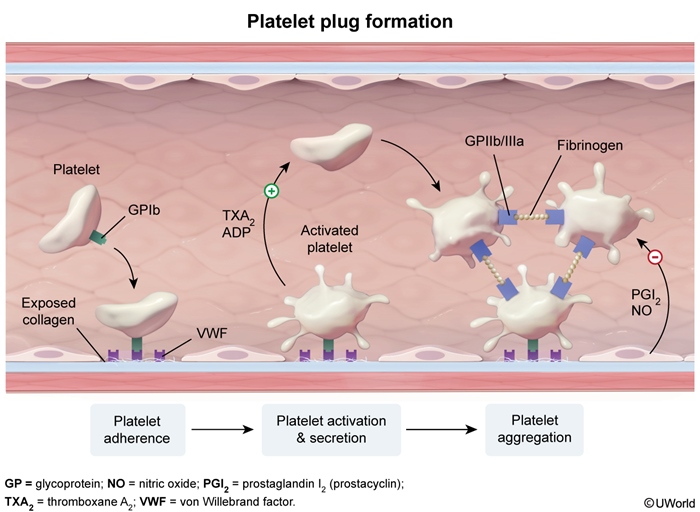
Primary hemostasis proceeds in three steps, and each of the three classic disorders breaks one specific step:
- Adhesion — platelet GPIb–IX–V binds vWF on exposed subendothelial collagen. Defective in Bernard-Soulier syndrome.
- Activation — platelets release ADP and TXA₂, change shape, and up-regulate receptors. Defective in uremia, where toxins blunt activation and granule release.
- Aggregation — GPIIb/IIIa binds fibrinogen, cross-linking adjacent platelets into a plug. Defective in Glanzmann thrombasthenia.
Mapping each defect onto the platelet-plug cascade makes the differences memorable — Bernard-Soulier fails the first step, uremia the middle step, and Glanzmann the final step:
Clinical Presentation & Etiology
Shared clinical picture — mucocutaneous bleeding. All three disorders bleed from skin and mucous membranes rather than into deep tissues or joints (deep/hemarthrosis bleeding instead points to a coagulation-factor defect such as hemophilia):
- Epistaxis (often the most common), gingival bleeding, easy bruising / ecchymoses, and petechiae.
- Menorrhagia, GI bleeding, and prolonged bleeding after minor trauma, dental work, or surgery (e.g., post-circumcision, after AV-fistula creation).
Etiology — inherited vs. acquired. The history usually separates the inherited defects from the acquired one:
- Bernard-Soulier & Glanzmann — inherited, autosomal recessive; bleeding begins in infancy / early childhood and is lifelong, often with a positive family history or consanguinity.
- Uremia — acquired in a known CKD/dialysis patient; bleeding tracks the degree of azotemia (markedly elevated BUN) and resolves as toxins are cleared.
| Etiology of platelet function disorders: Inherited (autosomal recessive) vs. acquired | |
| Inherited | Autosomal recessive |
| Bernard-Soulier syndrome | Deficiency/dysfunction of the GPIb–IX–V complex (GP1BA, GP1BB, GP9 genes) → defective adhesion |
| Glanzmann thrombasthenia | Deficiency/dysfunction of GPIIb/IIIa, integrin αIIbβ3 (ITGA2B, ITGB3 genes) → defective aggregation |
| Acquired | Systemic / iatrogenic |
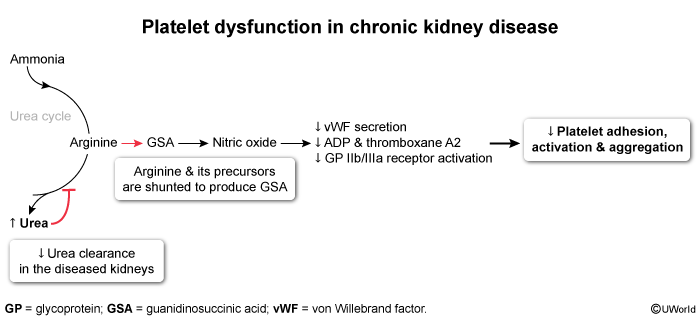
| Uremia (chronic kidney disease) | Uremic toxins (urea, guanidinosuccinic acid) plus anemia of CKD impair activation/aggregation — the most common acquired platelet defect in hospitalized patients |
| Drug-induced | Aspirin (irreversible COX-1), NSAIDs, clopidogrel — must be avoided in all of these patients |
In uremia the mechanism is multifactorial: accumulated toxins and excess nitric oxide impair platelet–vWF interaction and granule release, while the anemia of CKD pushes platelets away from the vessel wall — all of which is reversible with dialysis.
| Note – ملاحظة | |
Uremia is the most common acquired platelet function disorder in hospitalized patients. Always suspect it when a known CKD/dialysis patient bleeds without an obvious surgical or structural cause. |
ملاحظة |
Diagnostic Approach
Diagnosis rests on the shared screening pattern (prolonged bleeding time / PFA-100 with normal PT, aPTT, and usually normal count) followed by platelet aggregation studies — light-transmission aggregometry is the key confirmatory test. Compare all three side by side first:
| Bernard-Soulier vs. Glanzmann vs. Uremia | |||
|---|---|---|---|
| Feature | Bernard-Soulier | Glanzmann | Uremia |
| Inheritance / cause | Autosomal recessive | Autosomal recessive | Acquired (CKD) |
| Core defect | GPIb–IX–V deficiency | GPIIb/IIIa deficiency | Uremic toxins impair function |
| Step affected | Adhesion (platelet–vWF) | Aggregation (fibrinogen bridging) | Activation / aggregation |
| Platelet count | Low (mild thrombocytopenia) | Normal | Normal |
| Platelet size | Giant platelets (↑ MPV) | Normal | Normal |
| Bleeding time / PFA-100 | Prolonged | Prolonged | Prolonged |
| PT / aPTT | Normal | Normal | Normal |
| Ristocetin aggregation | Absent — NOT corrected by normal plasma | Normal | Usually normal |
| ADP / collagen / epinephrine | Normal | Absent | Decreased |
Absolute key diagnostic buzzwords:
- Bernard-Soulier: low platelet count + giant platelets on smear; absent ristocetin-induced aggregation that is NOT corrected by normal plasma; confirm with flow cytometry showing reduced GPIb.
- Glanzmann: normal count and size; normal ristocetin response but absent aggregation with ADP, collagen, epinephrine, and thrombin; confirm with flow cytometry showing reduced GPIIb/IIIa.
- Uremia: known CKD with markedly elevated BUN; normal count, prolonged bleeding time, normal PT/aPTT; the defect reverses with dialysis.
Bernard-Soulier vs. von Willebrand disease (vWD). Both fail to aggregate with ristocetin, so the discriminator is the mixing/ristocetin cofactor study: adding normal plasma supplies vWF and corrects vWD, but in BSS the platelet GPIb receptor itself is missing, so adding plasma does not correct the defect.
| فخ امتحاني – Exam Trap (BSS vs. vWD) | |
|
فخ امتحاني: كلاهما (BSS و vWD) يُظهران خللاً في اختبار الريستوسيتين، لكن إضافة البلازما الطبيعية تُصحح الخلل في vWD فقط، وليس في BSS. |
ملاحظة |
| Important – فكرة سؤال | |
|
تذكر |
See the laboratory characteristics of coagulopathies (PT, aPTT, platelet count, bleeding time) for how these qualitative defects sit alongside vWD, hemophilia, DIC, and ITP on coagulation-study pattern recognition.
Management Principles
Management is best organized by treatment type rather than by disease, because the supportive measures are shared and only the definitive therapy differs between the inherited defects and uremia.
1. Supportive / shared measures (all patients)
- Avoid antiplatelet agents — no aspirin, NSAIDs, or clopidogrel, which compound the defect.
- Local measures — direct compression and nasal packing for mucosal bleeding.
- Antifibrinolytics — tranexamic acid (oral 1 g three times daily, or IV 10 mg/kg) or aminocaproic acid for mucosal/menstrual bleeding and dental procedures.
2. Inherited disorders (Bernard-Soulier & Glanzmann)
- Platelet transfusion — the definitive therapy for severe bleeding or before surgery. Risk: alloantibody formation against the missing glycoprotein (GPIb or GPIIb/IIIa) → refractoriness to future transfusions, so reserve for significant bleeding.
- Recombinant factor VIIa (≈90 µg/kg IV) — useful when platelets are ineffective due to alloimmunization, especially in Glanzmann thrombasthenia.
3. Uremic platelet dysfunction (acquired)
- Dialysis — removes uremic toxins; the first-line approach for chronic/recurrent bleeding.
- Desmopressin (DDAVP) 0.3 µg/kg IV or SC — releases vWF/factor VIII from endothelium; rapid onset (1–2 h), ideal for acute bleeding or urgent pre-procedure cover (tachyphylaxis limits repeat dosing).
- Correct anemia with erythropoietin (target Hb ≈10 g/dL) — restores platelet–vessel-wall interaction.
- Cryoprecipitate — supplies vWF/fibrinogen if DDAVP fails.
- Conjugated estrogens (0.6 mg/kg/day IV for 5 days) — slower onset but a more sustained effect.
| ملاحظة سريرية هامة – Clinical Pearl (Uremia) | |
ملاحظة سريرية هامة: في مريض الكلى الذي ينزف بشكل حاد قبل الجراحة، العلاج الفوري هو DDAVP. أما للنزف المزمن، فالأساس هو غسيل الكلى (Dialysis) وتصحيح فقر الدم. |
ملاحظة |
| Important – فكرة سؤال | |
DDAVP (desmopressin) improves bleeding in uremia, vWD (type 1), and mild hemophilia A by releasing endothelial vWF/factor VIII. It does NOT work in Bernard-Soulier or Glanzmann — the missing glycoprotein cannot be replaced by raising vWF. For these inherited defects, platelet transfusion is the definitive therapy. |
تذكر |
High-Yield Summary & Mnemonics
Rapid-review takeaways for exams:
- All three present with mucocutaneous bleeding + normal PT/aPTT + prolonged bleeding time / PFA-100.
- Bernard-Soulier: low platelets, giant platelets, absent ristocetin aggregation not corrected by normal plasma.
- vWD vs. BSS: both fail ristocetin, but vWD is corrected by normal plasma; BSS is not.
- Glanzmann: normal count and size, normal ristocetin, absent aggregation with ADP / collagen / epinephrine.
- Uremia: the most common acquired platelet dysfunction; treat with dialysis + DDAVP and correct anemia.
- DDAVP works in uremia, vWD (type 1), and mild hemophilia A — it does NOT work in BSS or Glanzmann.
- Avoid aspirin/NSAIDs in all platelet function disorders.
- Definitive treatment for severe inherited bleeding = platelet transfusion; beware alloimmunization against the missing glycoprotein.
| Mnemonics – جمل تذكيرية | |
|
جملة تذكرية |
احصل على التجربة الكاملة
اشترك للوصول لفيديوهات الشرح التفصيلي والبطاقات التعليمية التفاعلية وأسئلة الممارسة مع تتبع التقدم.