شرح المدرسين

Summary
Von Willebrand disease (vWD) is the most common inherited bleeding disorder, caused by quantitative (type 1 [autosomal dominant, most common], type 3 [autosomal recessive, severe]) or qualitative (type 2) defects in von Willebrand factor (vWF). Because vWF mediates platelet adhesion via subendothelial GPIb and carries Factor VIII, patients present with mucocutaneous bleeding (menorrhagia, epistaxis) and iron-deficiency anemia without hemarthrosis. Screening reveals normal platelet counts (except type 2B), normal PT, prolonged bleeding time, and normal or mildly prolonged aPTT that corrects on mixing studies. The gold-standard diagnostic test is ristocetin cofactor activity (vWF:RCo). First-line management for type 1 is desmopressin (DDAVP); desmopressin is strictly contraindicated in type 2B (worsens thrombocytopenia) and ineffective in type 3, requiring vWF-containing concentrates. Aspirin and NSAIDs are strictly contraindicated.
Overview
Von Willebrand disease (vWD) is the most common inherited bleeding disorder (prevalence ~1%), caused by a quantitative or qualitative defect in von Willebrand factor (vWF) — a large glycoprotein synthesized by endothelial cells and megakaryocytes and stored in endothelial Weibel-Palade bodies and platelet α-granules.
- Inheritance: Autosomal dominant in types 1 and 2; autosomal recessive in type 3.
- Sex: Affects males and females equally, but women present more often (menorrhagia, postpartum bleeding).
- Onset: Usually mild; frequently diagnosed in adolescence/adulthood after surgery, dental work, or heavy menses.
Pathophysiology
What vWF does (two jobs)
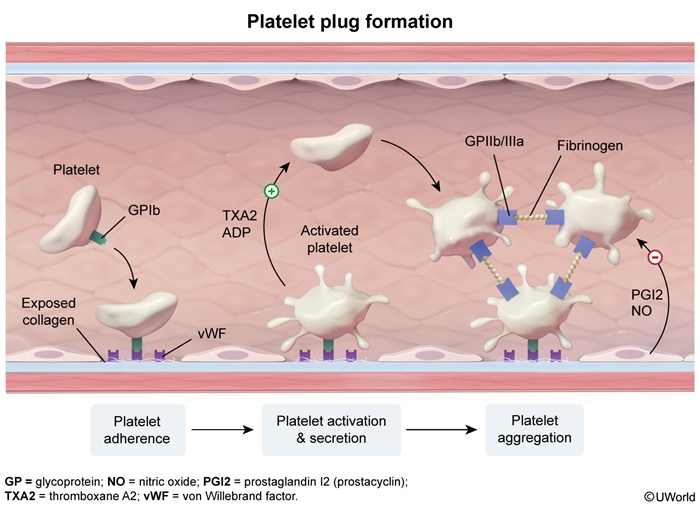
- Platelet adhesion (primary hemostasis): at a site of vascular injury vWF binds exposed subendothelial collagen, then captures platelets via the GPIb receptor → anchors platelets to the vessel wall.
- Factor VIII carrier: vWF circulates bound to Factor VIII, protecting it from proteolysis. Without vWF, FVIII half-life falls sharply → a functional FVIII deficiency.
Consequences of the defect
- Impaired platelet plug → mucocutaneous bleeding (skin and mucous membranes).
- Low Factor VIII → mildly prolonged aPTT (intrinsic pathway).
- Platelet number is normal — only platelet function is impaired (exception: type 2B).
| Mnemonic – Functions of vWF | |
|
"vWF = Velcro + FVIII carrier"
Lose vWF → you lose both primary hemostasis (platelet plug) and intrinsic-pathway support (↓ FVIII → ↑ aPTT). |
جملة تذكرية |
Classification (types of vWD)
Three main types — distinguished by whether vWF is reduced in quantity or defective in quality. Type 2 is further split into subtypes 2A, 2B, 2M, and 2N.
| Classification of Von Willebrand Disease: By mechanism of vWF defect | |
| Type 1 | Partial quantitative deficiency (~75%, most common) |
| Inheritance | Autosomal dominant |
| vWF level | Mildly–moderately ↓; vWF is functionally normal |
| Severity / Rx | Mild bleeding; responds well to DDAVP |
| Type 2 | Qualitative defect (~20%) — abnormal vWF |
| 2A | Loss of high-molecular-weight (HMW) multimers → ↓ platelet adhesion |
| 2B | Gain-of-function: vWF binds platelets spontaneously → thrombocytopenia. DDAVP CONTRAINDICATED |
| 2M | ↓ platelet binding without multimer loss |
| 2N | ↓ Factor VIII binding → mimics mild hemophilia A |
| Type 3 | Complete quantitative deficiency (rare, severe) |
| Inheritance | Autosomal recessive |
| vWF level | Virtually absent → very low FVIII |
| Presentation | Severe bleeding resembling hemophilia (hemarthrosis possible) |
| فخ امتحاني – Exam Trap | |
|
فخ امتحاني: في النوع 2B يرتبط الـ vWF بالصفائح تلقائياً ويستهلكها ← نقص صفيحات (thrombocytopenia). لذلك يُعدّ DDAVP ممنوعاً في 2B لأنه يفاقم نقص الصفيحات. تذكّر: 2B = Bad for DDAVP. |
ملاحظة |
Clinical Presentation
The hallmark is a mucocutaneous (platelet-type) bleeding pattern — superficial bleeding from skin and mucous membranes — not deep-tissue bleeding.
Typical bleeding
- Epistaxis — recurrent nosebleeds; often the earliest sign in children.
- Gum bleeding — especially with brushing or dental procedures.
- Easy bruising and prolonged oozing from small cuts.
- Menorrhagia — heavy menstrual bleeding is the most common presentation in women.
- Postpartum hemorrhage — vWF rises in pregnancy but falls rapidly after delivery.
- GI bleeding — in older patients, may be linked to angiodysplasia.
- Excessive bleeding after surgery, tonsillectomy, or tooth extraction.
What you do NOT typically see
- Hemarthrosis or deep muscle hematoma → these point to hemophilia, not vWD (exception: severe type 3).
- Petechiae are uncommon, because the platelet count is normal.
| Important – فكرة سؤال | |
Classic stem: a young woman with heavy menstrual periods since menarche, recurrent epistaxis, easy bruising, and prolonged bleeding after dental extraction; positive family history; normal platelet count with a mildly prolonged aPTT that corrects on a mixing study. → Think Von Willebrand disease, frequently presenting as iron-deficiency anemia from chronic mucosal blood loss. |
تذكر |
Complications & clinical course
- Iron-deficiency anemia from chronic mucosal blood loss (menorrhagia, GI bleeding) — a common first clue.
- Postpartum hemorrhage as vWF/FVIII fall sharply after delivery.
- Excessive surgical/dental bleeding when the disease is undiagnosed before a procedure.
- GI bleeding from angiodysplasia — particularly in older patients with type 2A.
- Acquired vWD — a rare secondary form caused by destruction or clearance of large vWF multimers, seen with aortic stenosis (Heyde syndrome = aortic stenosis + GI angiodysplasia bleeding from shear-induced loss of HMW multimers), lymphoproliferative disorders, hypothyroidism, and left ventricular assist devices.
| ملاحظة سريرية – Clinical Note | |
ملاحظة سريرية: أشيع تظاهر عند النساء هو غزارة الطمث (menorrhagia) منذ البلوغ، وقد تؤدّي إلى فقر دم بعوز الحديد. النزف هنا مخاطي جلدي وليس عميقاً — لا يوجد نزف مفصلي (hemarthrosis) كما في الهيموفيليا (إلا في النوع 3 الشديد). |
ملاحظة |
Diagnostic Approach & Differential Diagnosis
Diagnosis combines a screening coagulation panel (which shows a platelet-type pattern) with a confirmatory vWD panel. Suspect vWD in anyone with lifelong mucocutaneous bleeding, a positive family history, or unexplained iron-deficiency anemia.
Initial / screening labs
- Platelet count (CBC): Normal — low only in type 2B.
- PT: Normal.
- aPTT: Normal or mildly prolonged (low FVIII); corrects on a mixing study → confirms a factor deficiency, not an inhibitor.
- Bleeding time / PFA-100 closure time: Prolonged → reflects defective platelet adhesion.
Confirmatory testing (vWD panel)
- vWF antigen (vWF:Ag): quantitative vWF level — low in types 1 and 3.
- Ristocetin cofactor activity (vWF:RCo): the best functional test (gold-standard for activity); ristocetin induces vWF-mediated platelet agglutination — low in all symptomatic types.
- Factor VIII activity: low — most marked in types 2N and 3.
- vWF multimer analysis: used to subclassify type 2.
- Ristocetin-induced platelet aggregation (RIPA): Increased in type 2B (platelets agglutinate even at low ristocetin doses).
For the full pattern-recognition grid across bleeding disorders, see the Laboratory Characteristics of Coagulopathies for the PT, aPTT, platelet-count and bleeding-time pattern that separates vWD from hemophilia, DIC, uremia, and ITP.
Differential diagnosis — the master comparison
The two highest-yield mimics on the exam are hemophilia A (deep bleeding, X-linked, normal platelets) and ITP (low platelets, mucocutaneous bleeding). The table below contrasts all three.
| vWD vs Hemophilia A vs ITP — high-yield differential | |||
|---|---|---|---|
| Feature | Von Willebrand disease | Hemophilia A | ITP |
| Inheritance | Autosomal dominant (most) | X-linked recessive | Acquired / autoimmune |
| Bleeding pattern | Mucocutaneous (epistaxis, menorrhagia) | Deep — hemarthrosis, muscle hematoma | Mucocutaneous + petechiae |
| Platelet count | Normal (low only in type 2B) | Normal | Low |
| Bleeding time / PFA-100 | Prolonged | Normal | Prolonged |
| PT | Normal | Normal | Normal |
| aPTT | Normal or mildly ↑ | Markedly ↑ | Normal |
| Factor VIII | Normal or ↓ | ↓↓ | Normal |
| First-line treatment | DDAVP; vWF concentrate | Recombinant Factor VIII | Corticosteroids, IVIG |
Other conditions worth considering: Bernard-Soulier syndrome (GPIb defect → giant platelets, mild thrombocytopenia), Glanzmann thrombasthenia (GPIIb/IIIa defect → impaired aggregation), and uremic platelet dysfunction (acquired in CKD, also responds to DDAVP). For the inheritance, lab, and treatment details of the closest mimic, refer to the Hemophilia A & B comparison.
| فخ امتحاني – Exam Trap | |
|
فخ امتحاني: الـ aPTT قد يكون طبيعياً أو مرتفعاً قليلاً (بسبب نقص FVIII) ويُصحَّح في اختبار الخلط (mixing study) لأنها نقص عامل وليست مثبّطاً. الاختبار الوظيفي الأفضل للتشخيص هو Ristocetin cofactor activity (vWF:RCo)، ويكون الـ RIPA مرتفعاً في النوع 2B فقط. |
ملاحظة |
Management
General principles
- Avoid antiplatelet drugs — no aspirin or NSAIDs.
- Treat minor bleeds with local measures (pressure, packing) plus tranexamic acid.
- Plan ahead for surgery and dental work with prophylactic therapy.
Specific therapies
- Desmopressin (DDAVP): first-line for type 1 (and mild type 2A). Releases stored vWF and FVIII from endothelial Weibel-Palade bodies. Dose 0.3 µg/kg IV/SC over 15–30 min, or intranasal 150 µg (one spray) per nostril. Contraindicated in type 2B; ineffective in type 3.
- vWF-containing concentrates (e.g., Humate-P, plasma-derived or recombinant vWF/FVIII): used for types 2 and 3, major surgery, or severe bleeding. Dosed by ristocetin cofactor (RCo) units.
- Antifibrinolytics — tranexamic acid (oral/IV) or aminocaproic acid: adjuncts for menorrhagia, dental, and mucosal bleeding.
- Combined oral contraceptives: reduce menorrhagia by stabilizing the endometrium and slightly raising vWF/FVIII.
- Cryoprecipitate: contains vWF, FVIII, and fibrinogen — used only when concentrates are unavailable.
For elective procedures, dosing of replacement therapy is stratified by bleeding risk — see the Perioperative Management of VWD with VWF Concentrates for loading dose, maintenance dose, and duration by major vs minor surgery. For the broader pharmacology of desmopressin, the Effects of Desmopressin (DDAVP) Therapy contrasts its hemostatic and renal (V2-receptor) uses.
| Note – ملاحظة | |
|
DDAVP (desmopressin) is a synthetic ADH analog. In bleeding disorders it stimulates release of pre-formed vWF and Factor VIII from Weibel-Palade bodies.
|
ملاحظة |
| ملاحظة سريرية – Clinical Note | |
|
ملاحظة سريرية: الـ DDAVP يحرّر الـ vWF و FVIII المخزّن في أجسام Weibel–Palade البطانية؛ لذا فهو غير فعّال في النوع 3 (لا مخزون) وممنوع في 2B. الاستعمال المتكرر يسبّب تسرّع التحمّل (tachyphylaxis) نتيجة استنزاف المخزون، مع خطر نقص صوديوم الدم واحتباس الماء. تجنّب الأسبرين و NSAIDs في جميع المرضى. |
ملاحظة |
High-Yield Summary & Exam Traps
One-screen recap of the testable points — pair the mnemonic with the trap list below.
| Mnemonic – vWD essentials | |
"vWD = 1-2-3 + DDAVP"
Bleeding = Mucocutaneous → think MEN: Menorrhagia, Epistaxis, Nosebleed / gum bleeding. |
جملة تذكرية |
| Key Exam Traps – نقاط مهمة للامتحانات | |
|
تذكر |
احصل على التجربة الكاملة
اشترك للوصول لفيديوهات الشرح التفصيلي والبطاقات التعليمية التفاعلية وأسئلة الممارسة مع تتبع التقدم.