Summary
Hereditary spherocytosis (HS) is an autosomal dominant erythrocyte membrane disorder caused by mutations in anchoring proteins (most commonly ankyrin via ANK1 or spectrin), leading to loss of membrane surface area and sphere-shaped red cells. The resulting rigid spherocytes undergo splenic trapping and extravascular destruction, producing a normocytic (or mildly microcytic) hemolytic anemia.
Clinical hallmarks include the triad of anemia, jaundice, and splenomegaly, complicated by calcium bilirubinate (pigmented) gallstones and transient aplastic crises triggered by parvovirus B19. Peripheral blood smear demonstrates spherocytes (lacking central pallor) and polychromasia, alongside an elevated MCHC (> 36 g/dL) and a negative direct Coombs test (distinguishing it from warm AIHA). Diagnosis is confirmed via the eosin-5-maleimide (EMA) binding test or osmotic fragility test. Management consists of daily folic acid supplementation and splenectomy (delayed until after age 5–6 with prior encapsulated organism vaccinations) for moderate-to-severe disease.
Overview
Definition
Hereditary spherocytosis (HS) is the most common inherited hemolytic anemia in people of Northern European descent. A defect in RBC membrane–cytoskeleton anchoring proteins (most often ankyrin or spectrin) causes red cells to lose surface area and become small, round, rigid spherocytes that are trapped and destroyed in the spleen — i.e. extravascular hemolysis.
Epidemiology & genetics
- Most common inherited hemolytic anemia in Northern European ancestry (~1 in 2,000–5,000).
- Inheritance: autosomal dominant in ~75% (positive family history of anemia, jaundice, early gallstones, or splenectomy); the remainder are autosomal recessive or de novo.
- Most common mutated gene: ANK1 (ankyrin) — ~50% of cases. Others: SPTA1/SPTB (spectrin), SLC4A1 (band 3), EPB42 (protein 4.2).
- Age of presentation: wide range — from neonatal jaundice to adulthood, depending on severity.
Pathophysiology
Pathophysiology
Normal RBCs are biconcave because the lipid bilayer is tethered to an internal cytoskeleton by spectrin, ankyrin, band 3, and protein 4.2. When any anchoring protein is defective:
- The bilayer loses its anchoring and small membrane vesicles bud off.
- The cell loses surface area while keeping its volume → it becomes a sphere.
- Spherocytes are rigid and cannot squeeze through splenic sinusoids.
- Red-pulp macrophages in the spleen trap and destroy them → extravascular hemolysis.
- Heme breakdown → ↑ unconjugated (indirect) bilirubin → jaundice and pigmented gallstones.
- The marrow compensates → reticulocytosis (polychromasia on smear).
Because destruction is splenic rather than intracirculatory, HS sits firmly among the intravascular vs extravascular causes of hemolysis, which is worth reviewing to anchor where HS fits among hemolytic anemias.
| Important – فكرة سؤال | |
|
Hemolysis in HS is extravascular (splenic macrophages), NOT intravascular. Therefore you do NOT see hemoglobinuria or hemosiderinuria — these are intravascular clues. Expect ↑ indirect bilirubin, ↑ LDH, and ↓ haptoglobin instead. |
تذكر |
Clinical Presentation & Complications
Classic triad
- Anemia — fatigue, pallor, exertional dyspnea.
- Jaundice — scleral icterus; dark urine from urobilinogen (NOT hemoglobin).
- Splenomegaly — left-upper-quadrant fullness; the spleen is the site of hemolysis.
Presentations across the lifespan
- Neonatal jaundice — severe and prolonged; may need phototherapy or exchange transfusion; often the first clue.
- Chronic compensated hemolysis in children and young adults, with intermittent flares.
- Family history of anemia, early gallstones, or prior splenectomy.
Complications (one continuous clinical picture)
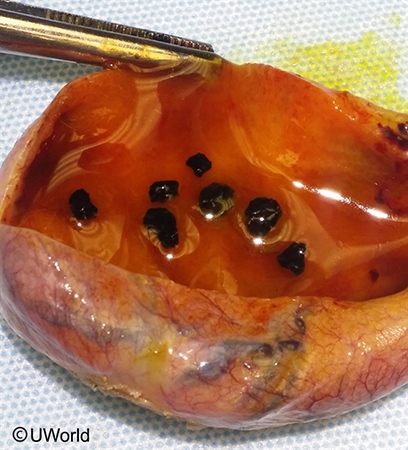
- Pigmented (black) gallstones — chronic hemolysis → ↑ unconjugated bilirubin → calcium bilirubinate stones; cause biliary colic, cholecystitis, or pancreatitis, and are common even in adolescents.
- Aplastic crisis — parvovirus B19 infects erythroid progenitors → transient marrow shutdown → sudden severe anemia with LOW reticulocytes.
- Hemolytic crisis — infection-triggered worsening anemia and jaundice with HIGH reticulocytes (more common than aplastic crisis).
- Megaloblastic crisis — folate depletion in patients not on supplements.
- Iron overload — in transfusion-dependent patients.
- Post-splenectomy sepsis (OPSI) — encapsulated organisms; prevention is covered under Management.
| Important – فكرة سؤال | |
|
A child with known HS who develops a sudden hemoglobin drop with LOW reticulocytes = aplastic crisis from parvovirus B19 (infects erythroid progenitors). Contrast with a hemolytic crisis (infection-triggered), where reticulocytes are HIGH. |
تذكر |
For a single-page revision aid, see the Hereditary spherocytosis clinical summary for the integrated epidemiology, clinical features, labs, treatment, and complications.
Diagnostic Approach
Diagnosis combines CBC + peripheral smear + hemolysis labs + a confirmatory test, with a Coombs test to separate HS from autoimmune hemolysis.
Initial labs
- CBC: normocytic anemia with ↑ MCHC (> 36 g/dL) — the most specific clue; MCV is usually normal to low.
- RDW: elevated.
- Reticulocytes: increased (compensatory).
- Hemolysis panel: ↑ indirect bilirubin, ↑ LDH, ↓ haptoglobin.
- Direct Coombs (DAT): NEGATIVE — the key step that excludes autoimmune hemolysis.
| فخ امتحاني – Exam Trap | |
|
ارتفاع الـ MCHC هو العلامة الأكثر تمييزاً في تعداد الدم الكامل لكثرة الكريات الحمر الكروية الوراثي. |
ملاحظة |
Peripheral smear
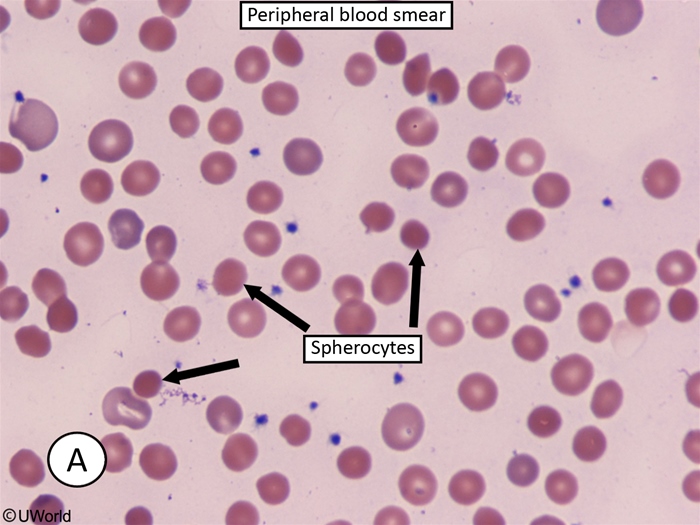
Spherocytes: small, round, densely staining RBCs lacking central pallor, accompanied by polychromasia (reticulocytes).
Confirmatory tests
- EMA (eosin-5-maleimide) binding test — current first-line confirmatory test; ↓ fluorescence because EMA binds band 3 (deficient in HS); high sensitivity and specificity.
- Osmotic fragility test — the classic test; spherocytes lyse easily in hypotonic saline; less sensitive and may miss mild cases.
- Acidified glycerol lysis test — alternative.
Key differential — spherocytes on the smear
Both HS and warm autoimmune hemolytic anemia (AIHA) show spherocytes — the Coombs test separates them.
| Spherocytes on Smear — HS vs. Warm Autoimmune Hemolytic Anemia (AIHA) | ||
|---|---|---|
| Feature | Hereditary Spherocytosis | Warm AIHA |
| Mechanism | Inherited membrane protein defect (ankyrin/spectrin) | IgG autoantibody against RBC surface |
| Direct Coombs (DAT) | NEGATIVE | POSITIVE |
| Family history | Often present (AD) | Usually absent |
| Typical age | Childhood / young adult | Any age; often adult |
| MCHC | ↑ (classic clue) | Usually normal |
| Confirmatory test | EMA binding / osmotic fragility | Direct antiglobulin (Coombs) test |
| Treatment | Folic acid ± splenectomy | Corticosteroids ± rituximab |
| ملاحظة سريرية – Clinical Note | |
|
وجود الخلايا الكروية مع اختبار كومبس سلبي يوجه التشخيص بقوة نحو كثرة الكريات الحمر الكروية الوراثي بدلاً من انحلال الدم المناعي. |
ملاحظة |
If Coombs is positive, work up autoimmune hemolysis instead — see the warm vs cold agglutinin AIHA comparison for the antibody type, triggers, and management that distinguish the two.
Other conditions to consider:
- G6PD deficiency — X-linked, episodic oxidative hemolysis with Heinz bodies and bite cells after triggers (fava beans, primaquine, sulfa, infection); no spherocytes. The G6PD deficiency summary lays out the bite-cell/Heinz-body picture and the negative Coombs test it shares with HS.
- ABO hemolytic disease of the newborn — neonatal jaundice with spherocytes, but Coombs positive.
- Sickle cell disease / thalassemia — different smear (sickle cells, target cells); abnormal hemoglobin electrophoresis.
- Hereditary elliptocytosis — related membrane defect, but smear shows elliptocytes and disease is usually mild.
Management
Supportive care (all patients)
- Folic acid — oral 1 mg daily to support high RBC turnover and prevent megaloblastic crisis.
- RBC transfusion — for severe anemia, hemolytic or aplastic crises, and symptomatic infants.
- Phototherapy ± exchange transfusion — for severe neonatal jaundice.
Splenectomy (definitive)
Removes the site of hemolysis → anemia and jaundice resolve, but the membrane defect persists and spherocytes remain on the smear.
- Indications: moderate-to-severe anemia, transfusion dependence, growth failure, or severe symptoms.
- Timing: ideally after age 5–6 years to reduce the risk of overwhelming post-splenectomy infection (OPSI).
- Vaccinate first (≥2 weeks pre-op): pneumococcal, meningococcal, and H. influenzae type b (encapsulated organisms).
- Concurrent cholecystectomy if pigmented gallstones are present.
- Post-op: lifelong penicillin prophylaxis in children; low threshold for sepsis from encapsulated bacteria; expect Howell-Jolly bodies on the smear.
| فخ امتحاني – Exam Trap | |
|
قبل استئصال الطحال يجب إعطاء اللقاحات ضد الجراثيم المغلفة (المكورات الرئوية، السحائية، المستدمية النزلية) بمدة لا تقل عن أسبوعين، وتأجيل العملية إلى ما بعد عمر 5–6 سنوات لتقليل خطر الإنتان الساحق بعد استئصال الطحال (OPSI). |
ملاحظة |
Refer to the hereditary spherocytosis management summary for the consolidated EMA test, folic acid, transfusion, and splenectomy pathway.
High-Yield Exam Pearls
| Mnemonic – HS Key Features: “SPHERE” | |
|
جملة تذكرية |
| Mnemonic – Membrane proteins: “A SPECtacular Band of 4.2” | |
|
جملة تذكرية |
| Key Points for Exams – نقاط مهمة للامتحانات | |
|
تذكر |
احصل على التجربة الكاملة
اشترك للوصول لفيديوهات الشرح التفصيلي والبطاقات التعليمية التفاعلية وأسئلة الممارسة مع تتبع التقدم.