Summary
Glucose-6-phosphate dehydrogenase (G6PD) deficiency is an X-linked recessive enzymopathy that impairs NADPH production via the hexose monophosphate shunt, leaving red blood cells vulnerable to reactive oxygen species and causing acute, episodic normocytic hemolytic anemia (MCV 80–100 fL). Oxidative stressors—most commonly infections, fava beans (favism), or drugs (e.g., dapsone, primaquine, nitrofurantoin, sulfonamides, rasburicase)—denature hemoglobin into insoluble aggregates. Clinical manifestations arise 24–72 hours post-exposure, featuring jaundice, back pain, and dark (cola-colored) urine. Peripheral blood smear displays bite cells (degmacytes) and Heinz bodies (visualized via supravital staining). Diagnosis requires a quantitative G6PD enzyme activity assay, which must be delayed 2–3 months post-crisis to prevent false-negative results from surviving young reticulocytes. Management relies on strictly avoiding oxidant triggers and providing supportive care (IV hydration, blood transfusions if severe); rasburicase is strictly contraindicated.
Overview
Glucose-6-phosphate dehydrogenase (G6PD) deficiency is the most common enzyme defect in humans (>400 million people) and the leading cause of drug- and infection-induced hemolytic anemia. Patients are asymptomatic until an oxidative trigger precipitates acute episodic hemolysis.
Definition & enzyme function
- Inherited deficiency of G6PD, the first and rate-limiting enzyme of the pentose phosphate pathway (HMP shunt).
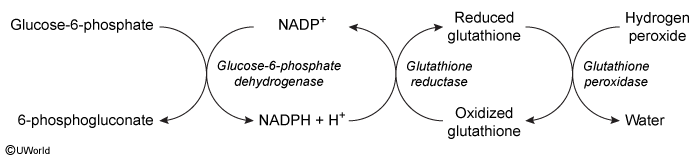
- G6PD generates NADPH, which:
- Regenerates reduced glutathione (GSH) → neutralizes H₂O₂ and other reactive oxygen species (ROS).
- Supports the neutrophil respiratory burst (NADPH oxidase).
- RBCs lack mitochondria, so the HMP shunt is their ONLY source of NADPH → they are uniquely vulnerable when G6PD is deficient.
Genetics & epidemiology
Genetics & epidemiology
- X-linked recessive → mainly affects males; female carriers are usually asymptomatic but may rarely hemolyze due to lyonization.
- Highest prevalence where malaria is/was endemic: Mediterranean (including Jordan and the surrounding region — high yield locally), Middle East, Africa, and Southeast Asia.
- Why? The deficiency confers partial protection against Plasmodium falciparum (the parasite cannot survive in oxidatively stressed RBCs) → positive selection, like sickle cell and thalassemia.
Variants
| G6PD Variants: Mediterranean vs African (A−) | ||
|---|---|---|
| Feature | Mediterranean variant | African (A−) variant |
| Severity | Severe | Mild |
| Enzyme activity | Markedly reduced (very low) | Mildly reduced (enzyme unstable but produced normally) |
| RBCs affected | Young AND old RBCs | Only older RBCs |
| Hemolysis | Severe; may require transfusion | Self-limited |
| Classic trigger | Fava beans (favism) | Drugs, infection |
Pathophysiology
Pathophysiology
When G6PD is deficient, an oxidative load overwhelms the cell in a predictable sequence:
- Oxidative trigger (drug, infection, fava bean) → generates ROS (mainly H₂O₂).
- ↓ NADPH → ↓ reduced glutathione (GSH).
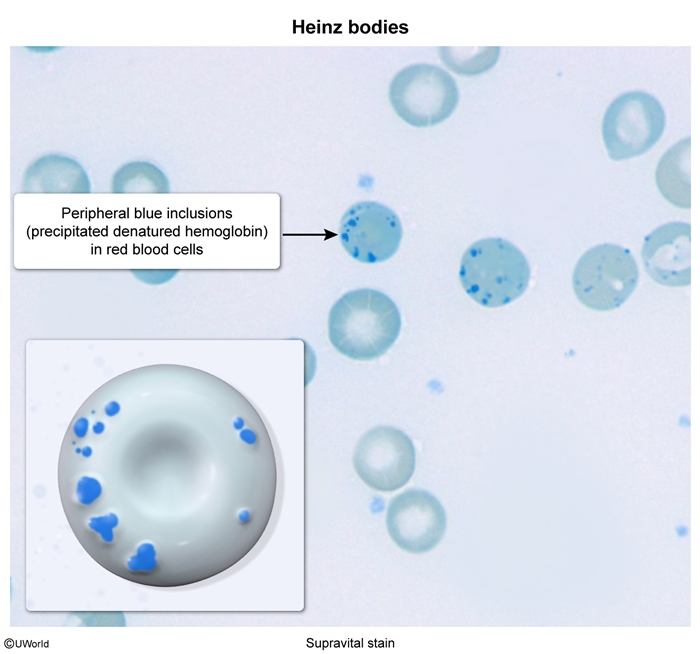
- ROS oxidize hemoglobin → denatured Hb precipitates as Heinz bodies.
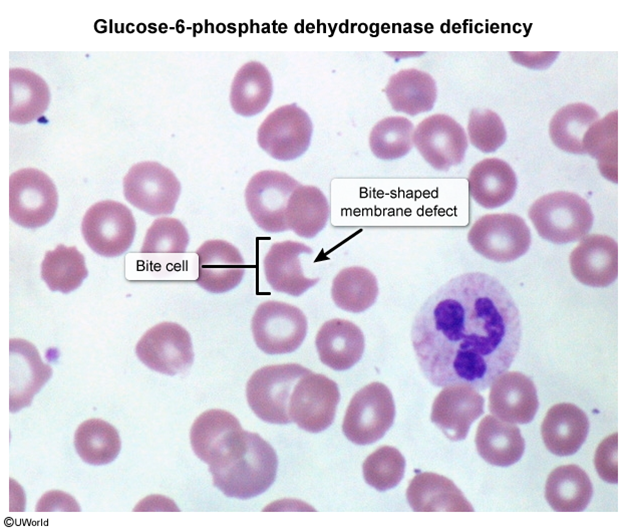
- Splenic macrophages remove Heinz bodies → leaving bite cells and blister cells.
- Damaged RBCs are destroyed:
- Mainly extravascular hemolysis (spleen) → unconjugated hyperbilirubinemia, jaundice.
- Severe attacks add intravascular hemolysis → hemoglobinemia, hemoglobinuria (dark urine), ↓ haptoglobin.
Clinical Presentation & Triggers
Patients are asymptomatic at baseline. Hemolysis occurs only after exposure to an oxidative trigger — the single definitive list:
| Triggers of Hemolysis in G6PD Deficiency: Patients are asymptomatic at baseline — hemolysis follows an oxidative trigger | |
| Infection | MOST COMMON TRIGGER |
| Viral / bacterial illness | Hepatitis, pneumonia, typhoid, any febrile illness |
| Drugs | AVOID |
| Sulfa drugs | Sulfamethoxazole (TMP-SMX), sulfasalazine, dapsone |
| Antimalarials | Primaquine; chloroquine (high dose) |
| Antibiotics | Nitrofurantoin |
| Other oxidants | Methylene blue, rasburicase, high-dose aspirin, phenazopyridine (urine analgesic) |
| Foods | AVOID |
| Fava beans | Cause favism — classic in the Mediterranean variant |
| Metabolic stress | PRECIPITANT |
| DKA / severe acidosis | Can precipitate a hemolytic episode |
See the full reference list of medications that trigger hemolysis in G6PD deficiency for the agents to avoid outright versus those to use with caution.
Clinical features
Symptoms begin 24–72 hours after exposure to a trigger and last 1–2 weeks (an acute, self-limited hemolytic episode):
- Acute hemolytic anemia — sudden pallor, fatigue, dyspnea, tachycardia.
- Jaundice / scleral icterus (unconjugated hyperbilirubinemia).
- Dark / cola-colored urine → hemoglobinuria (intravascular hemolysis).
- Back or abdominal pain.
- Splenomegaly in chronic or repeated attacks.
Special presentations
- Neonatal jaundice — unconjugated hyperbilirubinemia in the first 24–72 h of life; may require phototherapy or exchange transfusion; risk of kernicterus if untreated.
- Favism — severe hemolysis after fava-bean ingestion, almost exclusively in the Mediterranean variant.
- Chronic non-spherocytic hemolytic anemia (rare) — severe enzyme variants hemolyze even without an external trigger.
| Important – فكرة سؤال | |
|
Classic exam stem: a young Mediterranean or African boy develops pallor, jaundice, and dark (cola-colored) urine 1–3 days after eating fava beans or starting an oxidant drug (TMP-SMX, nitrofurantoin, primaquine). Smear shows bite cells and Heinz bodies (supravital stain). Coombs is negative. → G6PD deficiency. |
تذكر |
Diagnostic Approach
Step 1 — Recognize hemolysis (general labs):
- ↓ Hemoglobin/hematocrit; normocytic, normochromic anemia.
- ↑ Reticulocyte count (marrow response).
- ↑ LDH and ↑ indirect (unconjugated) bilirubin.
- ↓ Haptoglobin (especially with intravascular hemolysis).
- Hemoglobinuria → urine dipstick positive for blood with no RBCs on microscopy.
- Direct Coombs test: NEGATIVE (excludes autoimmune hemolysis).
Step 2 — Peripheral blood smear (high yield):
- Bite cells (degmacytes) — RBCs with a semicircular "bite" removed by splenic macrophages.
- Blister cells — submembranous vacuole of oxidized hemoglobin.
- Heinz bodies — denatured Hb inclusions; NOT visible on routine Wright-Giemsa → require a supravital stain (crystal violet or new methylene blue).
Step 3 — Confirm with G6PD enzyme assay:
- Quantitative measurement of G6PD activity in RBCs — the confirmatory (gold-standard) test.
- ⚠️ False negative during an acute attack — the old, deficient RBCs are already lysed and the surviving young reticulocytes have higher enzyme activity, so a level can read "normal."
- Wait 2–3 months after the episode to confirm the diagnosis.
| فخ امتحاني – Exam Trap | |
فخ امتحاني: يتم إجراء فحص إنزيم G6PD بعد 2-3 أشهر من نوبة انحلال الدم لتجنب النتائج السلبية الكاذبة. |
ملاحظة |
| Note – ملاحظة | |
G6PD is essentially a diagnosis of exclusion among hemolytic anemias: normocytic anemia + reticulocytosis + negative Coombs test + bite cells / Heinz bodies + an appropriate trigger. The enzyme assay only confirms — do NOT delay treatment to wait for it. |
ملاحظة |
Differential diagnosis
Compare G6PD with the other common normocytic hemolytic anemias tested on the exam:
| Differential Diagnosis of Hemolytic Anemia | ||||
|---|---|---|---|---|
| Feature | G6PD deficiency | Hereditary spherocytosis | Autoimmune hemolysis | Sickle cell |
| Inheritance | X-linked recessive | Autosomal dominant | Acquired | Autosomal recessive |
| Trigger | Drugs, fava beans, infection | Spontaneous; worse with infection | Idiopathic, drugs, lymphoma, infection (Mycoplasma, EBV) | Hypoxia, dehydration, infection |
| Smear | Bite cells, blister cells, Heinz bodies | Spherocytes (no central pallor) | Spherocytes ± agglutination | Sickle cells, target cells, Howell-Jolly |
| Coombs test | Negative | Negative | POSITIVE | Negative |
| Confirmatory test | G6PD enzyme assay (delay 2–3 mo) | Osmotic fragility / EMA binding | Direct Coombs (DAT) | Hb electrophoresis |
| Treatment | Avoid triggers; supportive | Splenectomy if severe | Steroids ± rituximab | Hydroxyurea, transfusion |
Two quick discriminators:
- Coombs POSITIVE → autoimmune hemolytic anemia (warm or cold), NOT G6PD.
- Spherocytes on smear → hereditary spherocytosis or autoimmune hemolysis; bite cells → G6PD.
Management & Prevention
There is no specific cure; treatment is supportive and centers on trigger avoidance.
Acute hemolytic episode:
- Step 1: Identify and stop the trigger — discontinue the offending drug, treat the precipitating infection, stop fava beans.
- Step 2: IV fluids / hydration to maintain urine output and prevent pigment-induced AKI from hemoglobinuria.
- Step 3: Blood transfusion only if symptomatic anemia or Hb < 7 g/dL.
- Step 4: Monitor renal function and electrolytes until hemolysis resolves.
Most episodes are self-limited in the African (A−) variant because young reticulocytes retain higher enzyme activity.
Neonatal jaundice:
- Phototherapy for moderate hyperbilirubinemia.
- Exchange transfusion for severe cases to prevent kernicterus.
Long-term / prevention:
- Patient education — a written list of drugs and foods to avoid (the single most important intervention).
- Newborn screening in high-prevalence regions (Jordan, Mediterranean).
- Genetic counseling for affected families.
- Vaccination (especially hepatitis A/B) to reduce infectious triggers.
| Important – فكرة سؤال | |
Rasburicase is contraindicated in G6PD deficiency — it generates H₂O₂ and triggers severe hemolysis. In a G6PD-deficient patient with tumor lysis syndrome, use allopurinol instead. |
تذكر |
| فخ امتحاني – Exam Trap | |
فخ امتحاني: راسبوريكاز (Rasburicase) ممنوع في نقص G6PD لأنه ينتج بيروكسيد الهيدروجين ويسبب انحلال دم شديد؛ استخدم الوبيورينول (Allopurinol) بدلاً منه في متلازمة تحلل الورم. |
ملاحظة |
Complications
- Acute kidney injury — pigment (hemoglobin) nephropathy from intravascular hemolysis.
- Severe anemia / shock — particularly in the Mediterranean variant.
- Neonatal kernicterus — untreated hyperbilirubinemia.
- Pigment gallstones (cholelithiasis) — chronic ↑ bilirubin with recurrent hemolysis.
- Chronic hemolytic anemia — rare severe enzyme variants.
High-Yield Exam Summary – نقاط مهمة للامتحانات
Mnemonics
| Mnemonic – Pathway | |
"G6PD → NADPH → GSH → kills H₂O₂" No G6PD → no NADPH → no reduced glutathione → ROS oxidize Hb → Heinz bodies → bite cells → hemolysis. |
جملة تذكرية |
| Mnemonic – Smear findings | |
"BBH – Bite, Blister, Heinz"
"Heinz bodies bite the dust" → Heinz bodies become bite cells. |
جملة تذكرية |
| Mnemonic – Drug triggers | |
"IS PAIN FUL" — oxidant drugs causing hemolysis in G6PD: INH (isoniazid) · Sulfa drugs · Primaquine · Aspirin (high dose) · Ibuprofen / NSAIDs (variable) · Nitrofurantoin · Fava beans · Urine analgesics (phenazopyridine) · Legumes / dapsone / methylene blue / rasburicase |
جملة تذكرية |
Key points
- Most common enzyme deficiency in the world · X-linked recessive · mainly affects males.
- High prevalence in the Mediterranean (including Jordan), Middle East, and Africa — protective against falciparum malaria.
- G6PD makes NADPH → reduces glutathione → protects RBCs from oxidative stress (H₂O₂).
- Triggers: infection (most common), fava beans, drugs (sulfa, dapsone, primaquine, nitrofurantoin, rasburicase, methylene blue).
- Presentation: acute hemolysis 1–3 days after a trigger → pallor, jaundice, back pain, cola-colored urine.
- Smear: bite cells + blister cells; Heinz bodies only on supravital (crystal violet) stain.
- Labs: ↑ retics, ↑ LDH, ↑ indirect bilirubin, ↓ haptoglobin, negative Coombs test.
- Diagnosis confirmed by G6PD enzyme assay 2–3 months after the acute episode (false negative during hemolysis).
- Treatment is supportive: stop trigger, hydration, transfuse if severe. No specific therapy.
- Rasburicase contraindicated → use allopurinol for tumor lysis syndrome.
- Neonatal jaundice in G6PD → phototherapy / exchange transfusion to prevent kernicterus.
- Mediterranean variant = severe (favism); African A− variant = mild, self-limited.
احصل على التجربة الكاملة
اشترك للوصول لفيديوهات الشرح التفصيلي والبطاقات التعليمية التفاعلية وأسئلة الممارسة مع تتبع التقدم.