Summary
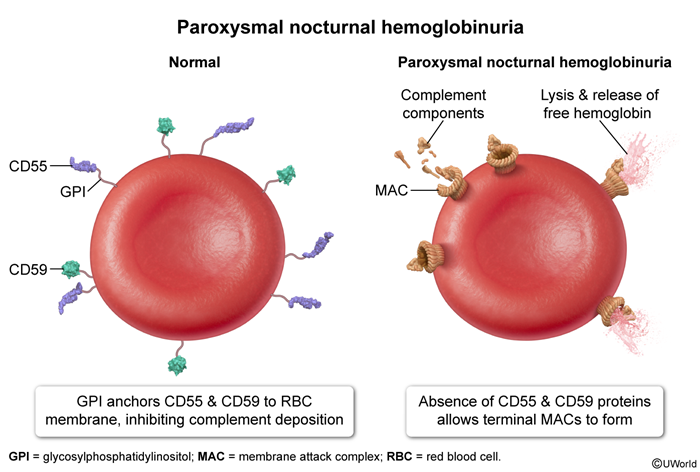
Paroxysmal nocturnal hemoglobinuria (PNH) is a rare, acquired clonal stem cell disorder caused by a somatic mutation in the X-linked PIGA gene, impairing glycosylphosphatidylinositol (GPI) anchor synthesis. This leads to the loss of surface complement regulators CD55 and CD59, leaving erythrocytes vulnerable to unchecked terminal complement-mediated (MAC) intravascular hemolysis (typically normocytic, MCV 80–100 fL, or microcytic from iron loss).
Clinical presentation features the classic triad of Coombs-negative intravascular hemolysis (dark morning urine/hemoglobinuria), pancytopenia (bone marrow failure), and atypical venous thrombosis (e.g., Budd-Chiari syndrome). Peripheral blood smear shows non-specific normocytic or polychromatic RBCs without spherocytes. Diagnosis is confirmed via peripheral blood flow cytometry showing absent CD55/CD59 or FLAER binding on blood cells. Treatment relies on C5 terminal complement inhibitors (eculizumab or ravulizumab), which mandate prior meningococcal vaccination; allogeneic HSCT is the only curative option.
Overview
What is PNH?
- PNH = a rare, acquired clonal disorder of the hematopoietic stem cell producing intravascular hemolysis, thrombosis, and bone marrow failure.
- It is the only acquired intrinsic (membrane) cause of hemolytic anemia — every other intrinsic cause (hereditary spherocytosis, G6PD deficiency, sickle cell) is inherited.
- Epidemiology: ~1–5 per million per year; typically young adults (median 30–40 y); strongly linked to aplastic anemia (a PNH clone is detectable in up to 25% of cases) and MDS.
- Name decoded: Paroxysmal (episodic attacks) · Nocturnal (mild respiratory acidosis during sleep activates complement) · Hemoglobinuria (free Hb in urine → dark morning urine).
Pathophysiology
Pathophysiology – one missing anchor
- Acquired somatic PIGA mutation (an X-linked gene, but the mutation is not inherited) arises in a single stem cell, which then expands as a clone — favored when the marrow is under immune attack (explains the aplastic-anemia link).
- PIGA performs the first step of GPI-anchor biosynthesis → without it, GPI-anchored surface proteins cannot attach.
- Loss of the complement regulators CD55 (DAF) and CD59 (MIRL) from blood cells.
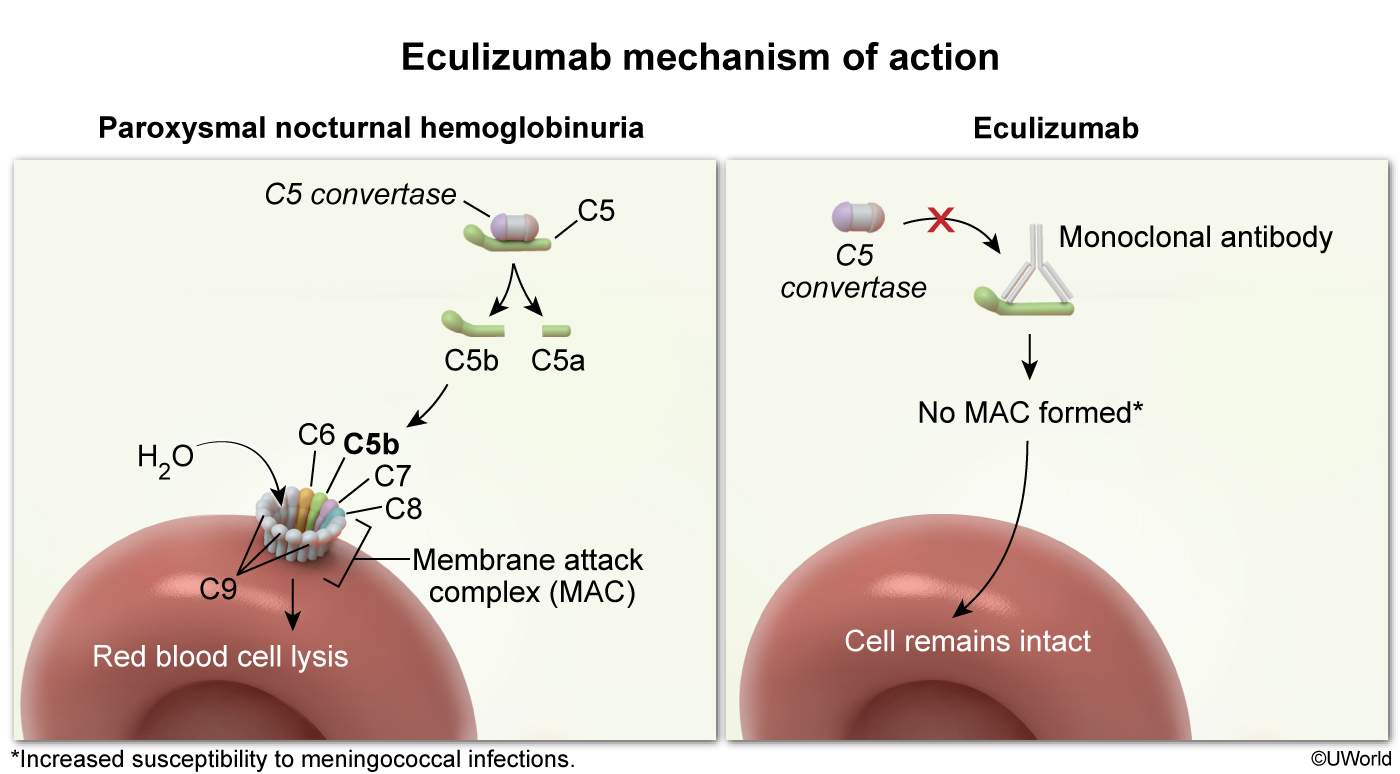
- Unchecked complement assembles the MAC (C5b–9) on the patient's own RBCs → chronic intravascular hemolysis → free hemoglobin in plasma and urine.
The same anchor defect drives the other two pillars: free hemoglobin scavenges nitric oxide (NO) → smooth-muscle dystonia and platelet activation (thrombosis), while the underlying stem-cell injury reduces all lineages (pancytopenia).
Clinical Presentation – The Classic Triad
Anchor the picture to the triad "HAT" — Hemolysis, Aplastic marrow, Thrombosis.
1. Intravascular hemolysis
- Fatigue, pallor, jaundice.
- Hemoglobinuria — dark/cola-colored urine, classically in the first morning sample.
- Chronic urinary iron loss → iron deficiency; high cell turnover → folate deficiency.
2. Atypical (venous) thrombosis — leading cause of death
- Venous thrombosis at unusual sites:
- Hepatic veins → Budd-Chiari syndrome (abdominal pain, ascites, hepatomegaly) — the classic exam clue.
- Portal, mesenteric, splenic, and cerebral (sagittal sinus) veins.
| فخ امتحاني – Exam Trap | |
| أي مريض شاب يعاني من متلازمة بود-كياري مع نقص في خلايا الدم، يجب التفكير مباشرةً في PNH. | ملاحظة |
3. Bone marrow failure
- Pancytopenia: anemia + thrombocytopenia (bleeding) + leukopenia (infections).
- May evolve to aplastic anemia or, rarely, AML.
Smooth-muscle dystonia (NO depletion)
- Esophageal spasm / dysphagia, abdominal pain, and erectile dysfunction — all from free-hemoglobin scavenging of nitric oxide.
Diagnostic Approach
Step 1 – Confirm intravascular hemolysis (initial labs)
- Serum: markedly ↑ LDH, ↑ indirect bilirubin, ↓ haptoglobin, ↑ reticulocytes; CBC shows normocytic anemia (microcytic if iron-deficient) ± pancytopenia.
- Direct antiglobulin test (Coombs): NEGATIVE — the key to excluding autoimmune hemolytic anemia.
- Urine: hemoglobinuria (dipstick positive for blood, no RBCs on microscopy) and chronic hemosiderinuria (specific for chronic intravascular hemolysis).
| ملاحظة امتحانية – Exam Note | |
| فحص كومبس السلبي هو مفتاح التشخيص التفريقي لاستبعاد فقر الدم الانحلالي المناعي. | ملاحظة |
Step 2 – Confirm with flow cytometry (gold standard)
- Peripheral-blood flow cytometry showing absent CD55 and CD59 on RBCs and WBCs — the diagnostic gold standard.
- FLAER (fluorescent aerolysin) binds the GPI anchor directly — more sensitive, best applied to granulocytes/monocytes.
- Historical tests (name-recognition only): Ham (acidified-serum) test and sugar-water (sucrose) test.
Differential diagnosis
Separate PNH from the other hemolytic anemias with one or two clinical clues — the matrix below is the highest-yield consolidation:
| PNH vs Other Hemolytic Anemias – Rapid Differentiation | ||||
|---|---|---|---|---|
| Feature | PNH | Autoimmune (AIHA) | Hereditary Spherocytosis | G6PD Deficiency |
| Inheritance | Acquired (somatic PIGA mutation) | Acquired (autoantibody) | Autosomal dominant | X-linked recessive |
| Site of hemolysis | Intravascular | Extravascular (warm) / intravascular (cold) | Extravascular (spleen) | Mostly intravascular |
| Coombs (DAT) | NEGATIVE | POSITIVE | Negative | Negative |
| Trigger | Spontaneous, sleep, infection | Drugs, lymphoma, SLE | Chronic; splenomegaly | Oxidative stress (fava beans, drugs, infection) |
| Diagnostic clue | Dark morning urine + Budd-Chiari; absent CD55/CD59 | Spherocytes + positive Coombs | Spherocytes + ↑ MCHC + ↑ osmotic fragility | Bite cells + Heinz bodies |
When the picture is dominated by pancytopenia, also consider aplastic anemia (hypocellular marrow; can coexist with PNH), MDS (dysplasia, older patients), and acute leukemia (blasts on smear).
Management
Supportive care (all patients)
- Folate and iron replacement (high turnover + urinary iron loss).
- Transfusion for symptomatic anemia.
- Anticoagulation for any thrombotic event (and prophylaxis in high-risk patients).
Targeted therapy – terminal complement inhibition
- Eculizumab — humanized anti-C5 monoclonal antibody; blocks MAC formation → dramatically reduces hemolysis, transfusion requirement, and thrombosis risk.
- Key adverse effect: Neisseria meningitidis infection (terminal complement is needed to lyse Neisseria) → give meningococcal vaccination ≥2 weeks before starting, ± penicillin prophylaxis.
- Ravulizumab — longer-acting anti-C5 (every-8-week dosing); same role.
| نقطة سريرية هامة – Clinical Pearl | |
| التطعيم ضد المكورات السحائية إلزامي قبل بدء علاج Eculizumab. | ملاحظة |
Curative therapy
- Allogeneic HSCT — the only curative option; reserved for severe marrow failure, refractory thrombosis, or malignant transformation.
Complications & High-Yield Pearls – نقاط مهمة للامتحانات
Complications
- Thrombosis — the leading cause of death (hepatic/Budd-Chiari, portal, mesenteric, cerebral veins).
- Chronic kidney disease — renal hemosiderin deposition from chronic hemoglobinuria.
- Pulmonary hypertension — chronic NO depletion.
- Iron-deficiency anemia — ongoing urinary iron loss.
- Aplastic anemia, and rarely MDS/AML transformation.
- Meningococcal sepsis — iatrogenic, from terminal complement-inhibitor therapy.
Mnemonics
| Mnemonic – The Triad "HAT" | |
HAT = the three pillars of PNH:
Recall the lost proteins as "CD55 + CD59" → both GPI-anchored complement regulators are lost. |
جملة تذكرية |
| Mnemonic – PNH = Please Note Hemolysis | |
|
جملة تذكرية |
High-yield pearl
| Important – فكرة سؤال | |
The classic vignette: a young adult with sudden abdominal pain, ascites, and pancytopenia, whose flow cytometry shows absent CD55/CD59. The lesion is hepatic vein thrombosis (Budd-Chiari) and the mechanism asked is complement activation (loss of GPI-anchored complement regulators) — NOT a Factor V mutation. Pitfall: hemolysis in PNH is Coombs-negative; a positive DAT points to autoimmune hemolytic anemia instead. |
تذكر |
Key Points for Exams – نقاط مهمة للامتحانات
- PNH = the only acquired membrane defect causing hemolytic anemia.
- PIGA mutation (X-linked but somatic — not inherited) → no GPI anchor → no CD55/CD59 → uncontrolled complement → intravascular hemolysis.
- Classic triad: Coombs-negative intravascular hemolysis + atypical thrombosis + pancytopenia.
- Most feared scenario: Budd-Chiari syndrome in a young patient with cytopenias and dark morning urine.
- Labs: ↑ LDH, ↓ haptoglobin, ↑ reticulocytes, negative Coombs, positive urine hemosiderin.
- Diagnosis: flow cytometry (absent CD55/CD59 ± FLAER); Ham & sucrose tests are historical.
- Treatment: Eculizumab/ravulizumab (anti-C5) — vaccinate against Neisseria meningitidis first; HSCT is curative.
- Leading cause of death: thrombosis.
احصل على التجربة الكاملة
اشترك للوصول لفيديوهات الشرح التفصيلي والبطاقات التعليمية التفاعلية وأسئلة الممارسة مع تتبع التقدم.