شرح المدرسين

SUMMARY
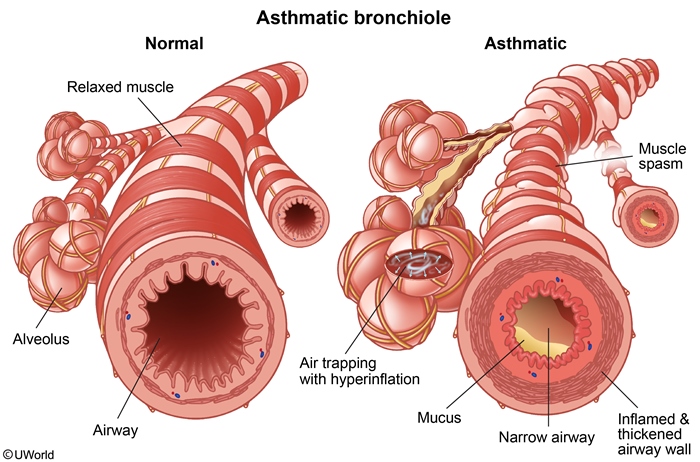
Asthma is the most common chronic disease of childhood — a reversible airway obstruction caused by bronchial smooth-muscle spasm, airway mucosal edema, mucus impaction, airway inflammation, and airway hyperresponsiveness.
- Presentation: episodic wheeze, cough, chest tightness, and dyspnea, often triggered by viral infection, allergens, exercise, or cold air.
- Diagnosis: clinical picture plus spirometry showing reversible obstruction (≥ 10–12% rise in FEV₁ after a bronchodilator).
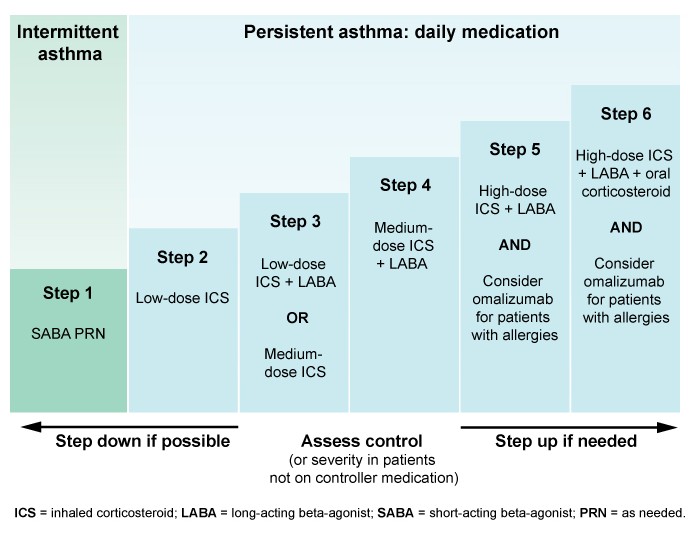
- Chronic management: a stepwise, control-based approach built on inhaled corticosteroids (ICS), stepping up or down roughly every 3 months.
- Acute exacerbation: oxygen + repeated SABA + early systemic corticosteroids, escalating to ipratropium and IV magnesium sulfate.
- Red flag: a silent chest, exhaustion, or a normalizing/rising pCO₂ signals impending respiratory failure (status asthmaticus).
Pathophysiology & Risk Factors
Asthma is a chronic inflammatory disorder producing reversible airway obstruction through four coexisting mechanisms: bronchial smooth-muscle spasm, airway mucosal edema, mucus impaction, and airway inflammation with hyperresponsiveness.
Etiology & contributing factors
- Genetic predisposition: family history of asthma or atopy (eczema, allergic rhinitis) is a major determinant of risk.
- Atopic sensitization: immune dysregulation with exaggerated IgE-mediated responses to inhaled or food allergens.
- Airway injury from infection: viral infections such as bronchiolitis in the first year of life are significant predisposing factors.
- Environmental triggers: allergens, pollutants, and tobacco smoke drive airway inflammation and hyperreactivity.
The pathophysiology is best appreciated by contrasting a normal airway with an asthmatic one:
Risk factors for childhood asthma
- Major: parental asthma, inhalant-allergen sensitization, eczema (atopic dermatitis).
- Minor: allergic rhinitis, wheezing apart from colds, peripheral blood eosinophilia ≥ 4%, food-allergen sensitization.
Top 4 precipitating factors for an attack
| Mnemonic - CAVE: Common Asthma Triggers | |
|
"Beware the CAVE of asthma triggers"
|
جملة تذكرية |
Clinical Presentation & Diagnosis
Clinical presentation
- Recurrent wheeze, respiratory distress, tachypnea, and accessory-muscle use during attacks.
- In school-age children, ~85% of exacerbations coincide with viral infection — the single biggest risk factor for hospitalization.
- ~15% of infants with recurrent wheeze continue to wheeze after age 6, and ~15% of children have their first wheezing episode after age 6.
Diagnosis
Diagnosis begins with a compatible history and physical examination — recurrent wheeze, shortness of breath, chest tightness, exercise intolerance, chronic cough, and occasionally mucoid vomiting.
Spirometry — the key test for confirming reversible obstruction: measure FEV₁ before and after a bronchodilator. A 10–12% increase in FEV₁ following the bronchodilator is consistent with reversible airway obstruction. An FEV₁/FVC ratio below 0.70 first establishes the obstructive pattern.
The obstructive versus normal spirometry pattern is shown here.
Reversibility also helps separate asthma from chronic obstructive pulmonary disease — open the reference for the FEV₁/FVC, bronchodilator-response, and DLCO patterns that distinguish them.
Classification & Control
Chronic asthma is graded along a severity spectrum from intermittent through severe persistent, with each step guiding the intensity of initial treatment. Once a patient is on therapy, reassess control every 3 months — control status (well controlled, not well controlled, very poorly controlled) guides whether to step up, step down, or maintain the current regimen.
| Intermittent | Mild Persistent | Moderate Persistent | Severe Persistent | |
| Daytime symptoms | ≤2 days/week | >2/week, not daily | Daily | Continual |
| Nighttime awakenings | ≤2/month | 3–4/month | >1/week, not nightly | 4–7/week |
| Exercise tolerance | Excellent | Symptoms with exertion | Frequent exertional symptoms | Severely limited |
| PEF or FEV₁ | ≥80% predicted | ≥80% predicted | 60–80% predicted | <60% predicted |
| PEF variability | <20% | 20–30% | >30% | >30% |
| Treatment step | Step 1 | Step 2 | Step 3 | Step 4/5 |
Control assessment (in patients already on therapy):
- well controlled (minimal symptoms, no exacerbations, normal lung function) guides stepping down;
- not well controlled (some breakthrough symptoms or exacerbations)
- very poorly controlled (daily symptoms, multiple exacerbations) both prompt step-up to higher intensity therapy.
Chronic Management & Pharmacology
Goal: achieve and maintain good control
- Minimal/no daytime or nighttime symptoms and no exacerbations.
- No limitation of daily activity and no missed school or work.
- Minimal SABA use and minimal adverse effects from therapy.
Reassess every 3 months: if control is achieved, step down to a less-intense regimen; if symptoms remain uncontrolled, step up.
Stepwise controller therapy
- Intermittent asthma: no daily controller medication is recommended at any age.
- Mild persistent (symptoms > 2×/week but not daily): low-dose ICS is the preferred initial controller for all ages. In patients ≥ 12 years, concomitant ICS + SABA (without daily controller) is an option.
- If low-dose ICS fails to control, escalate by age:
- ≤ 4 years → low-dose ICS + LABA (preferred alternatives: low-dose ICS + montelukast, or medium-dose ICS);
- 5–11 years → low-dose ICS + inhaled LABA (e.g., formoterol).
The full escalation ladder from intermittent through severe persistent asthma is summarised here:
| Note – SMART therapy | |
|
Single Maintenance And Reliever Therapy (SMART) uses one ICS + formoterol inhaler for both daily control and symptom relief. Formoterol's fast onset (unlike salmeterol) makes it suitable as the reliever component. |
ملاحظة |
| ملاحظة سريرية – SMART therapy في الطوارئ | |
|
بالطوارئ، دايما اسأل أهل المريض إذا بياخد SMART therapy عشان تعرف إذا أخد LABA اليوم أو لأ قبل ما تعطيه أي rescue dose. |
ملاحظة |
Drug classes at a glance
Corticosteroids are the most effective anti-inflammatory agents in asthma. For inhaled steroids, the highest-yield adverse effects are oral candidiasis (thrush), changes in growth velocity, and skin thinning/bruising; for systemic steroids, use the mnemonic below:
| Systemic Corticosteroid Long-Term Side Effects | |
|
"I COACH Growth – HPA"
|
جملة تذكرية |
| Asthma Pharmacotherapy — Drug Classes at a Glance | |||
|---|---|---|---|
| Drug class | Route | Main indication / use | Key side effects (high-yield) |
| Inhaled corticosteroids (ICS) | Inhaled | Preferred controller — first-line for all persistent asthma | Oral thrush, ↓ growth velocity, skin thinning/bruising |
| Systemic corticosteroids | Oral / IV | Acute exacerbation not responding to SABA | See I COACH Growth–HPA mnemonic above |
| SABA (salbutamol / albuterol) | Inhaled | Rescue/reliever; first-line in acute attack | Tremor, tachycardia, hypokalemia |
| LABA (salmeterol, formoterol) | Inhaled | Add-on to ICS; formoterol used in SMART — never monotherapy/rescue | Not for monotherapy or rescue use |
| LAMA (tiotropium) | Inhaled | Add-on in severe asthma (≥6 y) on ICS–LABA; not for acute bronchospasm | Dry mouth, constipation, sore throat |
| Leukotriene modifiers (montelukast, zafirlukast) | Oral | Controller alternative; prevents exercise-induced asthma | Neuropsychiatric effects (sleep disturbance, depression, aggression) |
| Cromolyn sodium (mast-cell stabilizer) | Inhaled | Alternative controller (not preferred) | Cough, dermatitis, myositis, gastroenteritis |
| Theophylline (methylxanthine) | Oral | Controller; not for acute use; needs serum-level monitoring | Narrow therapeutic index; many drug interactions |
| Biologics (omalizumab; mepolizumab; dupilumab) | SC / IM | Severe difficult-to-control allergic/eosinophilic asthma (≥6 y) | Injection-site reactions |
Three fixed ICS + LABA combination inhalers are in common use:
- Fluticasone + salmeterol (Advair).
- Budesonide + formoterol (Symbicort).
- Mometasone + formoterol (Dulera).
LABAs provide up to 12 hours of bronchodilation, and formoterol has the faster onset — but they are used only in combination with ICS.
| Clinical Note – LABA | |
|
Always remember in exams that you must never give LABA as monotherapy or rescue therapy — it must always be given with ICS. |
ملاحظة |
Theophylline is a methylxanthine with a narrow therapeutic range requiring serum-level monitoring; toxicity presents with tachycardia, GI symptoms, and behavioral effects. Levels rise with oral contraceptives, erythromycin, ciprofloxacin, and cimetidine, and fall with phenobarbital and phenytoin.
| Clinical Note – Theophylline and Drug Interactions | |
|
Always be aware of drug interactions on exams, especially with macrolides like erythromycin, as it raises theophylline toxicity significantly. |
ملاحظة |
| Clinical Note – Theophylline | |
|
Theophylline has a narrow therapeutic index; watch carefully for drug interactions, especially with macrolides such as erythromycin, which increase toxicity risk. |
ملاحظة |
Acute Exacerbation & Status Asthmaticus
Immediate assessment & severity grading
Check vitals (HR, RR, SpO₂), accessory-muscle use, and ability to speak in full sentences. Grade acute severity as:
- Mild/moderate: SpO₂ > 92%, able to talk/feed, wheeze audible (may only with stethoscope).
- Severe: SpO₂ < 92%, PEFR 33–50%, too breathless to feed/talk, accessory-muscle use, tachycardia (HR > 125 for >5y; > 140 for <5y).
- Life-threatening: SpO₂ < 92%, PEFR < 33%, silent chest (no wheeze, minimal air entry), cyanosis, exhaustion, altered consciousness, poor respiratory effort.
| Exam Trap – Silent Chest | |
|
Silent chest on examination means the patient is in severe danger with no air entry whatsoever; do not think that a decrease in wheezing means the patient is improving! |
تذكر |
Stepwise emergency management
- Step 1 — Oxygen: titrate to maintain SpO₂ 94–98%; high-flow O₂ may be needed for severe cases.
- Step 2 — SABA: nebulized salbutamol (albuterol) first-line, repeated every 20 minutes for the first hour.
- Step 3 — Systemic corticosteroids: oral or IV, given early to reduce inflammation and prevent relapse.
- Step 4 — Ipratropium bromide: add to SABA for moderate-to-severe attacks; shown to reduce hospitalizations.
- Step 5 — IV magnesium sulfate: a single infusion for severe attacks not responding to initial therapy.
- Step 6 — IV bronchodilators / adjuncts: aminophylline or IV salbutamol (rarely used due to side effects); heliox (helium–oxygen) may reduce work of breathing.
| Important – فكرة سؤال | |
|
High-dose inhaled albuterol (SABA) drives K⁺ into cells via the Na⁺/K⁺-ATPase and can cause clinically significant hypokalemia — presenting as muscle weakness, hyporeflexia, tremor, and potentially fatal arrhythmias. After aggressive nebulized therapy, recheck serum electrolytes and obtain an ECG. |
تذكر |
Monitoring & disposition
- Admit if: poor response after 1 hour of treatment, PEFR < 60–80% predicted, concerning vital signs, or an ongoing need for frequent bronchodilators.
- Discharge home if: good response, PEFR > 70–80% predicted, and minimal symptoms.
| Note — Normalizing pCO₂ is NOT improvement | |
|
A silent chest, cyanosis, exhaustion, or a normalizing/rising pCO₂ does NOT indicate improvement — it signals entry into respiratory failure with severely reduced air entry and tiring respiratory muscles! |
ملاحظة |
Status asthmaticus & respiratory failure
Acute severe asthma (status asthmaticus) is a severe attack in which the patient is at risk of developing respiratory failure. It typically occurs in patients with severe, poorly controlled asthma, or after massive exposure to allergens or sensitizing agents. A prior history of intubation for asthma is the single greatest predictor of death.
| Mnemonic - Mortality Risk in Status Asthmaticus | |
|
Remember the fatal asthmatic will meet "DEATHS":
|
جملة تذكرية |
Clinical features of respiratory failure: extreme fatigue, inability to complete sentences, altered mental status (drowsiness, confusion), absent/minimal wheezing from poor air entry, cyanosis, and chest-wall retractions.
Laboratory findings: ↓ PaO₂ and ↓ pH with ↑ pCO₂ (respiratory acidosis). A rising or "normalizing" pCO₂ in a tiring asthmatic is an ominous sign — not improvement — because it reflects muscle fatigue and collapsing air entry rather than resolving bronchospasm.
Key Points for Exams
- Asthma = reversible obstructive airway disease; confirm with spirometry showing a ≥ 10–12% FEV₁ rise after a bronchodilator.
- Complete FEV₁/FVC reversibility favors asthma over COPD (which shows partial/no reversibility).
- ICS is the preferred controller for all persistent asthma; step therapy up or down based on control, reassessing roughly every 3 months.
- LABA is never used as monotherapy or as rescue — always combined with ICS (formoterol is the reliever component in SMART).
- Acute attack sequence: O₂ → SABA → systemic corticosteroids → ipratropium → IV magnesium sulfate.
- A silent chest, cyanosis, exhaustion, or a normalizing/rising pCO₂ signals impending respiratory failure.
- High-dose albuterol → hypokalemia (muscle weakness, hyporeflexia, tremor) — recheck electrolytes and obtain an ECG.
- Prior intubation for asthma is the strongest single predictor of death in status asthmaticus.
- Systemic corticosteroid side effects: remember "I COACH Growth–HPA" — immunosuppression, cataracts, osteoporosis, HPA-axis suppression, Cushing features, hyperglycemia, and growth retardation.
- Montelukast prevents exercise-induced asthma but can cause neuropsychiatric effects; theophylline has a narrow therapeutic index with dangerous drug interactions (e.g., macrolides).
- Beta-blockers are relatively contraindicated in asthma — they can precipitate bronchospasm.
- Top 4 precipitating triggers: CAVE — **C**igarette smoke, **A**llergen exposure, **V**iral infection, **E**xercise.
احصل على التجربة الكاملة
اشترك للوصول لفيديوهات الشرح التفصيلي والبطاقات التعليمية التفاعلية وأسئلة الممارسة مع تتبع التقدم.