شرح المدرسين

Introduction
- Breast milk contains fats, carbohydrates (lactose), and maternal diet-derived proteins (whey, casein).
- Whey and casein proteins are found both in breastmilk, cow’s milk, and soy-based formula.
- Food protein induced allergic proctocolitis or Cow’s Milk Protein Allergy (CMPA) refers to adverse allergic reactions to proteins found in cow's milk, leading to rectal and colonic inflammation.
سجل دخولك لإضافة ملاحظات خاصة لكل قسم
· اشترك الآن
Epidemiology
- Cow protein Milk Allergy affects approximately 2-3% of infants.
- Cow milk-protein allergy is a condition exclusive to infants, almost all cases are diagnosed before the age of 1 year.
سجل دخولك لإضافة ملاحظات خاصة لكل قسم
· اشترك الآن
Types
| Types | |||
|---|---|---|---|
| Type | Pathophysiology | Clinical Picture | Diagnosis |
| IgE-Mediated Allergy |
|
|
|
| Non-IgE-Mediated Allergy |
|
|
|
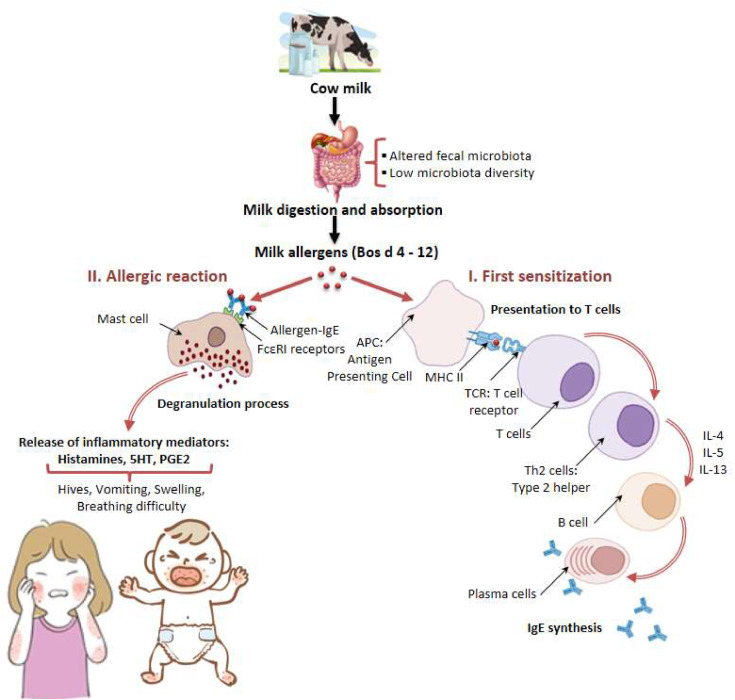
Important Note: There’s a third mechanism, known as mixed type Cow’s Protein Milk allergy, with manifestations involving inflammation of the esophagus.
سجل دخولك لإضافة ملاحظات خاصة لكل قسم
· اشترك الآن
Clinical Picture
- Symptoms:
- Skin: Eczematous rash and hives.
- Gastrointestinal: regurgitation, vomiting, diarrhea, abdominal pain, colic, and/or painless bloody stools.
- Respiratory: nasal congestion, wheezing, difficulty breathing (more common in IgE-mediated cases).
سجل دخولك لإضافة ملاحظات خاصة لكل قسم
· اشترك الآن
Diagnosis
- The diagnosis is mostly clinical and confirmed when symptoms improve in response to dietary modifications.
- Other tests that can be done to support the diagnosis, including:
- Skin Prick Test: Identifies IgE-mediated reactions.
- Serum Specific IgE Testing: Measures IgE antibodies to cow's milk proteins.
- Elimination Diet: Removal of cow's milk from the diet and monitoring for symptom improvement (for at least 2 weeks)
سجل دخولك لإضافة ملاحظات خاصة لكل قسم
· اشترك الآن
Treatment
- Elimination of Cow's Milk
- Avoid all forms of cow's milk and products containing cow's milk protein.
- Due to cross-reactivity, both dairy and soy should be avoided.
- The mother of a breastfed infant can breastfeed after eliminating dairy and soy products from her diet.
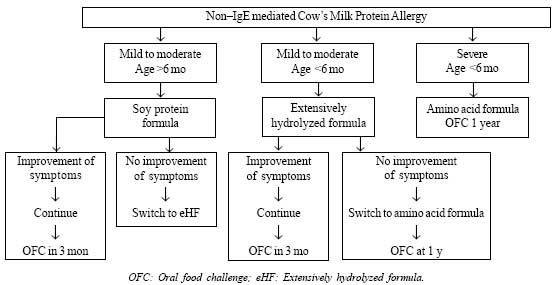
- Switching Formulas
- Use hypoallergenic formulas (e.g., extensively hydrolyzed formulas), they contain predigested proteins that do not induce an allergic reaction.
- if there is no response to hydrolyzed formulas, we switch to amino acid-based formulas.
سجل دخولك لإضافة ملاحظات خاصة لكل قسم
· اشترك الآن
Prognosis
- Visible bleeding should resolve within 3 days of diet elimination, but complete resolution may take up to 2 weeks.
- Almost all infants can tolerate dairy and soy products by age 1 year.
- Many children outgrow CMPA by age of 3-5 years.
سجل دخولك لإضافة ملاحظات خاصة لكل قسم
· اشترك الآن
احصل على التجربة الكاملة
اشترك للوصول لفيديوهات الشرح التفصيلي والبطاقات التعليمية التفاعلية وأسئلة الممارسة مع تتبع التقدم.
فيديوهات الشرح
بطاقات تفاعلية
أسئلة ممارسة
اشترك الآن