شرح المدرسين

Summary
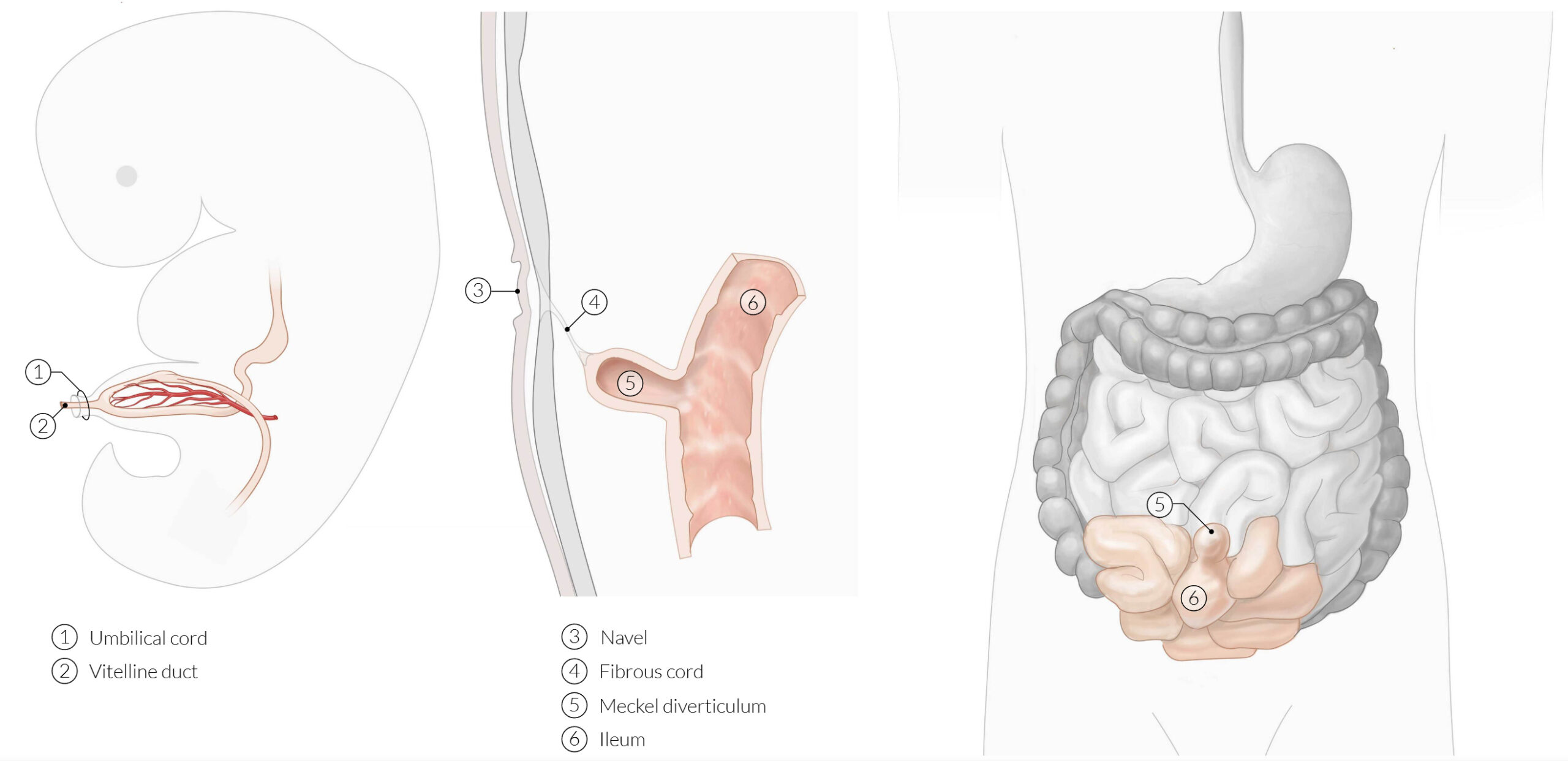
Meckel's diverticulum is the most common congenital anomaly of the GI tract, resulting from incomplete obliteration of the vitelline (omphalomesenteric) duct during the 7th week of gestation. It is a true diverticulum (contains all three bowel wall layers) located on the antimesenteric border of the ileum, typically within 2 feet of the ileocecal valve.
Most cases remain asymptomatic throughout life. When symptomatic — usually in children < 2 years old — the hallmark presentation is painless, brick-red rectal bleeding caused by acid secretion from ectopic gastric mucosa (most common ectopic tissue type) that ulcerates the adjacent ileal mucosa.
Introduction
- Meckel’s diverticulum is an outpouching (diverticulum) of all three layers of bowel wall (true diverticulum) in the terminal ileum.
- Meckel’s diverticulum is the most common congenital GI tract anomaly.
- This condition arises due to failure of the vitelline duct to obliterate during the 7th week of gestation (persistence of the vitelline duct, omphalomesenteric duct, in the small intestine).
- Most cases are asymptomatic. However, Meckel's diverticulum can present during the first two years of life with bleeding, volvulus, intussusception, or obstruction (mimics appendicitis).
- Diagnosis is achieved by Meckel’s scan.
| Meckel’s Diverticulum | |
|---|---|
| Feature | Details |
| Epidemiology |
Rule of 2s:
|
| True diverticulum |
|
| Clinical presentation |
|
| Diagnosis |
|
| Treatment |
|
Epidemiology
- The prevalence of Meckel diverticulum is usually noted to be approximately 2% of the population.
- It is usually located in the lower portion of the small intestine.
- Complications are found in about 5% of the population with this anomaly.
Etiology
- Meckel’s diverticulum results from incomplete obliteration of the vitelline duct (leading to the formation of a true diverticulum of the small intestines).
Clinical Presentation
- Meckel’s diverticulum is mostly asymptomatic (normal abdominal exam).
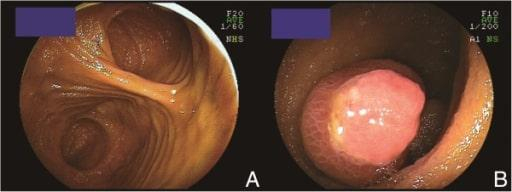
- Painless (rectal bleeding) hematochezia (due to the presence of gastric/pancreatic tissue).
- It is an important cause of lower GI bleeding in infants and children.
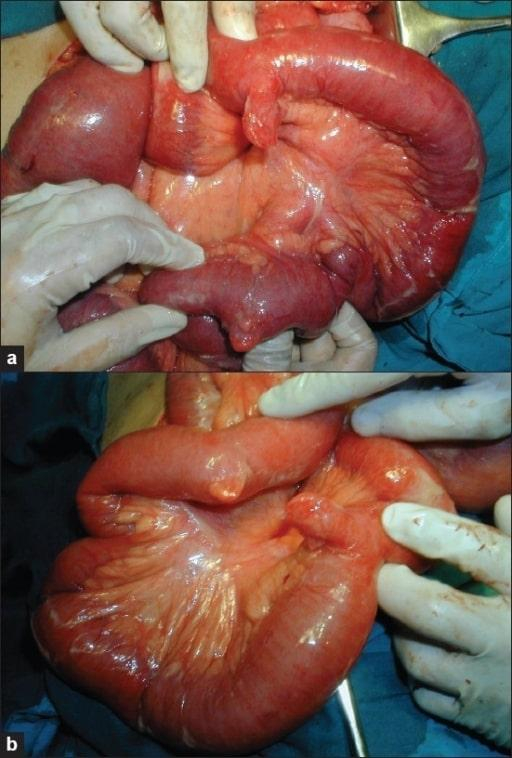
- Intussusception (leading point).
- Meckel’s diverticulum can mimic acute appendicitis.
- Entrapment of the Meckel’s diverticulum inside a hernia (called Littre’s hernia).
Diagnosis
- Technetium-99m pertechnetate radioisotope or Meckel’s scan (mucus-secreting cells of the ectopic gastric mucosa take up pertechnetate allowing visualization of the Meckel’s diverticulum).
- It is most commonly discovered as an incidental finding on laparotomy.
Differential Diagnosis
- Intussuception.
- Appendicitis.
- Hirschsprung disease.
Treatment
- Surgery is reserved for symptomatic cases (laparoscopic or open surgical removal).
Complication
- Hemorrhage (most common).
- Diverticulitis.
- Perforation.
احصل على التجربة الكاملة
اشترك للوصول لفيديوهات الشرح التفصيلي والبطاقات التعليمية التفاعلية وأسئلة الممارسة مع تتبع التقدم.