Summary
Newborns are classified by maturity (gestational age) and growth (birth weight). Preterm (<37 weeks) has increased mortality with complications from immaturity of lungs, germinal matrix, gut, retina, and metabolic control; post-term (≥42 weeks) risks asphyxia, meconium aspiration, stillbirth, or macrosomia. IUGR (prenatal) is symmetric (early, intrinsic) or asymmetric (late, uteroplacental, head-sparing). LGA infants risk shoulder dystocia and birth injury. SGA, LGA, and post-term newborns need glucose monitoring and polycythemia screening.
- Gestational age: preterm <37 weeks · term 37 0/7–41 6/7 weeks · post-term ≥42 0/7 weeks.
- Weight percentile: SGA <10th · AGA 10th–90th · LGA >90th.
- Symmetric IUGR: early (<24 weeks), intrinsic cause, all growth parameters small.
- Asymmetric IUGR: later (24 weeks onward), uteroplacental cause, head and length spared.
- LGA vs macrosomia: LGA is relative to gestational age; macrosomia is absolute weight (≥4,000 g).
Overview
- Gestational age: completed weeks from the first day of the last normal menstrual period (LMP); best confirmed by first-trimester ultrasound.
- Birth weight: weight measured as soon as possible after delivery, recorded to the nearest gram.
| Table 1: Classification of Newborns by Gestational Age: Gestational age counted from the first day of the last normal menstrual period (LMP) | |
| Preterm (<37 0/7 weeks) | Gestational age at birth |
| Extremely preterm | <28 0/7 weeks |
| Very preterm | 28 0/7 – 31 6/7 weeks |
| Moderate preterm | 32 0/7 – 33 6/7 weeks |
| Late preterm | 34 0/7 – 36 6/7 weeks |
| Term (37 0/7 – 41 6/7 weeks) | Gestational age at birth |
| Early term | 37 0/7 – 38 6/7 weeks |
| Full term | 39 0/7 – 40 6/7 weeks (lowest neonatal morbidity) |
| Late term | 41 0/7 – 41 6/7 weeks |
| Post-term | Gestational age at birth |
| Post-term | ≥42 0/7 weeks |
| Table 2: Classification of Newborns by Birth Weight and by Weight-for-Gestational-Age Percentile: Absolute weight categories ignore gestational age; percentile categories are read on an intrauterine growth chart | |
| A. Absolute birth weight (any gestational age) | Birth weight |
| Extremely low birth weight (ELBW) | <1,000 g |
| Very low birth weight (VLBW) | <1,500 g (1,000–1,499 g once ELBW is excluded) |
| Low birth weight (LBW) | <2,500 g (includes VLBW and ELBW; the 1,500–2,499 g band is “moderately” LBW) |
| Normal birth weight (NBW) | 2,500 g up to 4,000–4,200 g (some resources extend to 4,500 g) |
| Macrosomia | ≥4,000 g (US/ACOG threshold); some resources use >4,200 g; ≥4,500 g carries the highest risk |
| B. Weight for gestational age (percentile) | Birth weight percentile |
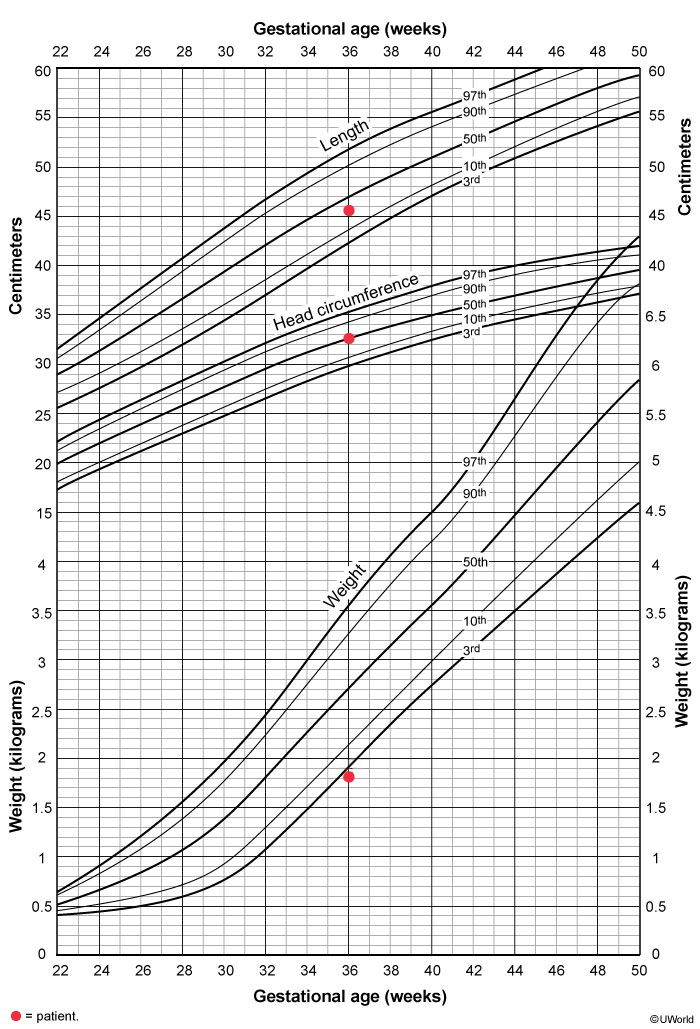
| Small for gestational age (SGA) | <10th percentile |
| Appropriate for gestational age (AGA) | 10th–90th percentile |
| Large for gestational age (LGA) | >90th percentile |
| Intrauterine growth restriction (IUGR / FGR) | Antenatal diagnosis: the fetus fails to reach its growth potential, with estimated fetal weight (or abdominal circumference) <10th percentile |
- The two systems are independent: a term infant can be low birth weight (growth restriction), and a 36-week preterm infant can weigh more than 2,500 g.
- Percentile labels need a growth chart for the infant's exact gestational age; a fixed weight cutoff cannot define SGA or LGA.
Prematurity (Preterm Delivery)
Prematurity
- Definition: delivery before 37 completed weeks (<37 0/7 weeks) counted from the LMP.
- Mortality is inversely related to gestational age: the earlier the birth, the higher the death and morbidity rates.
Risk factors for prematurity
- Obstetric history
- Prior preterm birth — the single most significant risk factor
- Previous abortion; short interpregnancy interval
- Assisted reproduction (often multiple gestation)
- Maternal and lifestyle factors
- Inadequate prenatal care
- Tobacco and substance use (especially cocaine)
- Maternal chronic disease; preeclampsia (indicated preterm delivery)
- Uterine and cervical factors
- Uterine anomalies (eg, bicornuate uterus)
- Short or incompetent cervix; previous cervical surgery
- Uterine overdistension: polyhydramnios
- Placental, fetal and infectious factors
- Placental bleeding: placenta previa, abruptio placentae
- Premature rupture of membranes, chorioamnionitis
- Genital infection: bacterial vaginosis, group B Streptococcus, STIs (herpes, syphilis)
- Fetal: congenital anomalies, erythroblastosis/nonimmune hydrops, fetal distress
Complications of prematurity
- Respiratory: respiratory distress syndrome (hyaline membrane disease) → bronchopulmonary dysplasia.
- Cardiovascular / CNS: patent ductus arteriosus; intracranial (intraventricular) hemorrhage; perinatal asphyxia; neurodevelopmental impairment.
- Metabolic / thermoregulatory: hypothermia, hypoglycemia, hypocalcemia, fluid and electrolyte abnormalities, indirect hyperbilirubinemia.
- GI / hematologic / eye / psychosocial: necrotizing enterocolitis, anemia, infections, retinopathy of prematurity, disrupted mother–father–infant interaction.
| Mnemonic – جملة تذكرية: Complications of prematurity = “PREMATURE” | |
Add Infection and disrupted parent–infant bonding to complete the list. |
جملة تذكرية |
Risk factors for mortality in prematurity
- Male sex
- 5-minute Apgar score <4
- Lack of antenatal steroids
- Persistent bradycardia at 5 minutes
- Hypothermia
- Intrauterine growth restriction
| Exam trap – فخ امتحاني | |
|
Prior preterm birth is the single strongest predictor of another preterm delivery. The mortality predictors are a different list: male sex, 5-minute Apgar <4, no antenatal steroids, persistent bradycardia at 5 minutes, hypothermia and IUGR. |
تذكر |
Obstetric management of threatened preterm delivery (steroids, tocolysis, magnesium) is taught in the preterm labor lesson.
Post-Term Delivery
Post-term delivery
- Definition: delivery at ≥42 0/7 weeks from the LMP (late term = 41 0/7–41 6/7 weeks).
- Frequency: classic texts quote up to 5–10% of deliveries when dating relied on the LMP; with early ultrasound dating and routine induction by 41–42 weeks, only about 0.25% of US pregnancies now reach 42 weeks.
- Mechanism: the ageing placenta fails progressively → chronic fetal hypoxemia and oligohydramnios; if the placenta keeps working, the fetus simply keeps growing.
Complications of post-term delivery
- Placental: placental insufficiency → intrauterine asphyxia → stillbirth.
- Respiratory: meconium aspiration syndrome (MAS).
- Growth: macrosomia → birth-related injuries and a higher rate of assisted vaginal delivery and cesarean section.
- Hematologic: polycythemia.
- Dysmaturity (postmaturity) syndrome: long thin body, little subcutaneous fat, dry peeling skin, long nails and meconium staining — see the features of fetal dysmaturity syndrome.
Risk factors, monitoring and the recommendation to deliver by 42 weeks are summarized in the late-term and postterm pregnancy table and taught in their own lesson.
Small for Gestational Age (SGA) & Intrauterine Growth Restriction (IUGR)
Growth Abnormalities
- SGA: birth weight <10th percentile (percentiles defined in the Overview); a postnatal diagnosis based on weight alone.
- IUGR / fetal growth restriction (FGR): a gestational diagnosis — the fetus fails to reach its expected growth potential, with ultrasound estimated fetal weight (or abdominal circumference) <10th percentile; classified by the pattern of growth parameters.
| Exam trap – فخ امتحاني | |
|
SGA ≠ IUGR. SGA is a postnatal label based only on birth weight <10th percentile (many SGA babies are simply constitutionally small). IUGR/FGR is an antenatal diagnosis of a fetus that is failing to reach its genetic growth potential — a growth-restricted fetus can even be born above the 10th percentile. |
تذكر |
Symmetric vs asymmetric IUGR
| Symmetric vs Asymmetric IUGR | ||
|---|---|---|
| Feature | Symmetric IUGR | Asymmetric IUGR |
| Timing (growth phase) | Type I – early interference with growth, from conception to 24 weeks | Type II – intrauterine malnutrition at 24–32 weeks Type III – late intrauterine malnutrition after 32 weeks |
| Growth parameters | Head circumference, length and weight all reduced proportionately (global growth lag) | Weight reduced; length and head circumference relatively spared (head-sparing); abdominal circumference lags first |
| Mechanism | Intrinsic fetal insult → fewer cells (impaired hyperplasia) | Extrinsic uteroplacental/maternal factor → smaller cells (impaired hypertrophy) with redistribution of blood to the brain |
| High-yield causes |
|
|
| Postnatal picture | Small but proportionate infant; may have dysmorphism or signs of congenital infection | Thin, wasted infant with scant subcutaneous fat and loose skin; head looks large for the body |
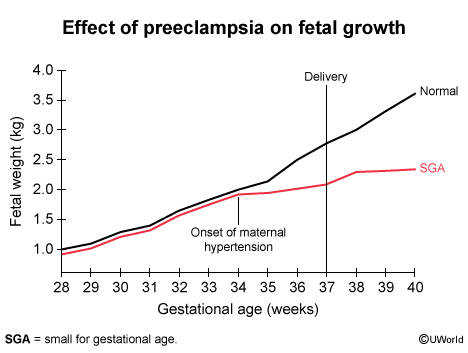
Late uteroplacental insufficiency produces a growth curve that flattens only after the insult begins, leaving the earlier-formed head and skeleton near normal.
| Clinical note – ملاحظة سريرية | |
|
An early intrinsic insult (trisomy, TORCH) cuts down cell number (hyperplasia), so every organ is small → symmetric IUGR. Late uteroplacental insufficiency cuts down cell size (hypertrophy) while cerebral vasodilation protects brain flow → head-sparing, asymmetric IUGR. |
ملاحظة |
| Mnemonic – جملة تذكرية: Symmetric (Type I) IUGR = “C-TORCH-D” | |
Everything that hits the fetus itself, early, gives a small-but-proportionate baby. |
جملة تذكرية |
- The neonatal findings of each congenital infection are listed in the TORCH infections table; a compact symmetric vs asymmetric FGR comparison is also available.
- Gestational diabetes does not cause IUGR — it drives fetal overgrowth (see LGA); smoking, preeclampsia, alcohol and maternal malnutrition all restrict growth.
Complications of SGA and IUGR
- Respiratory / cardiopulmonary: perinatal asphyxia and intrauterine fetal death; meconium aspiration; persistent pulmonary hypertension; RDS.
- Metabolic / thermoregulatory:
- Hypoglycemia — poor hepatic and muscle glycogen stores.
- Hypothermia — scant subcutaneous fat.
- Hypocalcemia — reduced placental calcium transfer.
- Hypermagnesemia — mainly when the mother received magnesium sulfate for preeclampsia.
- Impaired protein and lipid metabolism.
- Hematologic / immune / GI / CNS:
- Polycythemia/hyperviscosity — chronic hypoxia raises erythropoietin.
- Impaired immune function; necrotizing enterocolitis; intracranial hemorrhage; neurodevelopmental abnormalities.
Large for Gestational Age (LGA) & Macrosomia
Large for Gestational Age (LGA) & Macrosomia
- LGA: birth weight >90th percentile for gestational age.
- Macrosomia: absolute birth weight ≥4,000 g (US/ACOG; >4,200 g in some resources), whatever the gestational age; risk rises steeply above 4,500 g.
- A newborn can be LGA without ever reaching 4,000 g (eg, a large preterm infant).
| Exam trap – فخ امتحاني | |
|
LGA ≠ macrosomia. LGA is relative (>90th percentile for gestational age), so a 33-week infant weighing 2.9 kg is LGA though far below 4,000 g. Macrosomia is an absolute weight (≥4,000 g; >4,200 g in some resources) regardless of gestational age. |
تذكر |
Etiology
- Maternal factors:
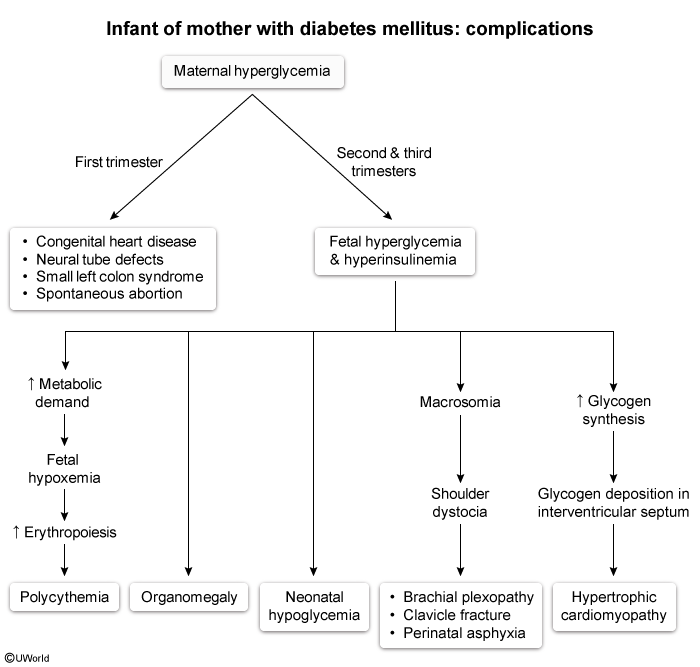
- Maternal diabetes or hyperinsulinism — fetal hyperglycemia → β-cell hyperplasia → fetal hyperinsulinemia, an anabolic drive for growth.
- Genetic/ethnic predisposition.
- Fetal factors:
- Prolonged gestation (>41 weeks).
- Genetic overgrowth disorders: Sotos syndrome, Beckwith–Wiedemann syndrome, Prader–Willi syndrome.
- Congenital hyperinsulinism.
- Normal constitutional variant.
Complications
| Complications of LGA / macrosomia | |
|---|---|
| Maternal complications | Fetal and neonatal complications |
| Prolonged labor | Perinatal asphyxia |
| Assisted vaginal delivery (vacuum, forceps) | Shoulder dystocia |
| Cesarean section | Birth injury: brachial plexus injury, clavicular fracture |
| Genital tract lacerations | Cerebral palsy secondary to hypoxia |
| Postpartum hemorrhage | Hypoglycemia |
| Uterine rupture | Polycythemia and hyperbilirubinemia |
| Death | |
- Mechanism of birth trauma: insulin-driven fat over the shoulders and trunk lets the anterior shoulder lodge behind the pubic symphysis (shoulder dystocia), leading to clavicle fracture or upper brachial plexus (Erb) palsy; an asymmetric Moro reflex is the usual clue.
- Infant of a diabetic mother adds hypocalcemia, hypomagnesemia and RDS from delayed surfactant production — see the neonatal complications of maternal diabetes; the full topic has its own lesson.
Key Points for Exams
- Preterm = <37 completed weeks; term = 37 0/7–41 6/7 (full term 39 0/7–40 6/7); post-term = ≥42 0/7 weeks.
- LBW <2,500 g, VLBW <1,500 g, ELBW <1,000 g — defined by weight alone, at any gestational age.
- SGA <10th, AGA 10th–90th, LGA >90th percentile for gestational age.
- Prior preterm birth is the strongest risk factor for preterm delivery.
- Lack of antenatal steroids, male sex, 5-minute Apgar <4, bradycardia at 5 minutes, hypothermia and IUGR predict death in preterm infants.
- Prematurity complications follow organ immaturity: RDS/BPD, IVH, PDA, NEC, ROP, hypothermia, hypoglycemia, hypocalcemia, jaundice.
- Post-term risks: placental insufficiency, asphyxia, stillbirth, meconium aspiration, macrosomia, polycythemia.
- SGA is a birth-weight label; IUGR is an antenatal failure to reach growth potential.
- Symmetric IUGR = early, intrinsic (chromosomes, TORCH, drugs); asymmetric IUGR = late, uteroplacental (hypertension, preeclampsia, smoking), head-sparing.
- Maternal smoking → growth restriction; gestational diabetes → LGA, never IUGR.
- Polycythemia in IUGR comes from chronic hypoxia → erythropoietin.
- LGA is relative; macrosomia is ≥4,000 g absolute.
- Macrosomia → shoulder dystocia → clavicle fracture, brachial plexus injury, asphyxia; maternal lacerations, PPH, cesarean.
| Important – Classic vignette clues | |
|
تذكر |
احصل على التجربة الكاملة
اشترك للوصول لفيديوهات الشرح التفصيلي والبطاقات التعليمية التفاعلية وأسئلة الممارسة مع تتبع التقدم.