شرح المدرسين

Introduction
- Developmental assessment and surveillance are central components of health maintenance.
- Developmental domains include motor, language, cognitive, and social–emotional skills.
- They are generalized reactions to stimuli develop into more specific, goal-directed reactions that become increasingly precise.
- It is essential to understand normal development and acceptable developmental variations in young children to recognize pathologic patterns.
- It is important to monitor the attainment of developmental milestones in each domain to accurately identify children with developmental delays who may benefit from early intervention.
- Development typically occurs in an orderly, predictable, intrinsic manner with wide variation in attainment of milestones.
- Development proceeds from head to toe in a proximal to distal fashion.
Developmental milestones
- Information about motor milestones should be obtained from the history as well as from the physical examination.
- Gross motor development evaluation includes:
- Assessment of gross motor milestones.
- Assessment of neuromaturational markers: primitive reflexes and postural reactions.
| Age (months) | Gross Motor Milestone |
|---|---|
| Birth | Turns heads from side to side |
| 2 |
Lifts head/chest in prone position Head support |
| 4 |
Sits with trunk support Begins rolling |
| 6 | Sits momentarily propped on hands |
| 7 | Sits without support |
| 8–10 | Crawls |
| 9 | Pulls to stand, Cruises |
| 12 |
Stands well Walks independently |
| 18 |
Runs Kicks a ball |
| 24 |
Walks up and down stairs with both feet on each step Jumps |
| 36 |
Walks up and down stairs with alternating feet Rides tricycle |
| 48 | Balances and hops on 1 foot |
| 60 | Skips |
Primitive Reflexes
Introduction
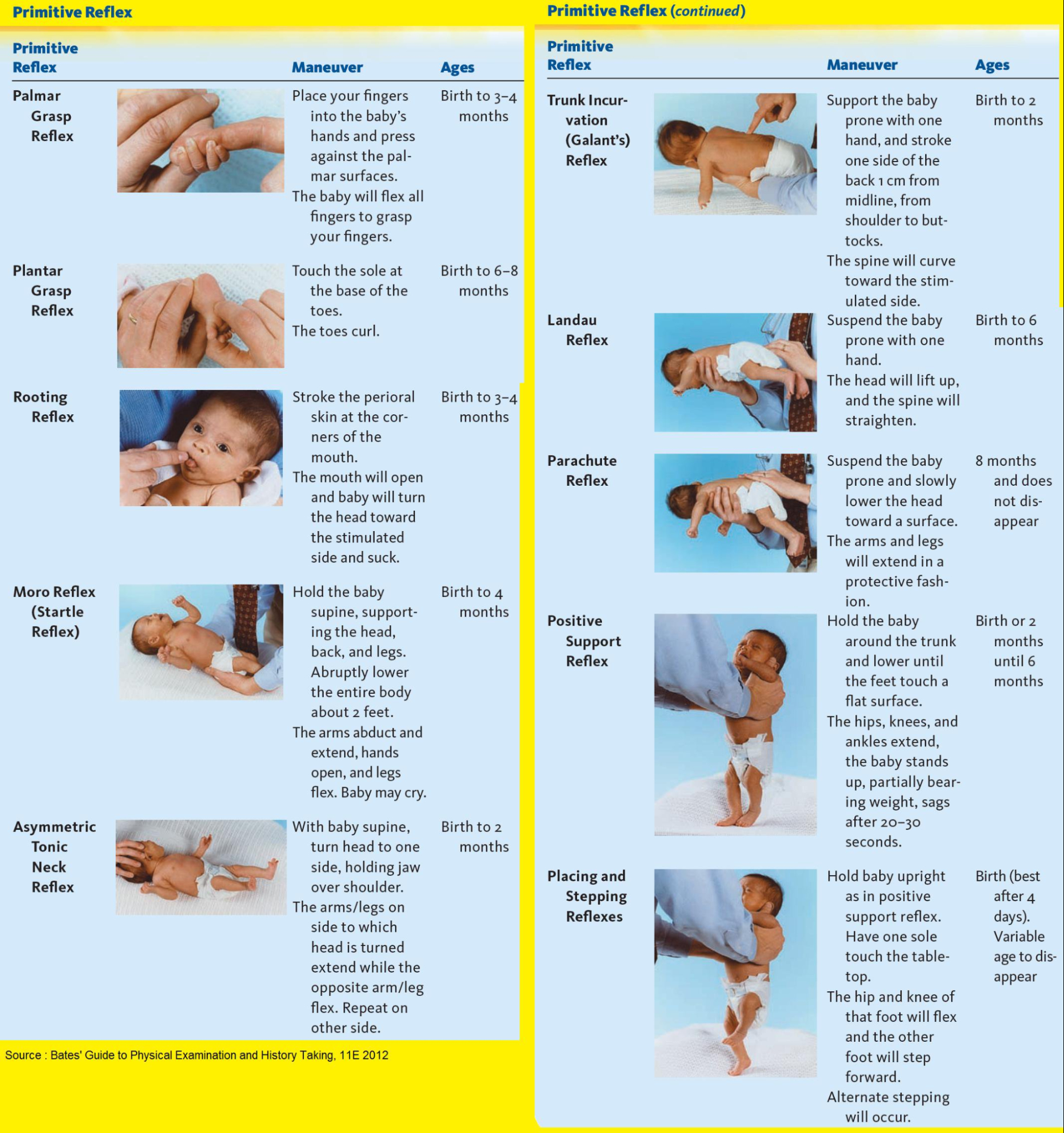
- Primitive reflexes are automatic, involuntary movements or actions exhibited by newborns and young infants in response to specific stimuli.
- These reflexes are mediated by the brainstem and spinal cord and are essential for survival and early development.
Characteristics of Primitive Reflexes
- Present at birth: Primitive reflexes are observable from birth and are often used as indicators of neurological function in neonates.
- Involuntary: They occur automatically without conscious control.
- Transient: These reflexes are gradually suppressed as the infant's central nervous system (CNS) matures, typically by 4–6 months of age.
- Integration: Their disappearance is a sign that higher brain centers (such as the cerebral cortex) are taking over motor control.
| Primitive Reflexes | |||||
|---|---|---|---|---|---|
| Primitive Reflex | Age | Stimulus | Response | Disappears | Abnormalities |
| Moro Reflex | Birth | Quickly lowering the infant's head or body while in a supine position |
Symmetric abduction and extension of arms with trunk extension, followed by adduction of upper extremities |
4–6 months |
Absent: prematurity (<28 weeks), nerve injury, clavicle fractures, CNS abnormality Exaggerated: CNS irritation Persistent: Cerebral palsy (CP) |
| Grasp Reflex | Birth | Place an object in palm or foot | Grasp of any object placed in the palm | 2 months | Persistent fisting beyond 2 months |
| Suckling Reflex | Birth | Touching the roof of the mouth or lips | Sucking | 4–7 months | Absent: prematurity (<32 weeks) |
| Rooting Reflex | Birth | Stroking the corner of mouth or cheek | Turning of the head toward the same side as stimulus | 4–7 months | |
| Atonic Neck Reflex | Birth | Turning the head to one side |
Arms and legs extend on the same side Flex on the opposite side (“fencer position”) |
4–6 months | |
| Stepping Reflex | Birth | Holding baby upright with feet touching a flat surface | Alternating stepping movements | 2 months (reappears later) | |
Postural Reactions
Introduction
- Postural reactions are a group of automatic movements that develop in infants as their central nervous system matures.
- These reactions are critical for maintaining posture, balance, and coordination during voluntary movements.
- They complement the primitive reflexes and are a sign of neurological maturity and integration.
Characteristics of Postural Reactions
- Emerge as primitive reflexes fade: Postural reactions develop after the suppression of primitive reflexes, typically beginning around 2–4 months of age.
- Gradual development: These reactions continue to mature throughout infancy and childhood as motor skills improve.
- Purpose: They help infants and children interact with their environment by maintaining upright posture, balance, and orientation.
- Voluntary and adaptive: Unlike primitive reflexes, postural reactions allow more adaptive and controlled responses to changes in position or balance.
| Postural Reactions | ||||
|---|---|---|---|---|
| Postural Reaction | Age | Description | Disappears | Abnormalities |
| Head righting | 2–6 months | The ability to keep the head vertical despite the body being tilted | Does not disappear (lifelong) |
Neurological disorders Motor disorders |
| Landau | 3–4 months | When held in a horizontal prone position, the infant lifts the head, arches the back, and straightens the legs. Arms may extend forward in the "superman" position. | 12–24 months | |
| Parachute | 6–10 months | Outstretched arms and legs when the body is abruptly moved head-first in a downward direction | Does not disappear (lifelong) | |
Fine Motor Skills Development
- Fine motor skills involve the use of the small muscles of the hands.
- An infant’s fine motor skills progress from control over proximal muscles to distal muscles.
| Age (months) | Fine Motor Skills Milestone |
|---|---|
| Birth | Keeps hand tightly fisted |
| 2 | Keeps hand unfisted 50% of the time Tracks past midline |
| 3–4 | Hands mostly open Reaches midline and then to mouth (mouthing) |
| 4–5 | Reaches to object |
| 6–7 | Transfer objects from hand to hand Raking grasp |
| 9 | 3-finger pincer grasp or immature pincer grasp Holds bottle or cup |
| 12 | 2-finger pincer grasp (mature pincer grasp) |
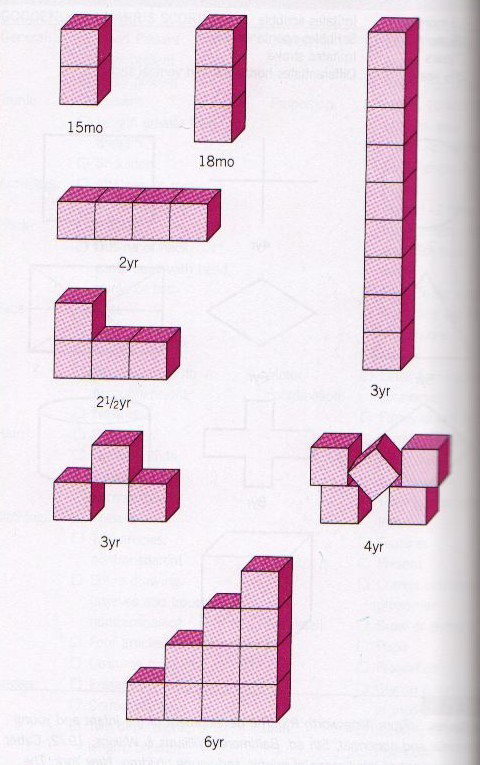
| 18 | Builds tower of 2–4 cubes Removes clothing |
| 24 | Builds tower of 6 cubes Copies a line |
| 36 | Copies a circle Uses utensils |
| 48 | Copies a cross |
| 60 | Copies a square Ties shoelaces Dresses/bathes independently Prints letters |
Red Flags in Motor Development
- Red flags in Motor Development
- Lack of steady head control beyond 2 months.
- Persistent hand fisting beyond 3 months.
- Early rolling over, early pulling to a stand instead of sitting
- Persistent toe walking
- Spontaneous postures, such as scissoring, and frog legs position.
- Early hand dominance before 18 months.
- Any asymmetries to movement
- If present need to rule out a list of conditions associated with motor delay, including:
- CNS injury.
- Spinal cord dysfunction.
- Peripheral nerve pathology.
- Motor end plate dysfunction.
- Muscular disorders.
- Metabolic disorders.
- Neurodegenerative conditions.
Language Skills Development
Introduction
- Delays in language development are more common than delays in other domains.
- Receptive language is always more advanced than expressive language (i.e., a child can usually understand 10 times as many words as he or she can speak).
- Language and speech are not synonymous.
- Language refers to the ability to communicate with symbols (i.e., in addition to speech, this includes sign language, gestures, writing, and “body language”).
- Speech is the vocal expression of language.
- A window of opportunity for optimal language acquisition occurs during the first 2 years of life.
| Age (months) | Basic Language Skills Milestone |
|---|---|
| Birth |
Attunes to human voice Develops differential recognition of parent’s voices |
| 2–3 |
Alerts to voice/sound Cooing (runs of vowels), musical sounds (e.g., ooh-ooh, aah-aah) |
| 4 |
Laughs Turns to voice |
| 6 |
Responds to name Babbling (mixing vowels and consonants) [e.g., ba-ba-ba, da-da-da] |
| 9–12 |
Jargoning (babbling with mixed consonants, inflection, and cadence) Begins using mama, dada (nonspecific) |
| 12 | 1–3 words, mama and dada (specific) |
| 18 |
10–25 words Identifies more than 1 body part |
| 24 |
Over 50 words Two-word telegraphic sentences (e.g., "mommy came") 25–50% of child’s speech should be intelligible |
| 36 |
3-word sentences More than 75% of child’s speech should be intelligible |
| 48 |
Identifies colors 100% of child’s speech should be intelligible |
| 60 |
Counts to 10 5-word sentences |
Differential diagnosis of speech or language delay
- Global developmental delay
- Hearing impairment
- Environmental deprivation
- Autism spectrum disorders
- Intellectual disability
Social-Cognitive Development
Introduction
- Intellectual development depends on attention, information processing, and memory.
- Infant intelligence can be estimated by evaluating problem-solving and language milestones.
- Language is the single best indicator of intellectual potential.
- In the school-age child, standardized intelligence tests measure both verbal skills and performance (nonverbal) skills.
- Social–emotional skills are the ability to interact and empathize with other people.
- Development of social skills depends on cultural and environmental factors.
- Several important milestones develop in the first 3 years of life.
| Age (months) | Social and Cognitive Milestones |
|---|---|
| 2 |
Social smile Recognizes parents |
| 4 | Enjoys looking around |
| 6 | Stranger anxiety |
| 9 |
Waves bye Object permanence |
| 12 |
Separation anxiety Follows 1-step commands with gestures |
| 18 |
Understands "mine" Begins pretend play |
| 24 |
Follows 1-step commands with gestures Parallel play Begins toilet training |
| 36 |
Knows age/gender Imaginative play |
| 48 | Cooperative play |
| 60 |
Has friends Completes toilet training |
Red flags in Social-emotional Development
- Lack of smiling or joyful expressions at 6 months of age.
- Doesn’t respond to his/her name at 12 months of age.
- Not demonstrating the ability to initiate or understand joint attention by 18 months of age.
- No emergence of pretend play by 3 years of age.
Red flags in Cognitive Development
- If skills are delayed significantly in both language and problem-solving Domains → Intellectual disability.
- If only language skills are delayed→ Hearing impairment or a communication disorder.
- If only problem-solving skills are delayed→Visual or Fine motor problems.
- If there is a significant discrepancy between language and problem-solving skills→Learning disability.
احصل على التجربة الكاملة
اشترك للوصول لفيديوهات الشرح التفصيلي والبطاقات التعليمية التفاعلية وأسئلة الممارسة مع تتبع التقدم.